
📊 Full opportunity report: Backyard Homes In The US: ADUs, Real Estate, And Zoning on IdeaNavigator AI — validation score, market gap, and execution plan.

Get business pricing on tech for your team
- Business-only prices and quantity discounts
- Tax-exempt purchasing
- Multiple users, one account, clear invoices
TL;DR
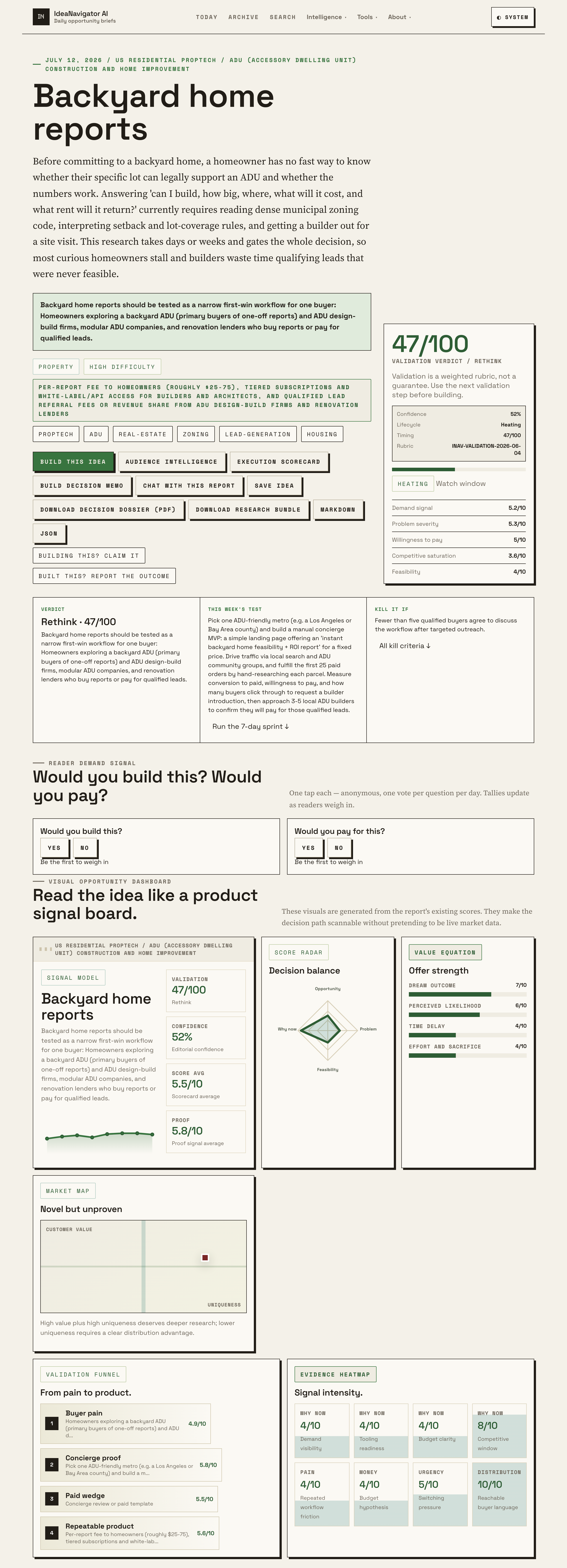
IdeaNavigator AI has outlined a proposed service that would assess whether a specific property may support an accessory dwelling unit and estimate costs and rental income. The concept is not evidence of a launched product or validated demand; the proposal calls for testing it in one market by fulfilling the first 25 orders manually.
IdeaNavigator AI has proposed a paid report that would assess whether a homeowner’s lot may support an accessory dwelling unit (ADU), estimate construction costs and rental income, and offer a builder referral. The proposal describes a business concept and validation plan; it does not establish that a product has launched or that homeowners and builders have agreed to pay.
The proposed service would let a homeowner enter a property address and receive a homeowner-ready PDF. For an initial market, the plan calls for combining county parcel information, such as lot boundaries, lot size and existing building footprints, with state ADU law and a manually curated set of local zoning rules. The report would estimate which ADU types may be allowed, possible size limits, setback and lot-coverage constraints, and the area that might be buildable.
The report would also include a construction-cost range and a projected rental-income estimate based on local rent comparisons. A button offering an introduction to a vetted builder could create a separate lead-generation business. IdeaNavigator AI suggests homeowner fees of roughly $25 to $75 per report, alongside subscriptions or white-label and API access for builders and architects, and referral fees or revenue sharing involving design-build firms and renovation lenders.
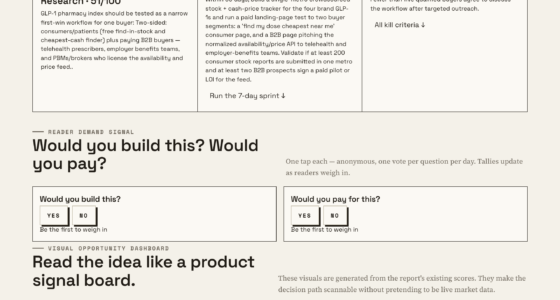
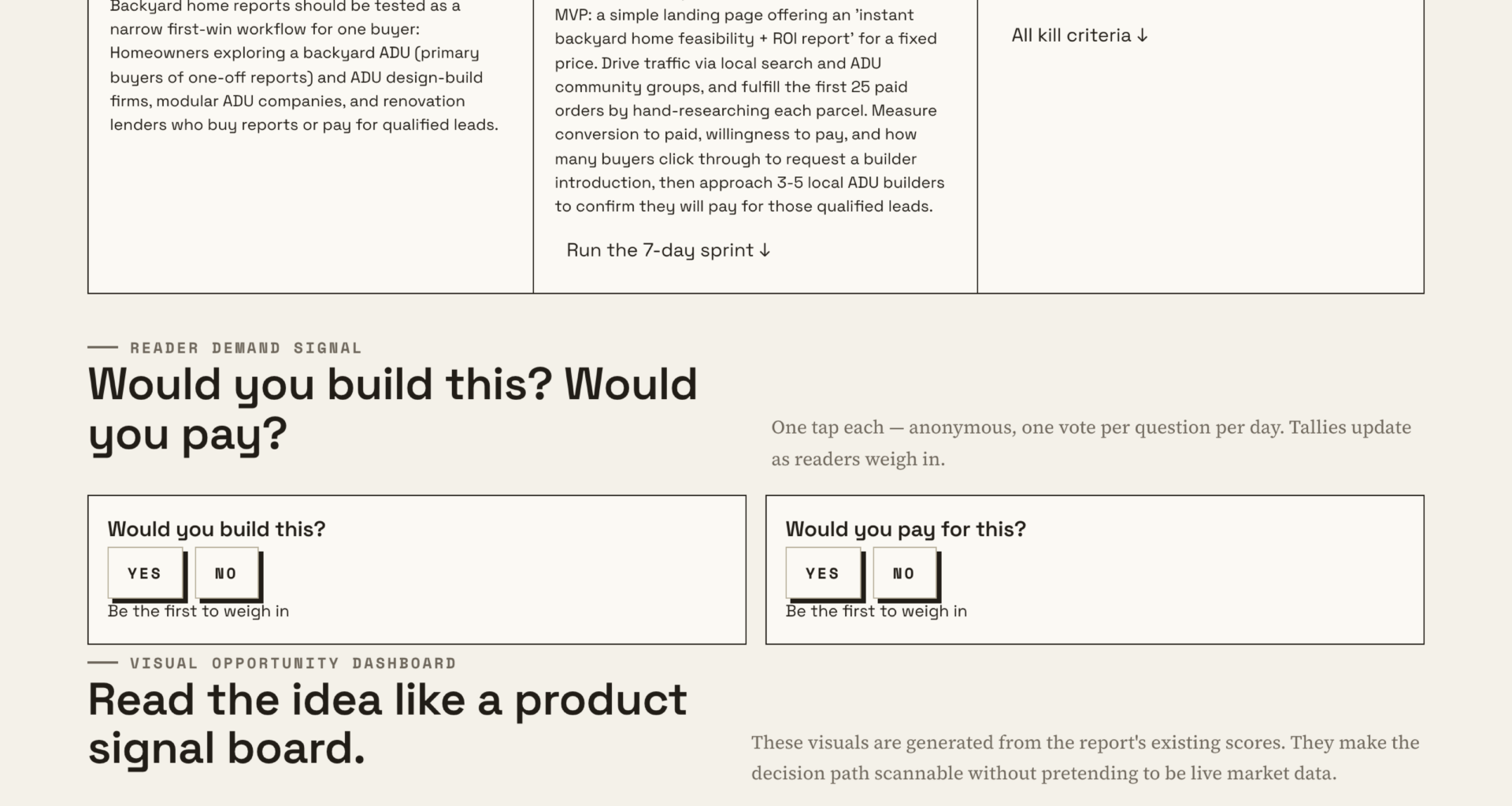
The proposed test is deliberately narrow: choose one ADU-friendly metro or county, create a landing page with a fixed-price offer, and fulfill the first 25 paid orders by hand. The plan would track purchases and requests for builder introductions, then approach three to five local builders to ask whether they would pay for qualified leads. These are proposed validation steps, not reported results.
A First Check for ADU Projects
The concept addresses an early step in a costly housing decision: assessing whether a particular lot may be suitable before paying for extensive design work or a site visit. Homeowners may need to reconcile municipal zoning rules, parcel conditions and project economics. The proposal says this research can take days or weeks and that uncertainty can delay homeowners and require builders to spend time assessing leads.
If a report could reliably organize those questions, it could help homeowners decide whether to seek professional advice and give builders a starting point for conversations. The report would be an initial screen, not a permit or a guarantee of construction feasibility. Its practical value would depend on accurate parcel records, current local rules and estimates that explain their assumptions.
The business case depends on homeowner interest and builder demand. A report priced at $25 to $75 would need to provide enough useful information to attract buyers, while referral revenue would depend on builders considering the resulting inquiries relevant and worth paying for. The proposed manual test is intended to examine these questions before any expansion.
ADU Rules Vary by Location
The proposal points to California’s statewide ADU legislation beginning in 2016 and subsequent loosening of rules as part of the case for testing the service. It also says other states and cities are following. Those broad trends do not determine what a specific property can accommodate: local requirements and the features of each parcel still matter to the report’s central promise.
IdeaNavigator AI cites more than 45,000 ADU permits in Los Angeles County in 2023 and says ADUs account for roughly one in five new housing units produced in California. The proposal also invokes a US housing shortage estimated in the millions of units. These figures are presented as context for the business opportunity; they do not show demand for this particular report, nor do they establish how many permitted units were completed or rented.
The proposed approach pairs parcel data with a hand-curated rule set and LLM-based code parsing. Starting in a single metro would limit the initial ruleset, but the proposal does not specify a launch jurisdiction, data providers or how frequently local rules would be checked and updated.
Demand and Accuracy Remain Untested
No operating product, paid-order results or builder commitments are described. It is not yet clear which city or county would be selected, how parcel data would be sourced, or how the report would handle incomplete records and conflicting interpretations of local rules. The proposal does not explain whether a planner, architect or other qualified professional would review each result.
Cost and rent figures would also be estimates, and the proposal gives no methodology, accuracy range or treatment of project-specific variables. It remains uncertain whether homeowners would pay the suggested fee, whether a report would change their decision, and whether builders or lenders would pay for referrals. The planned first 25 orders and builder outreach are ways to investigate those questions, not evidence that they have been answered.
A One-Market Test Comes First
The next step set out in the proposal is to choose one local market, publish a fixed-price landing page and manually research the first 25 paid properties. The test would record how many visitors buy a report and how many customers request a builder introduction. IdeaNavigator AI then proposes speaking with three to five local ADU builders about paying for those leads.
No schedule, selected market or test outcome is provided. A decision to expand would depend on what the manual work reveals about customer interest, the time and reliability required to assess each parcel, and builders’ willingness to pay. The proposal remains at the validation stage.
Source: IdeaNavigator AI
Key Questions
Has an ADU feasibility-report product launched?
The proposal describes a possible service and a manual test. It does not report a product launch.
What would a homeowner receive?
A proposed PDF would cover potential ADU types and size, zoning constraints, an estimated buildable area, a construction-cost range and projected rental income.
How much might a report cost?
IdeaNavigator AI suggests a price of roughly $25 to $75 per report. This is a proposed range, not a confirmed price.
Would the report confirm that a property can get a permit?
No such guarantee is described. The proposal outlines an initial feasibility estimate based on parcel information and local rules; it does not say the report would replace a permit review or professional assessment.
How would the idea be tested?
The proposed test would manually fulfill the first 25 paid orders in one market, measure purchases and builder-introduction requests, and ask three to five local builders whether they would pay for qualified leads.
Source: IdeaNavigator AI
Fall Picks
fall essentials
As an affiliate, we earn on qualifying purchases.