
AI social media scheduling tools can help turn ideas into platform-ready posts and a more consistent publishing plan, but many resources focus on strategy rather than scheduling software. I rank The AI Social Media Manager as the best overall resource for its end-to-end planning and repurposing focus, while AI for Social Media Managers: Plan Platform-Specific Posts Without Losing Brand Consistency stands out for channel adaptation. AI-Powered Digital Marketing and Business Automation is a more approachable starting point for beginners. The main tradeoff is depth versus simplicity: detailed systems can take longer to apply, while broad introductory guidance may leave scheduling workflows less developed. Read on for the full breakdown and help choosing the right fit for your workflow.

Get business pricing on tech for your team
- Business-only prices and quantity discounts
- Tax-exempt purchasing
- Multiple users, one account, clear invoices
Key Takeaways
- The AI Social Media Manager ranks first because its stated scope connects planning, creation, repurposing, and growth rather than concentrating on a single stage.
- Platform-specific guidance is the clearest differentiator in the lineup: the brand-consistency title addresses adapting posts across channels without losing a unified voice.
- Beginner-friendly breadth is the strength of AI-Powered Digital Marketing and Business Automation, though broad coverage may offer less focused scheduling direction.
- Small-business scaling and social media management are different needs; the small-business title suits owner-led workflows, while manager-focused titles speak more directly to professional practice.
- These listed products are guides and planning resources, not necessarily scheduling applications. Buyers who need automatic publishing should confirm that any chosen resource connects to a separate scheduler or platform.
| Social Media Content Planner |  | Best for Daily Planning | Format: Notebook | Primary use: Plan, schedule, and track social media posts | Intended users: Content creators | VIEW LATEST PRICE | See Our Full Breakdown |
| AI for Scaling Content and Social Media for Small Business Owners |  | Best for Small-Business AI Workflows | Format: Book | Series: AI Productivity for Small Business Owners | Volume: 6 | VIEW LATEST PRICE | See Our Full Breakdown |
| Effective Use of AI Tools for Social Media Managers |  | Best for Engagement and Strategy | Format: Not provided | Intended audience: Social media managers | Topics: AI-assisted content creation | VIEW LATEST PRICE | See Our Full Breakdown |
| AI for Social Media Managers: Plan Platform-Specific Posts Without Losing Brand Consistency |  | Best for Brand-Consistent Multiplatform Planning | Format: Not provided | Intended audience: Social media managers | Primary focus: Planning platform-specific posts | VIEW LATEST PRICE | See Our Full Breakdown |
| AI-Powered Digital Marketing and Business Automation: A Beginner’s Guide | 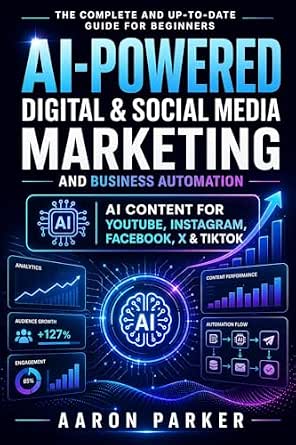 | Best for Beginners Across Multiple Platforms | Format: Guide | Audience: Beginners | Topics: Digital marketing | VIEW LATEST PRICE | See Our Full Breakdown |
| The AI Social Media Manager: A One-Person System for Planning, Creating, Repurposing, and Growing Social Media with AI |  | Best for Solo Creators | Format: Guide | Primary focus: Using AI for social media management | Workflow coverage: Planning, content creation, and repurposing | VIEW LATEST PRICE | See Our Full Breakdown |
| AI social media scheduling tool | Topics | Format | Intended users | Intended audience |
|---|---|---|---|---|
| Social Media Content Planner | — | Notebook | Content creators | — |
| AI for Scaling Content and Soc | AI-assisted content planning | Book | — | Small business owners |
| Effective Use of AI Tools for | AI-assisted content creation | Not provided | — | Social media managers |
| AI for Social Media Managers: | — | Not provided | — | Social media managers |
| AI-Powered Digital Marketing a | Digital marketing | Guide | — | — |
| The AI Social Media Manager: A | — | Guide | — | — |
More Details on Our Top Picks
Social Media Content Planner
Social Media Content Planner is the most practical pick here for someone who wants a hands-on routine for organizing posts, rather than a guide about AI. Its notebook format brings planning, scheduling, and tracking together, which can help a creator keep daily publishing tasks visible. That focus makes it more immediately usable as an organizer than AI for Scaling Content and Social Media for Small Business Owners, which describes a learning resource for AI-assisted work. The tradeoff is central to this roundup: the provided details do not identify any AI features, integrations, or platform-specific workflows. I also can’t verify the notebook’s layout or materials from the listing. Choose it for a paper-based planning habit; skip it if you need automated scheduling or AI-generated recommendations.
Pros:- Combines post planning, scheduling, and tracking in one organizer.
- Daily-organization focus can make recurring publishing tasks easier to track.
- Intended for creators, influencers, and small business owners.
Cons:- The available product information does not describe any AI capabilities.
- No layout, dimensions, or material details are provided.
- A notebook cannot provide the automation or platform integrations of a software scheduler.
Best for: Creators, influencers, and small business owners who prefer tracking daily social posts in a physical notebook.
Not ideal for: Social media teams seeking AI writing, automatic publishing, platform integrations, or a specified planner layout.
- Format:Notebook
- Primary use:Plan, schedule, and track social media posts
- Intended users:Content creators
- Intended users:Influencers
- Intended users:Small business owners
- Layout details:Not provided
Our verdict“Choose this notebook for a simple daily posting workflow, but pick an AI-focused guide or scheduling platform if automation is the priority.”
AI for Scaling Content and Social Media for Small Business Owners
AI for Scaling Content and Social Media for Small Business Owners is the clearest match for an owner trying to use AI across the content workflow, from planning and creation to scheduling. Its small-business focus separates it from Effective Use of AI Tools for Social Media Managers, which is framed around professional social media management, audience engagement, and marketing strategy. This book may suit an owner who needs to learn a repeatable approach before choosing tools, but it is not itself described as scheduling software. The listing also gives no specific AI products, examples, length, or format beyond identifying it as a book. That makes it harder to judge how actionable or current its guidance is. I’d favor it over the notebook planner for AI-focused learning, not for directly publishing posts.
Pros:- Addresses AI use across planning, content creation, and scheduling.
- Targets small business owners rather than a broad, unspecified audience.
- Part of the AI Productivity for Small Business Owners series.
Cons:- The listing does not name the AI tools or scheduling platforms covered.
- Book length and further format details are not provided.
- Offers guidance rather than an actual publishing or automation system.
Best for: Small business owners who want guidance on using AI to reduce the time spent planning, creating, and scheduling social content.
Not ideal for: Buyers who need a ready-to-use scheduler, named tool tutorials, or detailed information about a book’s length and format.
- Format:Book
- Series:AI Productivity for Small Business Owners
- Volume:6
- Intended audience:Small business owners
- Topics:AI-assisted content planning
- Topics:Content creation and social media scheduling
Our verdict“Choose this book to learn an AI-assisted content workflow for a small business, not to replace scheduling software.”
Effective Use of AI Tools for Social Media Managers
Effective Use of AI Tools for Social Media Managers looks beyond the publishing calendar, covering AI for content creation, audience engagement, and marketing strategy automation. That wider management angle gives it a different role from AI for Social Media Managers: Plan Platform-Specific Posts Without Losing Brand Consistency, whose stated emphasis is tailoring posts by platform while preserving brand voice. This guide may suit a manager who wants to think about how AI supports several parts of the job, not just adapting captions. However, the available description names no tools, examples, or specific scheduling process, and omits format and length. I can’t judge how hands-on its advice is from the supplied details. It is a learning resource, not a confirmed scheduler, so buyers seeking direct publishing automation should look for software with those capabilities.
Pros:- Covers AI-assisted social media content creation.
- Includes audience engagement as part of the stated scope.
- Addresses automation of marketing strategies, not only post drafting.
Cons:- No specific AI tools or social scheduling platforms are identified.
- Format and length details are not provided.
- The description does not explain how its advice translates into a day-to-day publishing workflow.
Best for: Social media managers seeking guidance on applying AI to content production, audience engagement, and marketing workflows.
Not ideal for: Buyers who need a specific scheduling tool, named platform instructions, or a clearly documented book format and length.
- Format:Not provided
- Intended audience:Social media managers
- Topics:AI-assisted content creation
- Topics:Audience engagement
- Topics:Marketing strategy automation
- Specific tools:Not provided
Our verdict“Pick this guide for a broad AI-and-management focus; choose the platform-specific guide if brand consistency across channels is your main concern.”
AI for Social Media Managers: Plan Platform-Specific Posts Without Losing Brand Consistency
AI for Social Media Managers: Plan Platform-Specific Posts Without Losing Brand Consistency centers on a specific scheduling challenge: adapting posts to each platform without letting the brand voice drift. That makes it a sharper fit for managers handling multiple channels than Social Media Content Planner, which organizes daily posts but provides no stated AI or platform-adaptation features. Its promise is also more narrowly defined than Effective Use of AI Tools for Social Media Managers, whose description ranges into audience engagement and strategy automation. The narrow focus may help readers seeking a consistent cross-platform approach, but the listing gives no details on format, tools, workflow, or examples. There is also no stated evidence that the book teaches or includes an actual scheduler. Treat it as a focused guide, not an integrated publishing product.
Pros:- Focuses on tailoring posts to individual platforms.
- Pairs platform-specific planning with brand-voice consistency.
- Addresses a distinct challenge for managers publishing across channels.
Cons:- The listing does not identify specific tools, platforms, or scheduling workflows.
- Format and length details are not provided.
- The described scope is narrower than guides covering engagement and marketing automation.
Best for: Social media managers who adapt content for multiple platforms and want to maintain a consistent brand voice.
Not ideal for: Beginners seeking a broad AI introduction, or teams that need a named scheduling tool, platform integrations, or detailed feature information.
- Format:Not provided
- Intended audience:Social media managers
- Primary focus:Planning platform-specific posts
- Brand focus:Maintaining brand consistency
- AI focus:AI for social media planning
- Specific tools:Not provided
Our verdict“Choose this guide when cross-platform adaptation and consistent brand voice matter more than broad AI training or hands-on scheduling software.”
AI-Powered Digital Marketing and Business Automation: A Beginner’s Guide
AI-Powered Digital Marketing and Business Automation: A Beginner’s Guide is the broadest starting point in this group: it connects social content with digital marketing and business automation and names YouTube, Instagram, Facebook, X, and TikTok. That platform range makes it more explicit about channel coverage than AI for Scaling Content and Social Media for Small Business Owners, though the latter focuses more directly on the small-business content workflow. The beginner orientation can help readers seeking a general introduction, but the description does not specify scheduling features, named AI tools, or how the platform guidance differs by channel. It also reaches beyond social publishing into automation, so a reader focused only on a posting calendar may find its scope too wide. I’d choose it for breadth, not for a clearly defined scheduling method.
Pros:- Names YouTube, Instagram, Facebook, X, and TikTok.
- Combines social media marketing with digital marketing and business automation.
- Explicitly aimed at beginners.
Cons:- The description does not detail a specific post scheduling workflow.
- No AI tools or platform integrations are identified.
- Its wider marketing and automation scope may be less focused than a dedicated social scheduling guide.
Best for: Beginners who want an introduction to AI-assisted marketing across several major social platforms and related business automation.
Not ideal for: Experienced social media managers seeking advanced scheduling workflows, named tools, or narrowly focused platform-specific guidance.
- Format:Guide
- Audience:Beginners
- Topics:Digital marketing
- Topics:Social media marketing
- Topics:Business automation
- Platforms:YouTube, Instagram, Facebook, X, TikTok
Our verdict“Choose this guide for a beginner-friendly, multi-platform introduction to AI marketing, but seek a dedicated scheduler for direct publishing features.”
The AI Social Media Manager: A One-Person System for Planning, Creating, Repurposing, and Growing Social Media with AI
A one-person workflow is the defining promise here: the guide brings AI into planning, content creation, repurposing, and social media growth rather than focusing on a single task. That makes it a useful fit for solo creators who need a repeatable way to manage several stages of publishing without a team. Compared with Social Media Content Planner, which signals a narrower planning focus, this book covers more of the content cycle. The tradeoff is that it is a guide, not scheduling software; the provided description does not establish specific integrations, automation, or platform publishing features. Readers seeking platform-specific posting advice may prefer AI for Social Media Managers: Plan Platform-Specific Posts Without Losing Brand Consistency. This is best approached as a framework for using AI alongside a scheduler, not as a replacement for one.
Pros:- Addresses planning, content creation, and repurposing in one guide.
- Frames the workflow around the needs of one person rather than a larger team.
- Connects AI use to social media growth, not just faster content production.
Cons:- It is a guide rather than a scheduling tool, so it does not itself publish or schedule posts.
- The provided product information does not specify platform integrations, automation capabilities, or detailed technical features.
Best for: Solo creators and independent business owners who want a single-person process for planning, creating, and repurposing AI-assisted social content.
Not ideal for: Social media teams looking for scheduling software, platform integrations, or documented automation features, or managers seeking detailed platform-by-platform guidance.
- Format:Guide
- Primary focus:Using AI for social media management
- Workflow coverage:Planning, content creation, and repurposing
- Intended workflow:One-person system
- Stated objective:Growing social media
- Scheduling software:Not specified in the provided product information
Our verdict“Choose this guide if you want an AI-assisted social content workflow for one person, but pair it with scheduling software if you need publishing features.”

How We Picked
I compared the six titles by how directly their stated focus addresses the work behind AI-assisted social media scheduling: planning a cadence, adapting content to platforms, preserving brand consistency, repurposing material, and making the process usable for the intended audience. Because the products are presented as guides rather than confirmed software platforms, I did not treat them as tools with verified publishing integrations, automation features, or analytics. That distinction matters: a guide can improve a workflow without putting posts into a queue.
The AI Social Media Manager ranks first for its broad, connected workflow, while the platform-specific planning guide follows for readers whose main challenge is adapting content by channel. The small-business and general manager resources come next, with their order reflecting audience fit rather than claims about unverified features. The two broader planning and beginner-oriented titles round out the list for readers who want a narrower starting point or introductory marketing context. I ranked by relevance and practical scope, not by assumed software performance.
| AI social media scheduling tool | Format | Intended users | Intended audience |
|---|---|---|---|
| Social Media Content Planner | Notebook | Content creators | — |
| AI for Scaling Content and Soc | Book | — | Small business owners |
| Effective Use of AI Tools for | Not provided | — | Social media managers |
| AI for Social Media Managers: | Not provided | — | Social media managers |
| AI-Powered Digital Marketing a | Guide | — | — |
| The AI Social Media Manager: A | Guide | — | — |
Factors to Consider When Choosing AI Social Media Scheduling Tools
Before choosing from this lineup, separate the resource that teaches a workflow from the software that runs it. A useful guide can clarify what to publish and how to adapt it, but it may not schedule posts, connect accounts, or report results. Use these questions to decide which kind of help your process needs.
Do You Need a Guide or a Publishing Platform?
Start by listing the tasks you expect the product to perform: draft ideas, generate captions, approve content, queue posts, publish automatically, or report performance. A guide can offer methods for the first several tasks without providing the account connections needed for publishing. This mismatch is a common source of disappointment when buyers search for scheduling tools but choose educational material. If automatic posting is non-negotiable, verify platform integrations and supported account types before committing to any software. If your main problem is an inconsistent content plan, a workflow guide may be useful even when it cannot publish for you. Many teams benefit from pairing planning guidance with a separate scheduler.
Match the Advice to Your Team’s Working Style
An owner creating posts between other responsibilities needs a different system from a social media manager coordinating drafts, reviews, and approvals. Small-business guidance often favors a lean process, while manager-focused material may address more deliberate channel and brand decisions. Buying for the wrong work pattern can leave you with steps that are too elaborate or too basic. Before choosing, map who supplies ideas, who edits AI output, and who approves the final post. If one person handles every step, prioritize repeatable templates and a manageable cadence. If several people contribute, look for clear handoffs and a shared source of brand guidance.
Check Platform-Specific Needs Before Chasing More AI
A single caption rarely fits every social channel without edits to length, tone, format, and call to action. Buyers often mistake one-click repurposing for a finished cross-platform workflow, then spend time correcting posts that feel generic or awkward. Decide which networks matter most and identify their distinct requirements before choosing a resource. Guidance focused on platform adaptation can be more useful than a broader promise of AI-generated volume. Also check whether your publishing software supports the formats and account types you actually use. A smaller set of well-adapted posts can serve a clearer purpose than a large queue of near-duplicates.
Treat Brand Consistency as a Process, Not a Prompt
AI output tends to be more consistent when the team has defined voice, audience, terminology, and boundaries before drafting. A prompt alone cannot replace decisions about what the brand should sound like or which claims it should avoid. Create a short reference sheet with approved language, examples, and topics that require human review. This makes any AI workflow easier to reuse and reduces the burden of editing each post from scratch. For regulated or sensitive subjects, add an approval step rather than relying on generated text without review. The best resource for your team is the one that supports these habits, not merely the one that produces the most copy.
Decide How Much Automation You Can Safely Maintain
More automation can save repetitive effort, but it also makes mistakes easier to distribute across accounts. Set a review standard based on the risk of the content: evergreen tips may need a light edit, while announcements, offers, or sensitive claims need closer approval. Ask whether your workflow needs automatic publishing or simply a reliable queue of reviewed drafts. Keep a human check for factual accuracy, links, image rights, and time-sensitive details. A system that fits your team’s review capacity is more useful than one with automation you cannot supervise. Start with a limited publishing cadence, then expand only when the review process is dependable.
Compare Total Workflow Effort, Not Feature Count
A long list of AI features can look appealing while leaving the hardest work—approval, edits, and coordination—untouched. Estimate how much time your current process spends on ideation, rewriting, formatting, and scheduling, then identify the largest bottleneck. Choose support that removes that bottleneck rather than adding another tool to maintain. Also account for setup time, team training, and the effort needed to keep brand instructions current. For a solo creator, a simple repeatable plan may beat an elaborate automation stack. For a team, shared workflows and clear ownership can matter more than extra generation options.
Frequently Asked Questions
Are the six listed products scheduling apps that can publish posts automatically?
The titles describe guides and educational resources, not confirmed scheduling software. They may help with planning, content creation, or AI workflows, but the supplied information does not establish that they connect to social accounts or publish posts. If direct scheduling is your main requirement, check the product details for supported platforms, account permissions, and publishing functions. You may need a separate scheduler alongside a guide.
Which option fits a solo business owner who has little time for content planning?
AI for Scaling Content and Social Media for Small Business Owners is the most clearly aimed at an owner-led workflow. Its stated audience makes it a natural starting point when one person manages marketing alongside other responsibilities. Compare it with The AI Social Media Manager if you want a broader system covering planning, creation, and repurposing. Before choosing, check whether the advice matches your channels and the amount of time you can devote to review and publishing.
Should I choose platform-specific guidance or a broader AI social media system?
Choose platform-specific guidance when you already have ideas but struggle to adapt them for different networks while keeping a consistent brand voice. A broader system makes more sense when your workflow is missing several connected steps, such as planning, drafting, and repurposing. The platform-focused guide in this roundup has a narrower stated purpose, while The AI Social Media Manager covers a wider process. If both problems matter, use a broad workflow as your foundation and add channel-specific rules for each network.
How can I tell whether a guide will help with actual scheduling rather than just content ideas?
Look for explicit instructions about creating a calendar, setting a publishing cadence, preparing posts for a queue, and connecting work to a scheduling platform. A title that mentions planning may still focus on editorial strategy rather than the mechanics of scheduling. Read the product description or contents for concrete workflows, templates, and examples. If automatic publishing matters, confirm that the product itself supports it rather than assuming AI guidance includes software access. This check can prevent buying a resource that solves a neighboring problem instead of your own.
What should a team do before letting AI-generated posts publish without review?
First establish a documented brand voice, approved facts, and subjects that require human approval. Test the workflow on a small set of posts and review accuracy, tone, formatting, and links before expanding its use. Assign responsibility for correcting errors and pausing scheduled content when circumstances change. Keep review for sensitive claims, promotions, and time-dependent announcements even after routine posts become more predictable. Automation should follow a dependable editorial process, not stand in for one.
Conclusion
Best overall: I recommend The AI Social Media Manager for readers who want one resource spanning planning, creation, repurposing, and growth. Best value for small-business workflows: choose AI for Scaling Content and Social Media for Small Business Owners if your priority is owner-led marketing guidance. Best for beginners: AI-Powered Digital Marketing and Business Automation offers the broadest introductory framing in its title. Best for platform-specific needs: pick AI for Social Media Managers: Plan Platform-Specific Posts Without Losing Brand Consistency when channel adaptation is your main challenge. Best premium-style, deeper workflow choice: the broader scope of The AI Social Media Manager makes it the strongest fit for readers seeking a more involved system, though the listed information does not establish a premium software tier. For a focused planning starting point, consider Social Media Content Planner; for a manager-centered perspective, compare Effective Use of AI Tools for Social Media Managers. None of these titles confirms automatic publishing, so pair your choice with a scheduler if posting directly from a queue is required.