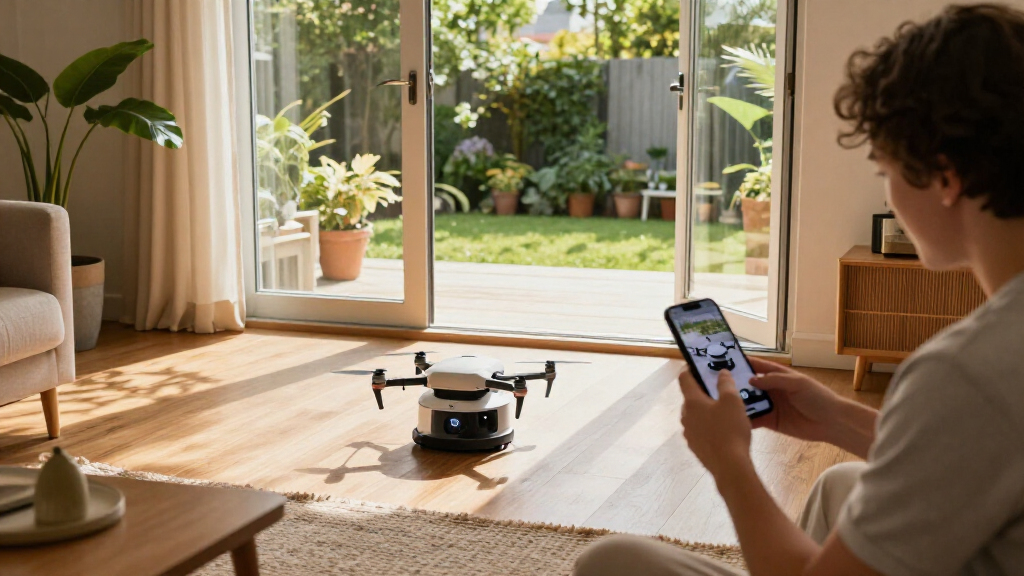

🔍 Read the full analysis: What Can Ring’s Home Drone And Patrol Robot Do? A Look At Privacy on ThorstenMeyerAI.com

Get business pricing on tech for your team
- Business-only prices and quantity discounts
- Tax-exempt purchasing
- Multiple users, one account, clear invoices
TL;DR
Amazon’s Ring announced two mobile security cameras on November 10, 2026: an indoor drone for homes and a wheeled patrol robot for businesses. Ring describes privacy controls including a camera-off dock and encryption, but the drone still needs FCC authorization, and critics say Ring’s encryption is not equivalent to end-to-end encryption.
Amazon’s Ring announced two mobile security cameras on November 10: a drone that patrols inside homes and a wheeled robot for businesses. The devices can move toward activity detected by other Ring products, bringing cameras into spaces fixed cameras cannot cover; their launch also raises questions about recording, cloud processing and privacy.
Ring’s Drone Cam is listed at $249.99, with US shipping planned for January 27, 2027. Ring says it can fly on scheduled routes or on demand, and take off when a Ring camera, sensor or alarm is triggered. Its listed specifications include 2K video, a 148-degree field of view, 360-degree rotation and two lights for dark areas. Ring says the drone’s camera is off while it is in its dock. The Verge reported that the device weighs 165 grams and that Ring estimates five to eight minutes of flight per charge.
The home drone’s availability is not settled: Ring says it has not received required FCC authorization and may not be sold until that approval is in place. The Verge also reported that the device depends on an internet connection, with the drone able only to land if Wi-Fi is unavailable. Ring has not stated in the supplied announcement material when authorization may be granted.
Ring lists its Rover Cam for businesses at $999.99, with US shipping set for December 16, 2026. The company says it can patrol on a schedule, investigate alerts from other Ring devices, and scan 360 degrees when it reaches a patrol point. Its features include a camera on an adjustable mast, two-way audio, a siren and a light tower. Ring says it streams and records up to 4K video while moving or patrolling, and can begin recording after detecting motion even when docked. Scheduled patrols for both products require a compatible Ring Protect plan.
Mobile security cameras bring privacy into focus
Ring announced an indoor drone for homes and a wheeled patrol robot for businesses. They can move cameras toward alerts, while raising questions about recording, cloud processing and user control.
Two cameras that move
Ring says both products can respond to alerts from other Ring devices.
Drone Cam
Flies on scheduled routes or on demand, with 2K video and a camera Ring says is off while docked.
Rover Cam
Patrols on wheels, streams and records up to 4K video, and includes two-way audio, a siren and a light tower.
Controls Ring describes
The announcement outlines some privacy features, but leaves details open.
- Drone camera off while docked
- Rover Sleep Mode retracts its camera mast and turns off its microphone
- Both products show when recording
- When recording starts in every situation
- How users review or delete footage
- How long video and mapping data are retained
Launch timing depends on approval
Ring lists US shipping dates, but the drone cannot be sold until it receives required FCC authorization.
Encryption and privacy context
Ring says its TAKE encryption lets cloud servers temporarily access keys for features such as smart alerts, then deletes them. The EFF says TAKE is not equivalent to end-to-end encryption.
Mobile Cameras Change Home Monitoring
Unlike fixed cameras, these products are designed to move toward an alert. That could help a household or business check an area beyond the view of a mounted camera, but it also means the camera’s position and field of view change as it moves. The devices therefore make recording behavior, user control and clear indicators of recording central to the privacy question.
Ring says its system, called AI Pilot, maps spaces, suggests patrol points and steers around obstacles using cameras, vision models, sensors and cloud processing. The company has not supplied details here about how long mapping data is retained or the precise data flows involved. Those are relevant questions for people deciding whether to let an autonomous camera operate inside a home or workplace.
Costs and operating limits may also shape who can use the products. Rover’s list price is nearly $1,000, while Drone Cam’s planned price is lower but its availability depends on regulatory approval. Ring says scheduled patrols require a paid compatible plan; the supplied material does not specify the plan’s price or whether every feature requires a subscription.
Products Worth Considering
Amazon Kindle Paperwhite (12th Generation, 2024), 16GB, 7-Inch Display, Raspberry

Apple Watch Series 12 GPS 42mm Smartwatch

Jackery Explorer 300 Portable Power Station with 40W Solar Panel, 292Wh
As an affiliate, we earn on qualifying purchases.
From Astro to Ring Robotics
Ring describes the announcement as a new category of autonomous mobile security. The idea builds on earlier work: Ring previewed an indoor drone called Always Home Cam in 2020. The Verge reported that founder Jamie Siminoff said development began in 2016. The newly announced Drone Cam is the latest version of that effort, though the supplied material does not detail how its design or capabilities changed over time.
Rover Cam has a separate connection to Amazon’s robotics work. Ring says it drew on feedback from Amazon Astro customers who valued its roving security features. The Verge reported that Amazon launched Astro for Business in 2023 and discontinued it about a year later. Ring’s announcement does not explain whether Rover will share the same business model or what lessons the company took from that earlier product.
Ring’s privacy claims also sit alongside its regulatory history. In May 2023, the Federal Trade Commission charged Ring with compromising customer privacy by allowing employees or contractors to access private videos and by failing to provide basic privacy and security protections. These were allegations in an FTC complaint; the supplied material does not establish that the new devices have repeated those practices.
““Privacy isn’t just a feature of Ring Robotics; it is the default.””
— Ring announcement
Approval, Data and User Controls
The most immediate open question is whether the FCC will authorize Drone Cam in time for Ring’s planned January shipment date. Ring says the device cannot be sold until it receives the required authorization, but the supplied material gives no decision date. The status of any approval is therefore subject to change.
Privacy protections are also not fully described in the launch material. Ring says Drone Cam’s camera is off in its dock, Rover has a Sleep Mode that retracts its camera mast and turns off its microphone, and both products show when they are recording. The announcement does not spell out every circumstance in which recording starts, how users can review or delete footage, or how long video and mapping data are retained.
Ring calls its encryption Throw Away the Key (TAKE) and says cloud servers temporarily access keys to run features such as smart alerts before deleting them. This differs from optional end-to-end encryption, under which only a customer’s devices hold the keys. The supplied material does not provide an independent technical assessment of TAKE for these two products. The FTC’s 2023 charges and EFF’s criticism are relevant history and opinion, respectively, not proof of how the new devices will perform.
FCC Review and Shipment Dates
Ring lists Rover Cam shipments for December 16, 2026, and Drone Cam shipments for January 27, 2027, in the United States. The drone’s schedule depends on FCC authorization. Readers considering either product will also need Ring’s further information on compatible Protect plans, privacy settings, recording controls and data retention as those details become available.
Before the listed dates, the main developments to watch are the FCC’s decision on Drone Cam and any additional product or privacy documentation from Ring. The supplied source material does not state whether Ring plans further demonstrations, independent testing or changes to the launch schedule.
Key Questions
What did Ring announce?
Ring announced Drone Cam, an indoor flying camera for homes, and Rover Cam, a wheeled patrol robot aimed at businesses. Ring says both can respond to alerts from other Ring cameras, sensors or alarms.
When will the devices be available?
Ring lists Rover Cam at $999.99, with US shipping planned for December 16, 2026. Drone Cam is listed at $249.99, with shipping planned for January 27, 2027, but Ring says it still needs FCC authorization before it can be sold.
What privacy controls does Ring describe?
Ring says Drone Cam’s camera is off while docked, Rover has a Sleep Mode that retracts its camera and turns off its microphone, and both devices have indicators to show when they are recording. Ring also says footage is protected by its TAKE encryption.
Is Ring’s TAKE encryption end-to-end encryption?
No. Ring says its servers temporarily access encryption keys to support cloud features, then delete them. Ring describes full end-to-end encryption, where only a customer’s devices hold the keys, as an optional setting. The EFF has criticized TAKE as falling short of end-to-end encryption protections.
What remains unknown about the products?
The FCC authorization timeline for Drone Cam is unknown. The supplied material also does not detail all recording triggers, data retention periods, or the cost of the compatible Ring Protect plan needed for scheduled patrols.
Source: ThorstenMeyerAI.com