TL;DR

Get business pricing on tech for your team
- Business-only prices and quantity discounts
- Tax-exempt purchasing
- Multiple users, one account, clear invoices
Intel describes its D270 as an inference-focused data-center GPU with up to 480 GB of LPDDR5X memory, 350-watt air cooling, and PCIe 5.0 connectivity. The company says it is designed for long-context and high-concurrency AI serving; independent performance results, pricing, availability, and detailed configurations are not provided in the supplied material.
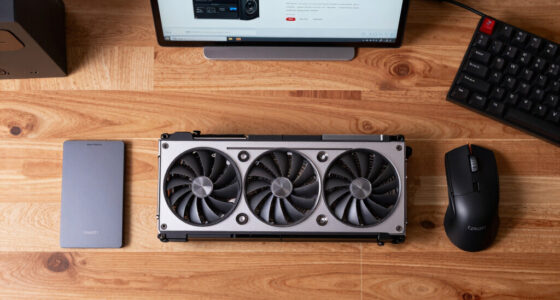
Intel has detailed the D270 data-center GPU, an accelerator it says is designed for production AI inference, with up to 480 GB of LPDDR5X memory per card. The company lists a 350-watt, air-cooled design and PCIe 5.0 support, positioning the hardware for long-context and high-concurrency workloads without requiring a liquid-cooling retrofit.
Intel describes the D270 as an inference-optimized GPU, intended to run deployed AI applications rather than train models at massive scale. The company identifies agentic AI, retrieval-augmented generation, enterprise assistants, coding assistants, document understanding, multimodal models, diffusion models, and high-concurrency serving as target workloads. These are product-use cases Intel says the accelerator is designed to support, not independently verified performance results.
The listed configuration includes 32 Xe3P cores and 256 XMX matrix engines. Intel says the design reallocates die area away from graphics and ray-tracing pipelines toward compute for inference. Its product page emphasizes prefill processing—the work of processing a prompt before generating a response—as well as keeping larger models, long contexts, and more concurrent sessions resident in memory.
Intel also lists a standard PCIe 5.0 form factor and passive, air-cooled operation at 350 watts. The company says the card is intended to fit existing data-center environments without proprietary networking or a bespoke system. Intel references PyTorch and vLLM in its software messaging; the supplied material does not provide a detailed compatibility matrix, benchmark suite, or deployment guide.
Memory Capacity for Long-Context Inference
The D270’s headline specification is its memory capacity of up to 480 GB. In inference workloads, large prompts and retrieval-heavy requests can increase memory needs, as can the KV cache used to retain context during generation. More available memory may let operators serve larger models, longer contexts, or more sessions on a card, depending on model size, software, and workload. Intel’s material presents these as design goals; it does not establish how much capacity a particular application can use or how the D270 performs against competing accelerators.
The air-cooled, 350-watt profile may also matter to operators weighing data-center power, rack density, and deployment changes. Intel’s stated aim is to make the GPU usable in standard PCIe servers and existing air-cooled racks. That could reduce some infrastructure changes compared with systems that need liquid cooling, but real-world fit will depend on server compatibility, power delivery, cooling limits, and the final card configuration.
For cloud providers, enterprises, and organizations operating sovereign or government cloud services, the product could add another option for inference capacity. The commercial relevance will depend on factors Intel has not specified in the supplied information, including price, availability, software maturity, measured throughput, and total cost per token.
As an affiliate, we earn on qualifying purchases.
Intel’s Inference-Focused D-Series
Intel frames the D-series around changes it sees in agentic AI workloads: applications may process long prompts, call tools, retrieve information, and make repeated model calls before returning a response. Such workflows can place pressure on memory capacity and prompt-processing performance, as well as on the ability to serve multiple sessions at once. This is Intel’s explanation for the D270’s emphasis on memory and inference compute.
The product information distinguishes the D270 from a GPU positioned primarily for large-scale model training. Intel instead highlights production serving and says the design supports precision choices ranging from low-precision inference to FP64 scientific computing. The supplied report gives no detailed throughput figures, test conditions, or independent validation for those capabilities.
Intel includes a performance comparison disclaimer referring to publicly available information and internal analysis as of February 2026, but the source material provided here does not include the underlying figures or test results. It says performance varies by use and configuration, and that memory-capacity comparisons are made at comparable bandwidth. Those qualifications do not substitute for published, reproducible benchmarks.
“Intel GPU D270 is an inference-optimized data center GPU designed for the agentic AI era.”
— Intel
As an affiliate, we earn on qualifying purchases.
Benchmarks, Pricing and Availability
The supplied product information does not specify pricing, a release date, shipping status, or customer availability. It also does not give the D270’s memory bandwidth, detailed card dimensions, supported model limits, or power-use measurements across workloads. Intel says memory can reach 480 GB per card, but the material does not explain whether every configuration will offer that capacity.
There are no independent tests or reproducible performance results in the source material to confirm throughput, latency, tokens per watt, or comparative cost. Intel’s reference to internal analysis and publicly available information is accompanied by caveats that results vary by use and configuration. It is not clear how the D270 compares with other data-center accelerators under equivalent software, model, and power conditions.
Software support also needs more detail. Intel names established frameworks in its messaging, but the supplied information does not list specific versions, validated models, deployment configurations, or the extent of support at product release. Those details will affect whether operators can adopt the card within existing systems.
As an affiliate, we earn on qualifying purchases.
Details Needed for Deployment Decisions
Intel invites customers to contact the company for product information and updates, but the source does not give a timetable for further disclosures. Prospective buyers will need availability and pricing information, a full technical specification, supported server configurations, and documentation for software and model compatibility before assessing deployment plans.
The next useful evidence would include independently reproducible benchmarks for representative inference workloads, with the model, context length, batch size, software stack, power draw, and comparison hardware disclosed. Those results could help determine whether the D270’s memory capacity and air-cooled design translate into practical gains in throughput, concurrency, or operating cost. Until such information is available, the confirmed development is Intel’s product announcement and stated design specifications—not a demonstrated performance advantage.
As an affiliate, we earn on qualifying purchases.
Key Questions
What is the Intel D270?
Intel describes the D270 as a data-center GPU optimized for production AI inference, including long-context and high-concurrency serving. The supplied material does not position it as a GPU primarily for large-scale model training.
How much memory does the D270 have?
Intel lists up to 480 GB of LPDDR5X memory per card. The source does not specify the memory capacity of every configuration or provide the D270’s memory-bandwidth figure.
Does the D270 require liquid cooling?
Intel lists a 350-watt air-cooled design and says it is intended for deployment in existing air-cooled racks. Specific server and rack compatibility will depend on the final configuration.
When will the Intel D270 be available, and what will it cost?
The supplied Intel product information does not give a release date, shipping status, or price. Intel directs interested customers to contact the company for updates.
Has Intel published proof of the D270’s performance claims?
The provided material does not include independent benchmarks or detailed, reproducible test results. Intel makes design and performance claims, but real-world throughput and cost comparisons remain unverified in this source.
Source: hn
Fall Picks
fall essentials
As an affiliate, we earn on qualifying purchases.