
AIThis post was created with the assistance of artificial intelligence (AI).
📊 Full opportunity report: Practice Before The Meeting: IEP Negotiation Rehearsal For Parents on IdeaNavigator AI — validation score, market gap, and execution plan.

Buying for a business?Offer from Amazon
Get business pricing on tech for your team
- Business-only prices and quantity discounts
- Tax-exempt purchasing
- Multiple users, one account, clear invoices
Create a free Business account Free to register
As an affiliate, we earn on qualifying purchases.
TL;DR
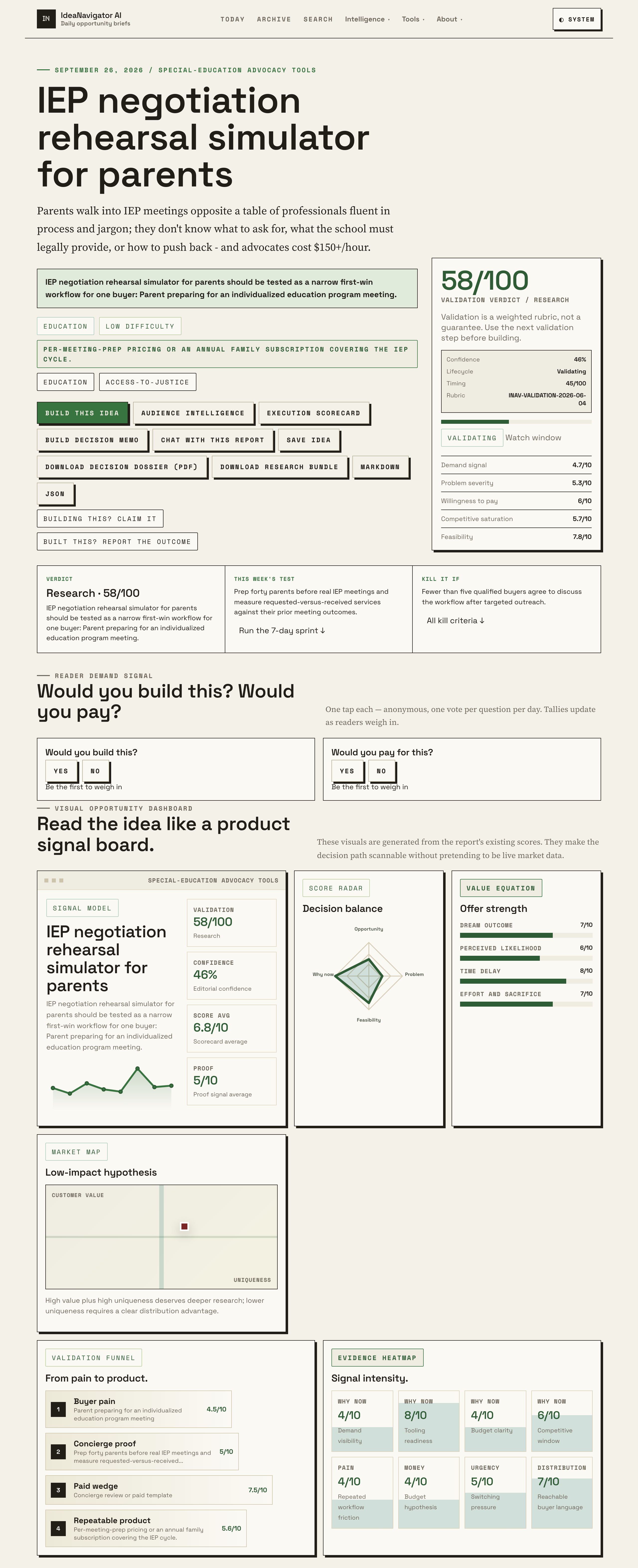
IdeaNavigator AI has outlined a proposed rehearsal simulator to help parents prepare for individualized education program meetings. The concept would use uploaded education records to explain rights, draft requests and simulate school responses; no operating product or evidence of results is reported.
At a glance
announcementWhen: Proposal described; development and tes…
The developmentIdeaNavigator AI published a proposal for an AI role-play tool to help parents prepare to negotiate services at IEP meetings.
Could Practice Change Meeting Preparation?
If developed and shown to be useful, the simulator could give parents a way to rehearse before a high-stakes discussion about a child’s educational program, especially when paid advocacy is unaffordable or unavailable. A plain-language review of documents could also help families arrive with more specific questions and requests. IdeaNavigator AI’s proposed evaluation would focus on whether families receive requested services compared with their own earlier outcomes. That would be an early indicator, not by itself proof that the tool caused any change: meeting circumstances and students’ needs can differ, and the proposal does not describe a controlled comparison. The concept’s practical value will depend on the accuracy of its legal explanations and whether parents can tell when they need qualified human advice.A Narrow Proposal for IEP Meetings
An individualized education program, or IEP, sets out education supports for an eligible student and is discussed by a team that includes the student’s parents or guardians and school representatives. Meetings can involve technical terms and decisions about services, making preparation relevant to families who want to understand records and communicate their concerns. IdeaNavigator AI presents this as a focused first use for role-play technology rather than a general special-education platform. Its proposal says language models can simulate conversation and cites rising special-education identification rates and tightening district resources as part of its rationale. It gives no dates, jurisdictions or data for those broader claims, so they are not independently quantified here. The proposal also does not identify a developer, release schedule or existing product.Accuracy and Trial Results Are Unknown
IdeaNavigator AI’s proposal does not say whether a simulator has been built, whether any parents have used it, or whether education or legal specialists have reviewed its explanations. It provides no evidence that the role-play can reliably represent how a particular school team may respond. The proposal does not explain how the tool would handle legal information that varies by jurisdiction and individual circumstances, protect uploaded student records, or correct errors. It is also unclear how the suggested 40-parent assessment would define prior meeting outcomes, account for differences between meetings or determine whether changes in services resulted from preparation.Testing Would Be the Next Step
IdeaNavigator AI proposes preparing 40 parents for upcoming IEP meetings and comparing the services they request and receive with their earlier meeting outcomes. The proposal gives no timetable, does not say whether participants have been recruited and does not specify how results would be published. Before families could assess it as a practical option, the concept would need a working product and clear information about its legal review, privacy protections, limitations and pricing. IdeaNavigator AI reports no launch date or further milestone.Key Questions
Is the IEP rehearsal simulator available now?
IdeaNavigator AI’s proposal describes a possible minimum version but does not report that a product has been built or launched.What would the proposed tool do?
According to IdeaNavigator AI’s proposal, it would review a parent’s uploaded IEP and evaluation reports, explain potential entitlements in plain language, suggest requests with legal grounding and simulate meeting responses for practice.Has the simulator been shown to improve meeting outcomes?
No results are reported in IdeaNavigator AI’s proposal. It suggests testing the tool with 40 parents and comparing requested and received services with their prior meeting outcomes.How much would it cost?
IdeaNavigator AI gives no price. Its proposal suggests payment for each meeting preparation session or an annual family subscription as possible business models.Source: IdeaNavigator AI
Fall Picks
fall essentials
fall essentials
As an affiliate, we earn on qualifying purchases.