📊 Full opportunity report: Mac vs GPU Tower for Local LLMs: The Heat-and-Noise Tradeoff on ThorstenMeyerAI.com — validation score, market gap, and execution plan.
TL;DR
This article compares Mac Silicon and GPU towers for running local large language models, focusing on heat, noise, capacity, and performance. The choice depends on model size and workload priorities.
Apple Silicon machines like the Mac Studio with M3 Ultra chips are inherently near-silent and low-power, contrasting sharply with high-performance GPU towers that generate significant heat and noise during large-scale AI inference tasks.
Recent analyses highlight fundamental differences between Mac Silicon and GPU towers in running local large language models (LLMs). GPU towers, equipped with high-bandwidth RTX 5090 cards, deliver superior throughput for models fitting within 32GB VRAM, but produce substantial heat (up to 800W+ power draw) and require complex thermal management. Conversely, Mac Studio with Apple Silicon offers a near-silent, low-power alternative capable of running models larger than 70 billion parameters by leveraging its large unified memory pool (up to 512GB), though at slower inference speeds.
GPU towers excel in scenarios demanding maximum tokens per second, especially for latency-sensitive applications, and support multi-GPU scaling and upgrades. However, they demand ongoing thermal management and noise control efforts. Mac Silicon’s architecture simplifies operation by eliminating fans and thermal adjustments, making it ideal for continuous, quiet operation, but with the tradeoff of slower inference speeds on large models. The choice hinges on whether the workload prioritizes speed or quiet, power-efficient operation.
Mac vs GPU tower
for local LLMs.
What if you sidestep the heat entirely with a different kind of machine? A tower is a high-bandwidth furnace you spend five levers quieting. Apple Silicon is near-silent by design — but asks for different tradeoffs. Match your priority in Part 2.
Put the loud, hot machine where its noise doesn’t matter, and the quiet one where you do. SSH into the tower when you need raw power; let the Mac handle everything else, silently.
Why Heat and Noise Are Critical in AI Hardware Choices
The comparison underscores a key consideration for AI practitioners: hardware choice impacts not only raw performance but also operational noise, heat management, and ease of use. For those running models continuously at a desk, the near-silent operation of Apple Silicon can be a decisive advantage, while high-throughput GPU towers remain essential for maximum performance on smaller models. This tradeoff influences hardware investment, workspace comfort, and maintenance effort, making the decision more nuanced than raw speed alone.

Apple Mac Studio, M3 Ultra 32-Core CPU / 80-Core GPU, 256GB Unified Memory, 8TB SSD
- Performance: Up to 32-core CPU and 80-core GPU
- Display Support: Supports up to eight 8K displays
- Memory Capacity: Up to 512GB RAM
As an affiliate, we earn on qualifying purchases.
As an affiliate, we earn on qualifying purchases.
Evolution of Local AI Hardware and Architectural Differences
The landscape of local AI hardware has evolved from traditional GPU towers to include integrated solutions like Apple Silicon, driven by differing architectural priorities. GPU towers prioritize bandwidth and upgradeability, supporting CUDA ecosystems and multi-GPU scaling, but at the cost of high heat and noise. Apple Silicon, with its unified memory architecture, emphasizes capacity and power efficiency, enabling large models to run on a single, silent device. This shift reflects broader trends toward energy-efficient, low-maintenance AI hardware suitable for continuous operation, especially in desktop environments.
"The heat-and-noise dimension is one of the sharpest differences between GPU towers and Apple Silicon for local AI inference."
— Thorsten Meyer
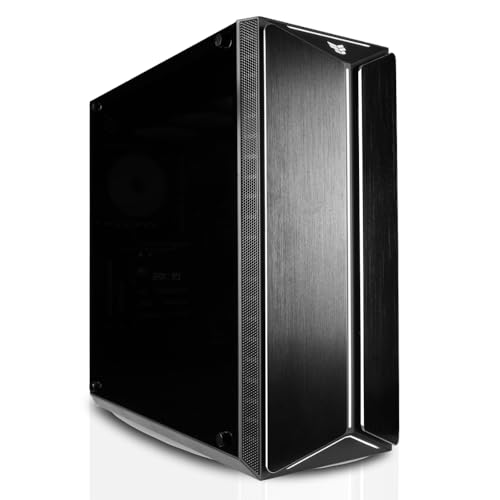
Sentinel Non-RGB RTX 5090, 16-Core AMD Ryzen 9 9950X, 128GB DDR5 RAM, 2x4TB Gen4 NVMe SSDs, Tower AI Workstation Desktop PC w/Windows 11 Pro, 3-Year Warranty, RGB Keyboard+Mouse, Internal Wi-Fi 7
- Powerful CPU: AMD Ryzen 9 9950X, 16 cores, up to 5.7 GHz
- Fast Storage: 2x4TB PCIe Gen4 NVMe SSDs
- High-Performance GPU: NVIDIA GeForce RTX 5090, 32GB GDDR7
As an affiliate, we earn on qualifying purchases.
As an affiliate, we earn on qualifying purchases.
Unanswered Questions About Long-Term Performance and Scalability
It remains unclear how Apple Silicon will evolve to support larger models or more complex workloads over time, and whether future hardware updates will narrow the performance gap with GPU towers. Additionally, the real-world thermal and acoustic performance of optimized GPU rigs can vary significantly based on configuration and cooling solutions. The long-term upgradeability and ecosystem support for Mac Silicon in AI development are also still developing, leaving some questions about its scalability and suitability for intensive, multi-model deployments.

Acer Veriton AI Mini Workstation Personal Computer GN100-UD11 Series
- Powerful AI Performance: 1 PFLOPS FP4 AI with NVIDIA GB10 Superchip
- Pre-installed NVIDIA DGX OS: Optimized for full NVIDIA AI stack
- High-Performance GPU & CPU: Blackwell GPU with 5th-gen Tensor Cores and 20-core Arm CPU
As an affiliate, we earn on qualifying purchases.
As an affiliate, we earn on qualifying purchases.
Upcoming Hardware Developments and Performance Benchmarks
Further testing and benchmarking of the latest Mac Silicon chips against high-end GPU towers are expected as new models are released. Hardware manufacturers may introduce more power-efficient or higher-capacity chips, potentially shifting the balance in favor of Apple Silicon for certain workloads. Meanwhile, AI practitioners should monitor updates in thermal management, inference speed improvements, and ecosystem support to inform future hardware investments. The decision between heat/noise efficiency and raw throughput will continue to evolve as technology advances.

Corsair Vengeance a7500 Gaming PC – Liquid Cooled AMD Ryzen 5 9600X CPU – NVIDIA GeForce RTX 5060 GPU – 16GB Vengeance RGB DDR5 Memory – 1TB M.2 SSD – Black
- Graphics Card: NVIDIA GeForce RTX 50 Series GPU
- Processor: Liquid-cooled AMD Ryzen 5 9600X
- Memory: 16GB Vengeance RGB DDR5 RAM
As an affiliate, we earn on qualifying purchases.
As an affiliate, we earn on qualifying purchases.
Key Questions
Can Apple Silicon run large language models as effectively as GPU towers?
Apple Silicon can run large models larger than 70 billion parameters by leveraging its large unified memory, but typically at slower inference speeds compared to GPU towers optimized for bandwidth and throughput.
What are the main operational advantages of Mac Silicon over GPU towers?
Mac Silicon offers near-silent operation, low power consumption, and minimal heat production, making it ideal for continuous, low-maintenance AI workloads.
Are GPU towers still necessary for high-performance AI inference?
Yes, for maximum throughput on models that fit within VRAM and for workloads requiring CUDA ecosystem support, GPU towers remain the preferred choice.
Will future Mac Silicon models support larger models or multi-GPU setups?
It is uncertain; current designs focus on capacity and power efficiency, but future updates may expand scalability and performance capabilities.
How does heat and noise impact ongoing AI operations?
High heat and noise levels in GPU towers require active thermal management and noise control, which can increase complexity and maintenance. Mac Silicon’s near-silent operation eliminates these issues.
Source: ThorstenMeyerAI.com