TL;DR
The International Energy Agency says AI efficiency gains are helping broaden adoption, while data center electricity use rose in 2025. Jevons paradox describes how lower costs can encourage enough additional use to increase total consumption, though research finds this outcome is not inevitable.
The International Energy Agency (IEA) says efficiency gains are helping expand AI adoption as data center electricity use grows, a pattern it connects to Jevons paradox. The figures cited in a November 2026 analysis show data center electricity consumption rose 17% in 2025, while consumption at facilities built for AI rose 50%; they do not establish how much of the increase came from AI use alone.

Get business pricing on tech for your team
- Business-only prices and quantity discounts
- Tax-exempt purchasing
- Multiple users, one account, clear invoices
The IEA reports that energy used per AI task has fallen by at least an order of magnitude annually in recent years, describing the pace as unprecedented in energy history. The same source reports 485 terawatt-hours of electricity use by data centers worldwide in 2025 and projects about 950 terawatt-hours in 2030. The projection is an estimate, not a confirmed future outcome.
Other figures in the source point to rising use alongside falling costs. Epoch AI estimates the cost of a given level of AI performance has fallen about 13 times per year since 2023. Google’s monthly token count rose from 9.7 trillion in May 2024 to more than 3.2 quadrillion in May 2026, according to the source. Those measures describe different things: lower performance costs do not directly show lower electricity per task, and token volume does not by itself quantify power consumption.
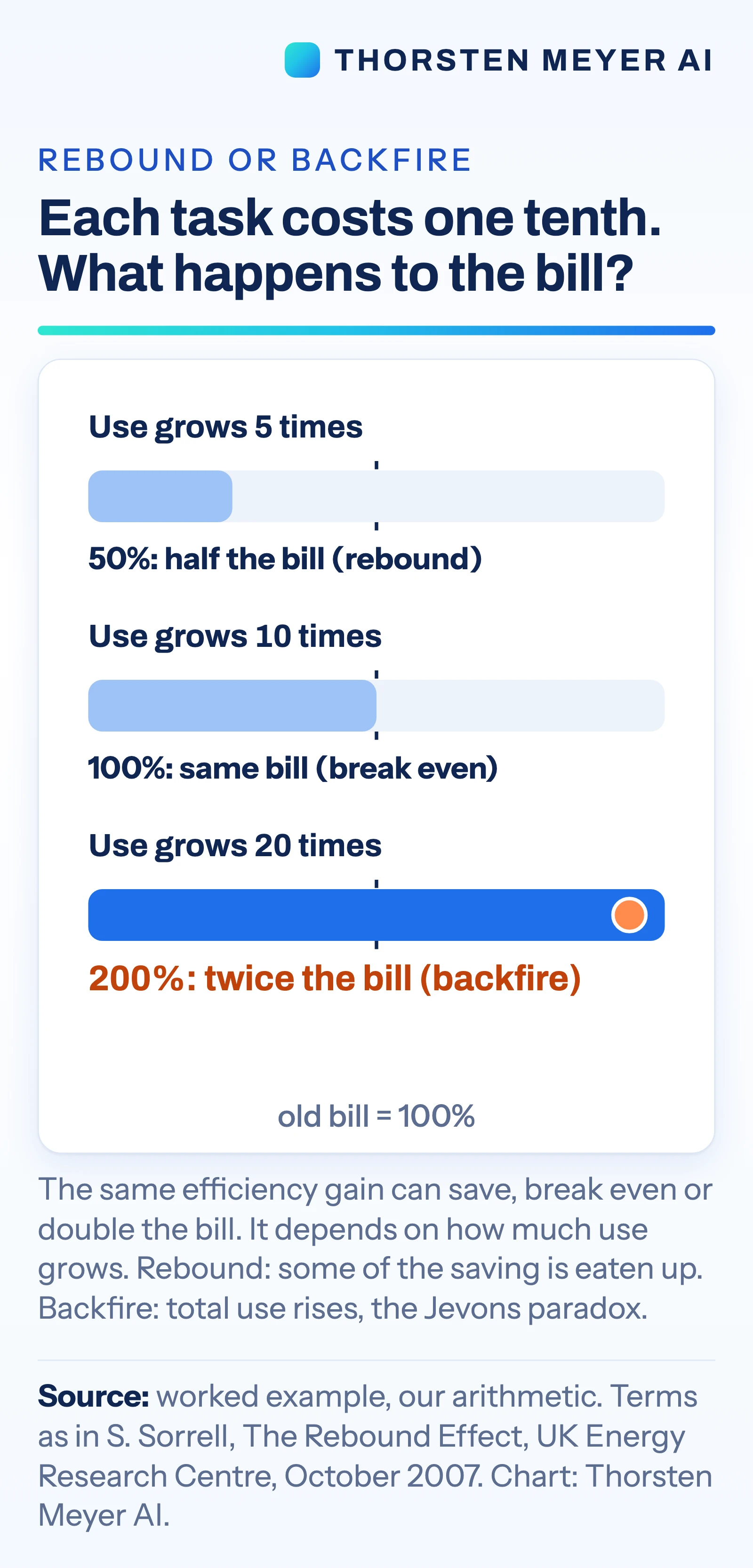
The IEA says efficiency gains are “also fuelling broader adoption of AI services, a dynamic known as the Jevons paradox,” and says total electricity use from AI is set to increase in the near term. This is the agency’s explanation and outlook. The source does not give a full breakdown of how much of projected data center demand comes from AI, or how much stems from other drivers.
Why Lower AI Costs Matter
For companies, lower processing costs can make AI practical for tasks that were previously too costly, while also encouraging more frequent or extensive use. Total spending can rise even as the cost per task falls. A useful business measure is the cost of a completed task, including repeated model calls and review, rather than token price alone.
For electricity planning, the distinction is between efficiency per task and total demand. A simple text request may use little power, while widespread use and more computationally intensive applications, such as video generation or agent systems, could add to aggregate loads. The source provides no per-prompt energy estimate, so it cannot support a precise comparison between an individual query and broader demand.
Products Worth Considering

Amazon Kindle Paperwhite (2024, 16 GB) – 7-inch Display, Black

Logitech MX Master 4 Ergonomic Wireless Mouse with Haptic Feedback, Graphite

Apple AirPods Pro 3 Wireless Earbuds with Active Noise Cancellation
As an affiliate, we earn on qualifying purchases.
From Coal to Computing
British economist William Stanley Jevons described the idea in his 1865 book The Coal Question. He argued that more efficient steam engines could make coal-powered work profitable in more settings, expanding demand enough to offset fuel savings per engine. He cited Scottish iron production, where he said coal use per ton fell to less than a third of its former level while total consumption increased tenfold.
Modern energy analysis distinguishes a rebound effect, where increased use erodes some expected savings, from “backfire,” where additional use outweighs the efficiency gain and total consumption rises. A 2007 review for the UK Energy Research Centre found that efficiency improvements usually still save energy overall, though the savings may be smaller than engineering estimates. The AI case may fit the backfire pattern, but it remains an empirical question rather than a rule that applies to every technology.
“It is wholly a confusion of ideas to suppose that the economical use of fuel is equivalent to a diminished consumption. The very contrary is the truth.”
— William Stanley Jevons, The Coal Question (1865), Chapter VII
How Much Demand Comes From AI
The figures cited do not isolate AI’s share of all data center electricity use, nor do they show how much of the 2025 increase resulted from cheaper AI services. It is also unclear from the source how future efficiency improvements, growth in usage, hardware changes and energy supply will interact. A rise in total use is possible, but Jevons paradox does not make it automatic.
Track Use Alongside Efficiency
The next milestones are whether the IEA’s projected data center demand approaches 950 terawatt-hours in 2030 and how much of that demand is attributable to AI. Companies can track task-level costs alongside the volume and type of AI work they run; energy analysts will need comparable data on efficiency and total consumption to determine whether savings are being outweighed by adoption.
Key Questions
What is Jevons paradox?
It is the possibility that making a resource more efficient lowers the effective cost of its use, prompting enough additional demand to increase total consumption.
Does cheaper AI always use more electricity overall?
No. Jevons paradox describes a possible outcome, not a guaranteed one. The cited 2007 UK Energy Research Centre review found efficiency gains usually still reduce energy use overall.
What data center electricity figures does the source cite?
It reports 485 terawatt-hours of worldwide data center electricity use in 2025 and cites an IEA projection of about 950 terawatt-hours in 2030.
How much of the growth is confirmed to come from AI?
The source says electricity use rose 50% at data centers built for AI in 2025, but does not provide a complete breakdown of AI’s contribution to worldwide data center demand.
Source: Thorsten Meyer AI