
TL;DR
In a post dated November 25, 2026, Thorsten Meyer describes replacing several paid software services with tools built using Anthropic’s Claude and OpenAI’s Codex coding agents. He says the tools handle analytics, project tracking, PDFs and video, while he remains responsible for reviewing, maintaining and securing them.
Thorsten Meyer says he has replaced paid services for web analytics, project tracking, PDF work and video recording with custom tools built using Anthropic’s Claude and OpenAI’s Codex. In a post published November 25, 2026, he describes the setup as a way to tailor software to his work, while acknowledging that maintenance, security and review now fall to him.

Get business pricing on tech for your team
- Business-only prices and quantity discounts
- Tax-exempt purchasing
- Multiple users, one account, clear invoices
Meyer says he pays for several Claude and Codex subscriptions and uses their coding agents to build tools for his own workflow. He describes the agents as systems that can read a software project, write code, run tests and report results after he gives them a task. He says he sets goals and checks their work; the post does not provide a cost comparison with the services he stopped paying for.
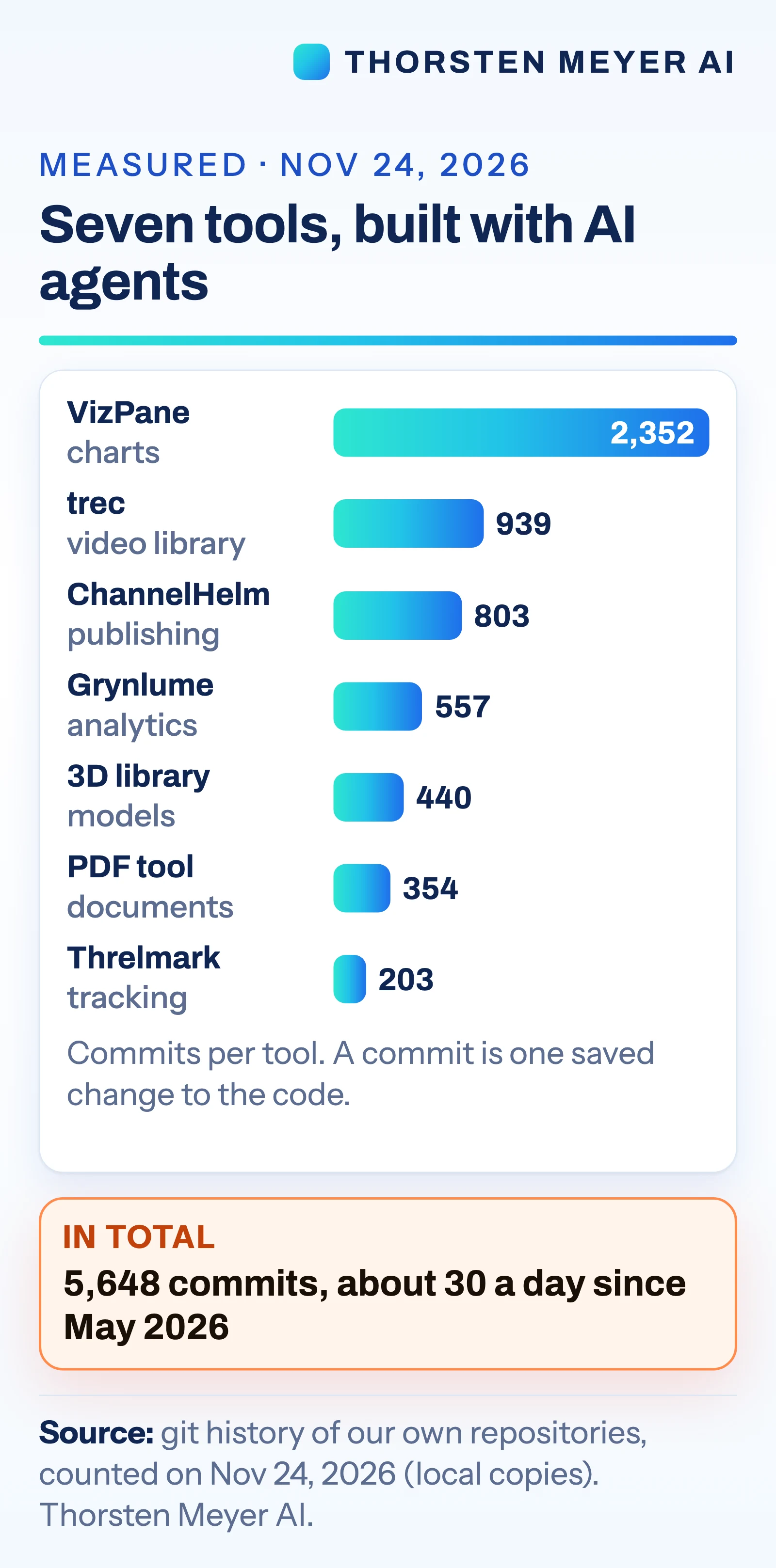
His example follows one publishing job across seven tools: a project tracker, tool guides, video transcription, a PDF reference, a 3D model library, a publishing system and an analytics tool. Meyer says the tools can pass work to one another without a person clicking through each step. He reports that seven tools in his repositories had 5,648 commits and 2,128 test files as of November 24, 2026. Those figures describe his own repositories; the post gives no comparison baseline.
Meyer also says he pays separately to use AI models for voice, images and video clips. The video accompanying the post uses an AI voice clone of Meyer, according to the source material. He presents the workflow as his personal practice, not as a measured study or a recommendation that every business should build its own software.
A Different Trade-Off for Small Teams
The account illustrates how AI coding agents may let a solo worker or small business create software for a narrow, specific workflow. Instead of adapting work to a general-purpose service, Meyer says he can shape each tool around his own needs and connect it to the others. That could matter to people whose work does not fit standard software neatly.
The approach shifts costs and responsibilities. Meyer says his main software subscriptions are now Claude and Codex, but he also takes on upkeep, security decisions and code review. He says he depends heavily on Anthropic and OpenAI. His post does not quantify the time spent on these duties or establish whether the approach costs less overall than subscriptions once that work is counted.
Products Worth Considering

Amazon Kindle Paperwhite (2024, 16 GB) – 7-inch Display, Black
Amazon Kindle Paperwhite (2024) – 16GB, 7 Glare-Free Display, Waterproof

Bose QuietComfort Headphones (2nd Gen), Wireless Noise-Cancelling Over-Ear Headphones, Black
As an affiliate, we earn on qualifying purchases.
From Software Rental to Custom Tools
Meyer contrasts his tools with software as a service, in which customers use applications hosted by a provider. He cites the U.S. National Institute of Standards and Technology’s definition of SaaS in Special Publication 800-145: users access a provider’s applications on cloud infrastructure and generally do not manage the underlying servers or application capabilities, aside from limited settings.
He argues that coding agents change who can make a tailored application. In his description, a person can explain a task in plain language while an agent works within a project’s code. He says written project rules, plans and work logs help agents retain business-specific instructions between sessions, since they do not automatically learn an organization over time.
For tools to work together, Meyer says each needs a readable guide and a standard interface that other software can use. His article describes this as making applications “agentic”: usable by AI agents as well as people. The source excerpt does not give technical details about the interfaces or explain how access is secured.
““The scarce part is no longer the code. It is knowing exactly what you need, and checking that you got it.””
— Thorsten Meyer
Costs and Safeguards Remain Unreported
The post does not state how much Meyer previously spent on software, what his current Claude and Codex subscriptions cost, or how much time he puts into maintaining the custom tools. It therefore does not establish net savings. It also gives no independent assessment of the tools’ reliability, security or performance.
The reported repository counts are dated observations from Meyer’s own projects, with no baseline supplied. The article excerpt does not describe the tools’ hosting arrangements, backup practices, access controls or recovery plans. Those details would help readers judge the operational risks of relying on self-built software.
More Detail Needed to Judge the Model
Meyer presents the article as a written companion to a deeper video about his workflow. The next useful details for readers would be a breakdown of subscription and model-use costs, the time required to maintain each tool, and how he tests and secures systems that pass work between one another. The source material does not announce a release date or a broader rollout.
Key Questions
Which paid software does Meyer say he replaced?
He says custom tools now handle web analytics, project tracking, PDF work and video recording. The post does not name the former paid services or provide their subscription prices.
Which AI tools did he use to build the software?
Meyer says he used Claude from Anthropic and Codex from OpenAI. He describes giving the agents tasks, reviewing their code and checking their results.
Did Meyer show that his approach saves money?
No cost comparison is included in the source material. Meyer says his software bill is for Claude and Codex subscriptions, with separate per-use payments for models that generate voices, images and video, but he does not compare the total with his previous expenses.
What does Meyer mean by an “agentic” tool?
He means a tool that other software can learn about through a written guide and use through a standard interface, without requiring a person to click through its screens.
What responsibilities does Meyer take on?
He says maintenance, security and review are his responsibility. The post does not detail the safeguards or ongoing time required for those tasks.
Source: Thorsten Meyer AI