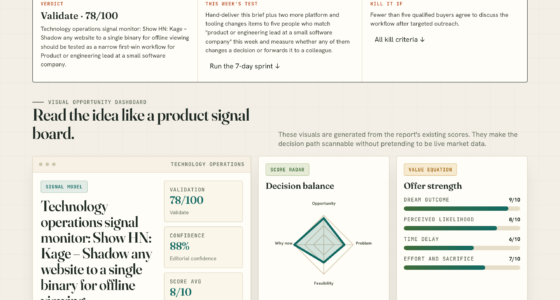

📊 Full opportunity report: Build, Rent, or Quantize: Cutting Your Memory Bill Without Cutting Capability on ThorstenMeyerAI.com — validation score, market gap, and execution plan.

Get business pricing on tech for your team
- Business-only prices and quantity discounts
- Tax-exempt purchasing
- Multiple users, one account, clear invoices
TL;DR
AI developers face rising memory costs. Building hardware, renting cloud resources, and quantizing models are key strategies. Quantization, especially weight and cache compression, offers significant savings with minimal quality loss.
AI developers can now significantly cut memory costs without sacrificing capability by applying model quantization, a third lever alongside building and renting hardware, according to recent industry analyses. This approach is gaining prominence as memory prices surge across markets, impacting both cloud and local deployment options.
The traditional choices for managing AI memory costs are building dedicated hardware or renting cloud resources. Building is most economical for steady, high-utilization workloads, while renting offers flexibility for variable or short-term needs. However, a third approach—quantization—has emerged as a highly effective way to reduce the memory footprint of AI models. Recent advancements, like Google’s TurboQuant, compress key-value caches to roughly 3 bits per token, reducing memory use by over 6× with negligible quality loss, especially at long contexts. This allows models to run on less expensive hardware or serve more users on existing setups.
Experts emphasize that quantization is not a magic solution but a powerful tool when applied correctly. Weight quantization reduces model parameters from 16-bit to 4-bit, cutting memory by nearly 4× while maintaining approximately 95% of the original quality. Combined with cache compression, this can make large models more accessible and affordable, especially during memory shortages. However, pushing quantization below certain thresholds degrades reasoning and coding capabilities, so it must be used judiciously.
Build, rent, or quantize
Memory got expensive everywhere — to buy and to rent. Most people argue build-vs-rent and miss the cheapest lever: shrink how much memory the work needs in the first place. Cut the bill without cutting capability.
For steady, high-utilization, private work. ~½ the lifetime cost of cloud. Right-size, used 3090s, or Apple unified memory. Capital up front.
For elastic, spiky, uncertain work. Can’t buy half a cluster for two weeks. But the bill creeps up — rent defensively: reserve, right-size, monitor.
Make the model need less memory — modern compression does it at little quality cost. The one move that lowers the bill in both venues.
★ the underused multiplierThe mistake the squeeze punishes hardest is solving a memory problem by buying more memory, when you could have needed less. Build when ownership pays, rent when flexibility pays — and quantize always, because shrinking the requirement is the only lever that makes both cheaper at once, and the only one that’s nearly free. The first question is never “build or rent” — it’s “how little memory can this take?” Next: when does cheap memory come back?
Implications for AI Deployment Costs and Capabilities
This development is critical because it offers a cost-effective way to scale AI capabilities without additional hardware investment. As memory prices continue to rise, quantization enables organizations to maintain or even improve performance on existing hardware, reducing the need for costly upgrades. It also democratizes access to large models by lowering hardware barriers, especially in environments with limited budgets or in scenarios where rapid deployment is essential.
Furthermore, the ability to compress models with minimal quality loss could reshape how AI services are delivered, making long-context models more feasible in real-world applications. This shift could influence cloud providers, hardware manufacturers, and AI developers to prioritize quantization-friendly frameworks and tools, accelerating adoption across the industry.
As an affiliate, we earn on qualifying purchases.
Memory Costs Rise Across AI Ecosystems
Over the past year, the cost of AI memory has increased significantly, driven by hardware shortages and demand for larger models. Earlier parts of this series documented a broad squeeze across hardware supply chains and cloud pricing, which has made scaling AI models more expensive. Building dedicated infrastructure has become less attractive due to high upfront costs, while cloud renting remains flexible but increasingly costly due to rising instance prices and memory-optimized SKU premiums.
In response, researchers and industry leaders have focused on model compression techniques. Recent breakthroughs, such as Google’s TurboQuant, demonstrate that sophisticated quantization can reduce memory needs by over 6×, making large models more accessible without hardware upgrades. These advances are timely as the AI community faces a growing need to deploy long-context models efficiently amid ongoing hardware shortages.
“TurboQuant compresses key-value caches to approximately 3 bits per token, enabling long-context models to run efficiently at a fraction of previous memory costs.”
— Google AI Research Team
As an affiliate, we earn on qualifying purchases.
Limitations and Practical Constraints of Quantization
While quantization offers significant benefits, it is not a universal solution. Pushing quantization below Q4 (4-bit) degrades model reasoning and coding capabilities, which are critical for many AI applications. The upcoming integration of TurboQuant into mainstream inference frameworks like vLLM is still in progress, with official support expected later in 2026. Community forks and experimental implementations are available but not yet production-ready. Additionally, some techniques like Mixture-of-Experts (MoE) models primarily save compute speed rather than memory, and their applicability varies.
AI model weight quantization software
As an affiliate, we earn on qualifying purchases.
As an affiliate, we earn on qualifying purchases.
Upcoming Adoption and Framework Integration of Quantization
In the coming months, expect major AI frameworks to incorporate TurboQuant and similar quantization methods more seamlessly. Industry leaders are likely to adopt these techniques to optimize existing hardware, reducing costs and increasing capacity. Further research will clarify the limits of quantization, especially for reasoning tasks, and developers will need to balance quality and compression based on application needs. Monitoring these developments will be essential for organizations aiming to optimize AI deployment strategies in a constrained memory market.
As an affiliate, we earn on qualifying purchases.
Key Questions
How much can quantization reduce memory costs?
Quantization, especially weight Q4 and cache FP8 compression, can reduce model memory requirements by over 6×, enabling large models to run on less expensive hardware or serve more users per instance.
Does quantization affect AI model quality?
When applied correctly, quantization preserves roughly 95% of the original model quality. Pushing below Q4 can cause noticeable degradation, especially in reasoning and coding tasks.
Is TurboQuant available for all inference frameworks?
As of mid-2026, TurboQuant is not yet integrated into major frameworks like vLLM but is expected later in 2026. Community versions are available for testing and early adoption.
Can quantization replace building or renting hardware?
Quantization complements these strategies by reducing memory needs, but it does not eliminate the need for hardware or cloud resources in all scenarios. It is a leverage point, not a complete solution.
Source: ThorstenMeyerAI.com
Halloween Picks
halloween
As an affiliate, we earn on qualifying purchases.