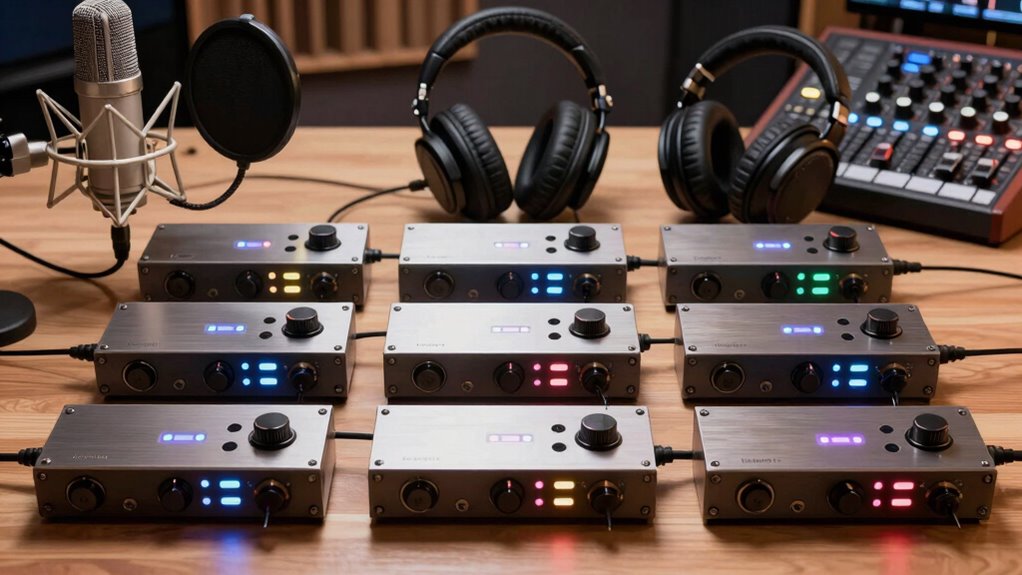
For podcast studios on a budget, finding a headphone amplifier that balances performance and affordability is essential. The FIFINE N6 stands out as the best overall choice, offering reliable multi-channel support and clear sound. The HA400 series provides a solid, budget-friendly alternative with versatile features, while the Mackie HM-4 excels in compact design for small setups. However, tradeoffs include varying build quality, feature sets, and power output, which can influence your decision. Continue reading for a detailed breakdown to help you find the perfect amplifier for your studio needs.

Get business pricing on tech for your team
- Business-only prices and quantity discounts
- Tax-exempt purchasing
- Multiple users, one account, clear invoices
Complete the kit


Key Takeaways
- The top picks balance power, multi-channel support, and ease of use within the $400 limit.
- Build quality varies significantly, impacting durability and long-term reliability.
- Features like independent volume control and mute functions are common but differ in complexity and control quality.
- Compact models are suitable for small spaces but may lack advanced features found in larger units.
- Price often correlates with feature set and build quality, so consider your long-term needs before choosing.
| LZSIG Headphone Amplifier with Bass Boost, 1‑IN Multi‑OUT, 12V, 4 Channel |  | Best Overall for Versatile Multi-Channel Monitoring | Number of Channels: 4 | Input Ports: 1/8 inch and 1/4 inch TRS | Output Ports: 4 x 1/4 inch TRS | VIEW ON AMAZON | See Our Full Breakdown |
| FIFINE N6 4-Channel Metal Stereo Headphone Amplifier for Audio Mixer |  | Best Value for Compact, Rugged Monitoring | Number of Channels: 4 | Input Ports: 1/4 inch TRS | Output Ports: 4 x 1/4 inch TRS | VIEW ON AMAZON | See Our Full Breakdown |
| 4-Channel Headphone Amplifier with 8 Outputs, Individual Volume, Mute, and RGB Lighting |  | Best for Creative Setups with Visual Flair | Channels: 4 | Outputs: 8 | Input Types: 1/4 inch, 1/8 inch, RCA | VIEW ON AMAZON | See Our Full Breakdown |
| 4 Channel Headphone Amplifier, Mini Metal Stereo Audio Amp with 1/4″ TRS Input & 4 TRS Outputs, 12V Power Adapter, Portable Headphone Splitter for PC, Guitar, Studio, Stage |  | Best for Portable, Space-Efficient Monitoring | Input: 1/4 inch TRS stereo | Outputs: 4 TRS headphone outputs | Power: 12V DC adapter | VIEW ON AMAZON | See Our Full Breakdown |
| HA400 Headphone Amplifier 4 Channel Metal Stereo Audio Amplifier |  | Best for Versatile Studio and Stage Use | Connector: 1/4 inch TRS | Number of Channels: 4 | Operational Chip: JRC4580 | VIEW ON AMAZON | See Our Full Breakdown |
| Headphone Amplifier HA400 4-Channel Stereo Audio Amplifier with DC 12V Power Adapter |  | Best Overall for Versatile Multi-Use Setups | Model Number: HA-4000 | Power Supply: DC 12V | Number of Channels: 4 | VIEW ON AMAZON | See Our Full Breakdown |
| SinLoon HA400 4-Channel Stereo Headphone Amplifier with Independent Volume Control |  | Best for Fidelity and Durability in Studio and Stage | Number of Channels: 4 | Maximum Output Power: >40mW | Input Connection: 1/4″ TRS stereo | VIEW ON AMAZON | See Our Full Breakdown |
| Bolanle PH400 4-Channel Headphone Amplifier with 8 Outputs |  | Best for Multi-Output Flexibility and Visual Feedback | Outputs: 8 (4× 3.5mm and 4× 6.35mm) | Impedance: 250Ω | Power supply: DC 5V/3A | VIEW ON AMAZON | See Our Full Breakdown |
| Mackie HM-4 Headphone Amplifier (4-Channel), Compact Splitter, Black |  | Best for Simplicity and Plug-and-Play Convenience | Compatible Devices: Not specified | Number of Bands: 4 | Speaker Size: 0.25 inches | VIEW ON AMAZON | See Our Full Breakdown |
| headphone amplifier for podcast studios under 400 | Number of Channels | Dimensions |
|---|---|---|
| LZSIG Headphone Amplifier with | 4 | — |
| FIFINE N6 4-Channel Metal Ster | 4 | — |
| 4-Channel Headphone Amplifier | — | — |
| 4 Channel Headphone Amplifier | — | 90 × 55 × 40 mm |
| HA400 Headphone Amplifier 4 Ch | 4 | 90 x 55 x 40 mm |
| Headphone Amplifier HA400 4-Ch | 4 | 4.07 x 1.18 x 2.24 inches |
| SinLoon HA400 4-Channel Stereo | 4 | 104x57x47mm |
| Bolanle PH400 4-Channel Headph | — | 5.75" × 3.11" × 0.98" |
| Mackie HM-4 Headphone Amplifie | — | — |
More Details on Our Top Picks
LZSIG Headphone Amplifier with Bass Boost, 1‑IN Multi‑OUT, 12V, 4 Channel
This pick stands out for its combination of four independent outputs and a built-in bass boost feature, making it ideal for podcasters who need to monitor multiple sources or guests simultaneously with enhanced audio clarity. Compared to the HA400, the LZSIG offers a dedicated bass boost, which can be a game-changer for vocal and bass-heavy content, though it involves a slightly more complex setup. Its ultra-low-noise operational amplifiers ensure distortion-free sound, surpassing many budget options. The four independent volume controls provide precise adjustments, essential in professional podcast settings. However, it requires a 12V power supply and might be bulkier than smaller models, making it less ideal for very portable setups. This amplifier makes the most sense for users who prioritize flexibility, sound quality, and multi-user monitoring in a semi-permanent studio environment.
Pros:- Supports four independent headphone outputs with adjustable volume
- Enhanced audio with bass boost for richer vocal and bass response
- Ultra-low-noise performance ensures clear, distortion-free sound
- Works with both 1/8″ and 1/4″ connectors, versatile for various headphones
Cons:- Requires a dedicated 12V power source, adding to setup complexity
- Larger footprint may not suit tight spaces or portable use
- No built-in mixing or input options, limited to monitoring
Best for: Podcasters and studio operators needing multi-headphone outputs with tone customization
Not ideal for: Travel podcasters or those with minimal space who prefer USB-powered, compact units
- Number of Channels:4
- Input Ports:1/8 inch and 1/4 inch TRS
- Output Ports:4 x 1/4 inch TRS
- Power:12V DC adapter
- Item Weight:12 ounces
- Bass Boost:Yes
Our verdict“This amplifier is best for serious podcasters seeking reliable multi-channel monitoring with customizable sound quality.”
FIFINE N6 4-Channel Metal Stereo Headphone Amplifier for Audio Mixer
Compared to the larger, feature-rich options like the LZSIG, the FIFINE N6 offers a straightforward, durable solution with four independent outputs, perfect for users who need reliable monitoring without extra bells and whistles. Its metal construction ensures durability on stage or in mobile setups, though it lacks tone-shaping features like bass boost. The separate volume controls for each channel make it easy to fine-tune multiple headphones, but the reliance on specific 1/4″ TRS cables (not included) can add to initial costs. Its lightweight design may raise concerns about stability during intense use, but this is offset by its rugged build. This model makes the most sense for users who prioritize simplicity, durability, and a clean audio signal within a tight budget.
Pros:- Solid metal construction for durability and portability
- Provides clear, high-quality stereo audio with minimal distortion
- Independent volume controls for each channel
- Supports multiple headphones simultaneously
Cons:- Requires 1/4″ TRS cables which are not included, adding to setup cost
- Limited to four outputs, no extended input options
- Very lightweight, which may affect stability
Best for: Stage performers, mobile recording setups, or budget-conscious podcasters needing durable, independent monitoring
Not ideal for: Podcasters seeking tone customization or integrated features like Bluetooth
- Number of Channels:4
- Input Ports:1/4 inch TRS
- Output Ports:4 x 1/4 inch TRS
- Power:12V DC adapter included
- Item Weight:1 g
- Warranty:One year
Our verdict“Best suited for users who need a durable, no-nonsense headphone amp for stage or studio use with reliable performance.”
4-Channel Headphone Amplifier with 8 Outputs, Individual Volume, Mute, and RGB Lighting
This model shines in environments where aesthetics and multiple headphone users matter, such as streaming or creative studios. It supports up to 8 headphones, far surpassing typical 4-channel amps, with independent volume controls and mute buttons for each. Its RGB lighting adds visual appeal, although some may find it distracting during serious recording sessions. The professional-grade audio quality with low distortion makes it suitable for detailed editing and mixing, but its external power supply and larger size limit portability. Compared with the HA400, it offers more outputs and visual customization but at the cost of increased complexity and potential distraction. It makes sense for creative teams or streamers who want multi-user monitoring with a touch of personality.
Pros:- Supports up to 8 headphones simultaneously with independent controls
- Low distortion and high signal-to-noise ratio for professional audio quality
- Vibrant RGB lighting enhances user experience
- Compact, durable metal build
Cons:- Requires external power supply (DC 5V), less portable
- Lighting may be distracting in serious recording environments
- Limited to four channels, not a full mixer
Best for: Content creators, streamers, and studios looking for multi-headphone support with aesthetic flair
Not ideal for: Minimalist podcasters or those who prefer simple, distraction-free equipment
- Channels:4
- Outputs:8
- Input Types:1/4 inch, 1/8 inch, RCA
- Power Supply:DC 5V
- Item Weight:1.32 pounds
- Lighting:RGB breathing lights
Our verdict“Ideal for creators who want multi-headphone support with eye-catching aesthetics and professional sound quality.”
4 Channel Headphone Amplifier, Mini Metal Stereo Audio Amp with 1/4″ TRS Input & 4 TRS Outputs, 12V Power Adapter, Portable Headphone Splitter for PC, Guitar, Studio, Stage
Compared with larger models like the HA400, this unit excels in portability and simplicity, making it perfect for podcasters or musicians on the go. Its compact size, with four outputs and independent volume controls, ensures versatile use without sacrificing sound quality. The durable metal housing guarantees longevity, while the 12V power supply ensures stable operation. Its compatibility with various devices makes it suitable for quick setups on stage, in the studio, or at home. However, it is designed primarily for headphones with 32–100Ω impedance, which could limit compatibility with some high-impedance models. The lack of advanced features like tone control or Bluetooth means it’s best suited for straightforward monitoring needs. This makes it ideal for users prioritizing portability and simplicity over extensive customization.
Pros:- Highly portable and space-efficient design
- Independent volume controls for each channel
- Durable metal construction for longevity
- Supports multiple headphones sharing a single source
Cons:- Limited to headphones with 32–100Ω impedance, may not suit all models
- Requires external 12V power, adds to setup steps
- No built-in tone shaping or wireless features
Best for: Mobile podcasters, musicians, or stage performers requiring a compact, reliable headphone splitter
Not ideal for: Studio engineers needing detailed tone control or multi-input mixing
- Input:1/4 inch TRS stereo
- Outputs:4 TRS headphone outputs
- Power:12V DC adapter
- Dimensions:90 × 55 × 40 mm
- Color:Black
- Amplifier Type:Solid State
Our verdict“Perfect for mobile use where portability, durability, and straightforward monitoring are priorities.”
HA400 Headphone Amplifier 4 Channel Metal Stereo Audio Amplifier
Compared to the other compact units, the HA400 offers a straightforward, reliable 4-channel solution with independent volume control and high-fidelity sound. Its simple design focuses on delivering clear stereo output with low noise, making it well-suited for studio, stage, or outdoor applications. It’s slightly bulkier than ultra-compact models but provides a more traditional, familiar interface for audio monitoring. The requirement for a 12V power supply and lack of wireless features limit its convenience but do not detract from its core performance. For users who want a proven, no-frills amp with a two-year warranty, it remains a solid choice, though it lacks tone-shaping features found in some higher-end models.
Pros:- Independent volume controls for each channel
- High-quality low-noise operational amplifier ensures clean sound
- Compact and portable metal design
- Two-year warranty for peace of mind
Cons:- Requires external 12V power supply, less convenient for quick setups
- Limited to headphones with 32-100Ω impedance
- No built-in wireless or advanced features
Best for: Podcasters, musicians, and stage performers needing a dependable, straightforward multi-channel amp
Not ideal for: Streamers or users seeking wireless connectivity or advanced tone controls
- Connector:1/4 inch TRS
- Number of Channels:4
- Operational Chip:JRC4580
- Power Supply:12V DC adapter
- Dimensions:90 x 55 x 40 mm
- Supported Impedance:32-100 Ω
Our verdict“A reliable choice for traditional monitoring needs in studio or live environments, emphasizing durability and sound clarity.”
Headphone Amplifier HA400 4-Channel Stereo Audio Amplifier with DC 12V Power Adapter
The HA400 stands out for its compact size combined with solid multi-channel performance, making it a versatile choice for podcast studios, stage, or outdoor applications. Compared to the SinLoon HA400, it offers similar four-channel support but with a slightly bulkier design and less detailed feature set. Its high-power stereo output ensures clear sound even at higher volumes, but some users report noise issues at maximum levels, which can affect audio quality during critical recordings. The inclusion of a 12V power supply and independent volume controls for each channel makes it straightforward to set up and use across different scenarios. However, the lack of detailed connectivity options and limited info on noise performance suggests it’s best for straightforward applications rather than complex setups requiring pristine audio fidelity.
Pros:- Compact and portable for easy transport
- High-quality stereo sound with independent volume control
- Supports up to four headphones simultaneously
Cons:- Limited description of additional features or connectivity options
- Some users experience noise at high volumes
Best for: Podcasters or studio owners needing a reliable, portable multi-channel amplifier for varied environments
Not ideal for: Users requiring wireless or Bluetooth connectivity or detailed feature customization
- Model Number:HA-4000
- Power Supply:DC 12V
- Number of Channels:4
- Dimensions:4.07 x 1.18 x 2.24 inches
- Operational Chip:JRC4580
- Warranty:1 Year
Our verdict“This amplifier offers a balanced mix of portability and multi-channel power, making it ideal for versatile use but less suited for noise-sensitive applications.”
SinLoon HA400 4-Channel Stereo Headphone Amplifier with Independent Volume Control
The SinLoon HA400 excels in delivering high-fidelity audio with low distortion, making it well-suited for professional podcasting and studio work. Unlike the Mackie HM-4, which is more basic and geared towards simple monitoring, the SinLoon offers support for a wider range of headphone impedances, providing flexibility for different setups. Its sturdy metal chassis and compact size make it durable for portable use, but it’s limited to four channels, which could be restrictive for larger studios. The device requires a 12V DC power supply, adding to its portability but also to setup complexity. While lacking wireless features, its low distortion and independent controls make it a solid choice for audio purists who prioritize sound quality over extras.
Pros:- High audio fidelity with low distortion
- Supports a wide headphone impedance range
- Durable metal chassis and portable design
Cons:- Limited to four channels, restricting expansion
- No wireless or Bluetooth connectivity
Best for: Podcast producers and musicians who prioritize sound fidelity and durable, portable equipment
Not ideal for: Environments needing wireless connectivity or larger multi-channel configurations
- Number of Channels:4
- Maximum Output Power:>40mW
- Input Connection:1/4″ TRS stereo
- Output Connection:Four 1/4″ TRS outputs
- Impedance:80Ω (outputs), 100kΩ (input)
- Dimensions:104x57x47mm
Our verdict“This model is perfect for those who value audio quality and durability over additional features, especially in portable or professional settings.”
Bolanle PH400 4-Channel Headphone Amplifier with 8 Outputs
The Bolanle PH400 offers a unique advantage with its 8 outputs and colorful LED volume knob, making it ideal for professional monitoring and small rehearsal spaces. Its high output power and mono/stereo toggle provide versatile monitoring options, but the device is limited to wired connections only, which can restrict placement flexibility compared to wireless options like the Mackie HM-4. The compact size and metal housing make it durable, while the multiple outputs support complex setups. However, its 250Ω impedance and 5V power supply require compatible headphones and external power, respectively. While the visual feedback is a nice touch, the lack of wireless features and limited connectivity options mean it’s best for wired setups where power and output flexibility are priorities.
Pros:- High output power for demanding headphones
- Multiple outputs for flexible configurations
- Colorful LED volume knob adds visual clarity
Cons:- Limited to wired connectivity
- Requires external power supply
Best for: Home studios or professional environments needing multiple outputs and visual monitoring cues
Not ideal for: Podcasters or mobile setups requiring wireless connectivity or battery operation
- Outputs:8 (4× 3.5mm and 4× 6.35mm)
- Impedance:250Ω
- Power supply:DC 5V/3A
- Dimensions:5.75″ × 3.11″ × 0.98″
- Weight:12.32 ounces
Our verdict“This amplifier suits those who need multiple outputs and visual feedback in a wired setup but isn’t designed for wireless or portable use.”
Mackie HM-4 Headphone Amplifier (4-Channel), Compact Splitter, Black
The Mackie HM-4 offers a straightforward, plug-and-play solution for small studios or home setups that need multiple headphones. Its simple design, with four independent volume controls and a 1/4-inch stereo input, makes it easy to set up without worrying about external power supplies or complex configurations. Compared to the HA400, it’s more compact and lightweight, ideal for tight spaces or quick setups. However, it lacks detailed info on device compatibility and doesn’t support wireless features, which may limit flexibility for some users. Its balanced, clear sound profile makes it suitable for monitoring, but it’s less ideal for applications demanding high-end audio fidelity or complex routing.
Pros:- Compact and lightweight design
- Easy plug-and-play setup
- Independent volume controls for each channel
Cons:- Limited compatibility info
- No power supply included
Best for: Podcasters or educators needing a lightweight, easy-to-use multi-headphone splitter
Not ideal for: Pro audio engineers seeking advanced connectivity or higher channel counts
- Compatible Devices:Not specified
- Number of Bands:4
- Speaker Size:0.25 inches
- Power Source:Corded electric
- Output Channel Quantity:4
- Item Dimensions:2.3″D x 4.3″W x 2″H
Our verdict“This model is perfect for quick, simple setups where ease of use and portability are the priorities, but it lacks advanced features for complex environments.”

How We Picked
To select the best headphone amplifiers under 400, I evaluated each product based on performance, ease of use, build quality, and feature set. Reliability and user feedback were also considered to ensure real-world applicability. Products were ranked by their ability to support multiple headphones simultaneously, clarity of audio, and versatility in studio environments. I prioritized models that offered a good balance of value for money without sacrificing essential features, helping both budget-conscious buyers and those seeking reliable professional gear. This approach ensures the list reflects practical, well-rounded options suitable for various studio setups.Factors to Consider When Choosing Headphone Amplifier For Podcast Studios Under 400
Choosing the right headphone amplifier for your podcast studio involves more than just budget; it requires understanding key features that impact your workflow, sound quality, and future expandability. The following factors help clarify what makes a model suitable for your specific needs and how to avoid common pitfalls when selecting equipment under $400.Power Output and Headphone Compatibility
Ensure the amplifier provides enough power for your headphones, especially if you use high-impedance models. Underpowered units may result in low volume and poor sound clarity. Check the maximum output levels and whether the device can support multiple headphones at once without distortion. This is especially important for larger studios or collaborative podcast setups where multiple hosts or guests require consistent quality and volume control.
Number of Channels and Outputs
More channels mean greater flexibility, but not all are necessary for every studio. Consider how many headphones you need to connect simultaneously and whether the amplifier offers independent volume controls for each. Some models include mute buttons or adjustable gains, which can simplify managing multiple sources during recording sessions. Overspending on unnecessary channels can also take away from features you might prefer, so match the product to your workflow.
Build Quality and Durability
While many budget models are made with plastic components, look for metal housings or reinforced construction if you plan to use the amplifier regularly. A sturdy build can withstand the rigors of a busy studio environment and reduce the risk of failure. Cheaper models might save money initially but could lead to repairs or replacements sooner than expected, impacting your long-term investment.
Additional Features and Controls
Features like independent volume control, mute switches, LED indicators, and RGB lighting can enhance usability. However, more complex controls might add unnecessary clutter or complexity for beginners. Decide which features are essential for your workflow—extra controls can improve efficiency but might also increase the learning curve or cost. Think about how intuitive the interface needs to be for your team.
Size, Portability, and Power Source
If space is limited or mobility is a concern, opt for a compact, lightweight model with easy access to power sources. Some amplifiers include USB or battery-powered options, which can be useful for mobile setups or quick reconfigurations. Larger, more powerful units tend to require dedicated power adapters and more space, but they often offer greater output and durability.
Frequently Asked Questions
Will a cheaper amplifier under 400 compromise sound quality?
Not necessarily. Many budget-friendly amplifiers deliver clear audio and sufficient power for typical podcasting needs. However, lower-cost units might lack advanced features or durable construction, which can affect long-term performance. It’s important to prioritize build quality and power output to ensure your recordings sound professional and that the equipment lasts through regular use.
Can I connect high-impedance headphones to these amplifiers?
Most models in this price range support standard impedance headphones, but high-impedance models may require more powerful amplification. Check the maximum output voltage and power ratings—if they’re not specified, look for reviews or specifications indicating support for high-impedance cans. Otherwise, you risk low volume levels or poor audio fidelity, which can hinder your recording quality.
Are multi-channel amps suitable for small podcast setups?
Yes, multi-channel amplifiers are well-suited for small studios, especially when multiple hosts or guests need to monitor audio simultaneously. They simplify setup by providing multiple outputs in a single device, saving space and reducing clutter. Just ensure the model offers enough channels for your needs and that controls are straightforward to operate during recordings.
Is it better to buy a more feature-rich amplifier or a simple one?
This depends on your familiarity with audio equipment and your specific needs. Beginners might prefer simpler models with fewer controls for ease of use, while experienced users may benefit from additional features like independent volume controls or mute buttons for more precise management. Balance your current skill level with potential future needs to avoid outgrowing a basic model too quickly.
How important is build material in a budget headphone amplifier?
Build material impacts durability and longevity, especially in a busy studio environment. Metal housings tend to withstand daily wear better than plastic, which might be cheaper but more prone to damage. While material alone isn’t the sole factor, investing in a well-constructed unit can prevent costly repairs or replacements, making it a key consideration within your budget.
Conclusion
For those seeking an all-around reliable choice, the FIFINE N6 offers excellent multi-channel support and clear sound at a reasonable price, making it ideal for most podcast setups. Budget-conscious users who prioritize durability may find the HA400 series a perfect match, providing solid performance without extra bells and whistles. Beginners should lean toward models with simpler controls, like the Mackie HM-4, which offers straightforward operation. For studio owners needing a compact, portable solution, these options provide versatility without exceeding the $400 limit, ensuring you find the right fit for your podcasting needs.
As an affiliate, we earn on qualifying purchases.Halloween Picks

ELAMAS 11ft Animatronic Flying Witch Halloween Decoration

Haunted Hill Farm 2-Ft. Zombie Raccoon Halloween Animatronic

Halloween Inflatable Haunted House Maze – 20×20 ft with Removable Roof and Blower