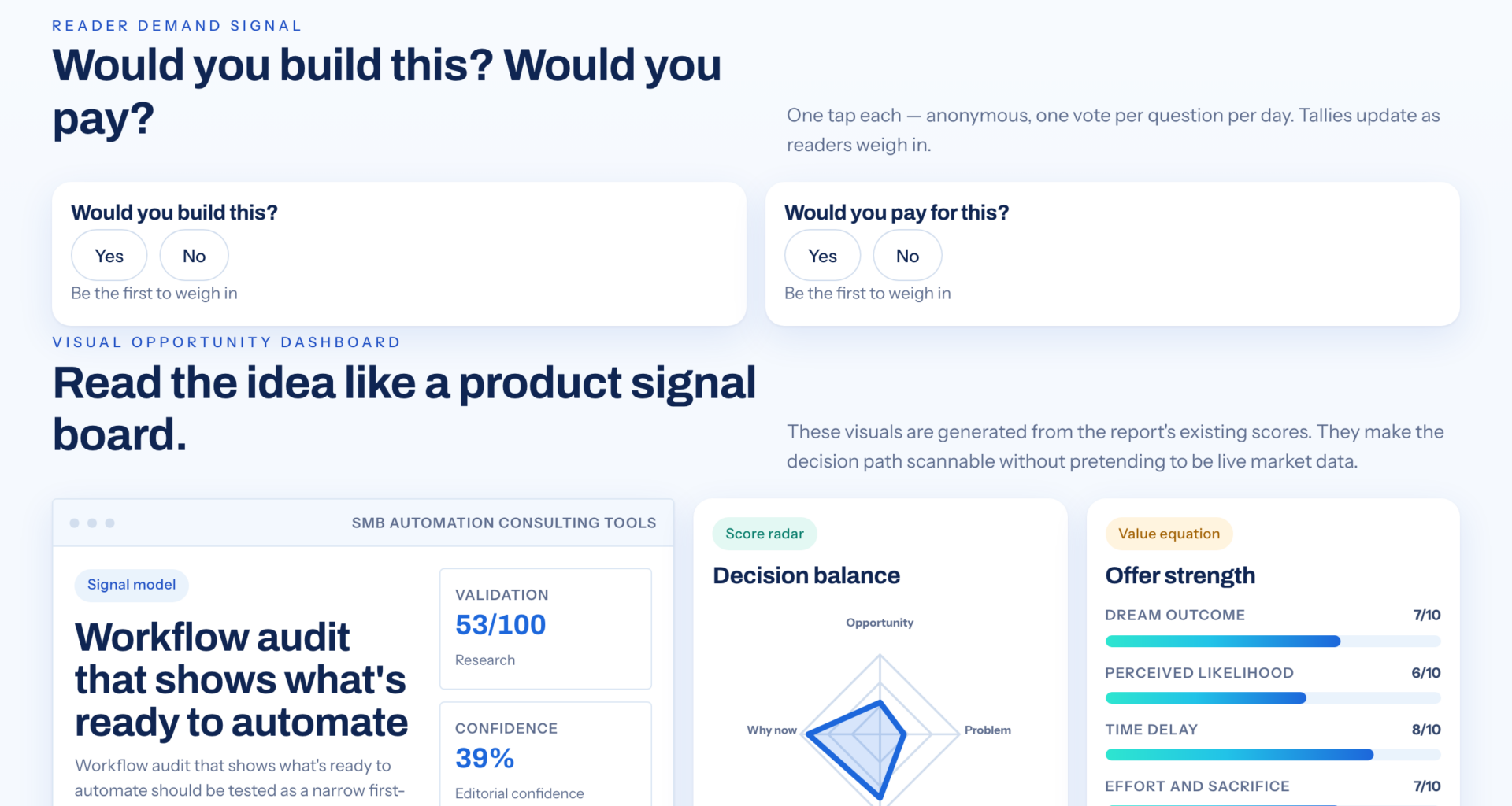

📊 Full opportunity report: What To Automate First: A Practical Workflow Audit on IdeaNavigator AI — validation score, market gap, and execution plan.

Get business pricing on tech for your team
- Business-only prices and quantity discounts
- Tax-exempt purchasing
- Multiple users, one account, clear invoices
TL;DR
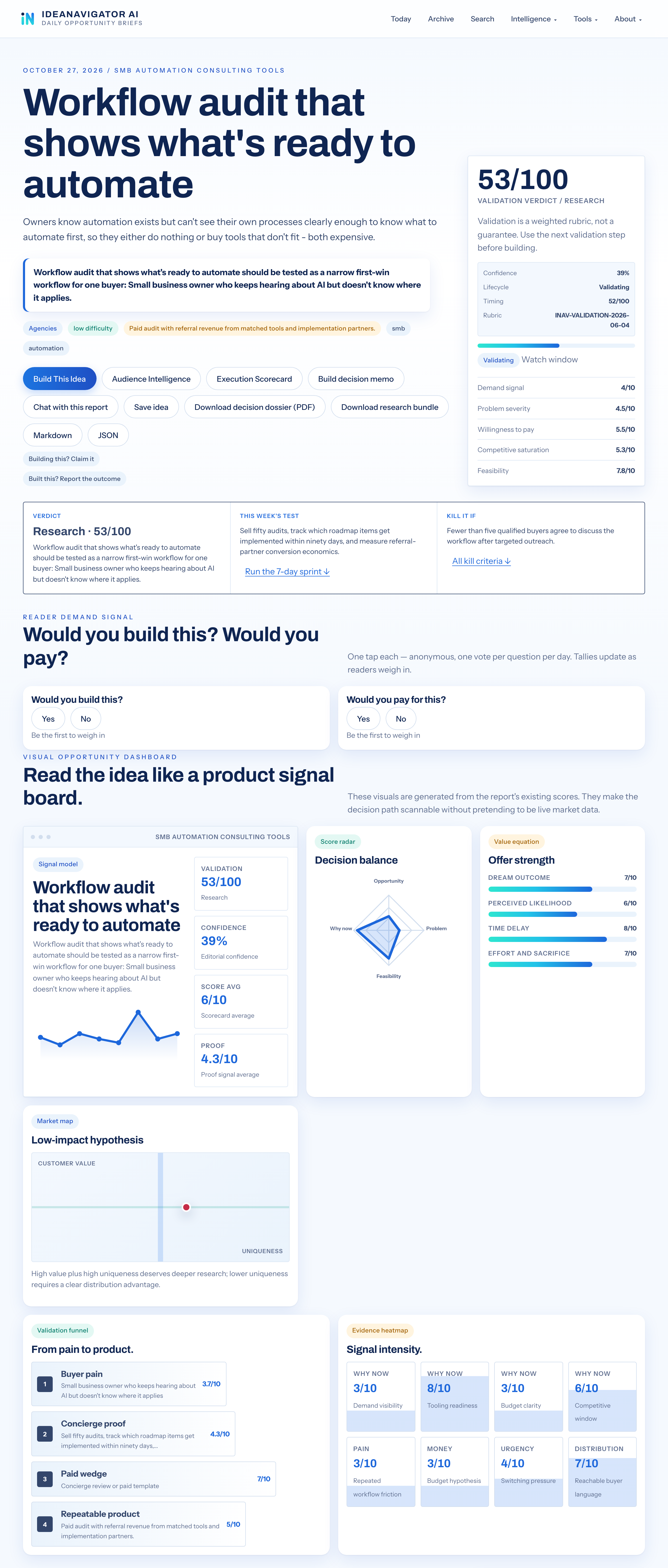
IdeaNavigator AI’s proposal describes a workflow-audit product for small-business owners who are unsure where automation fits. The concept would interview an owner, map processes, rank them by readiness, return and difficulty, and suggest a 90-day plan. The proposal outlines a commercial test, but provides no customer results or validation of the business case.
IdeaNavigator AI has proposed a paid workflow audit intended to help small-business owners decide which processes to automate first. In its published concept, the company describes a guided interview, a scored process map and a sequenced 90-day roadmap. The material does not report a completed product, customer results or a launch date.
IdeaNavigator AI describes the intended customer as a small-business owner who hears about AI and automation but is unsure which everyday tasks could benefit. The proposal identifies two potential risks: owners may postpone decisions or pay for tools that do not match their operations. These are the proposal’s stated rationale, not measured findings about small-business spending or adoption.
The proposed minimum viable product would interview an owner about business operations, then create a process map assessing each opportunity for automation readiness, potential return on investment and implementation difficulty. It would arrange recommendations into a 90-day sequence and match individual steps with possible tools. The published description does not specify how scores would be calculated or how recommendations would be independently checked.
IdeaNavigator AI proposes combining audit fees with referral revenue from recommended software and implementation partners. Its stated validation test is to sell 50 audits, track which roadmap items customers implement within 90 days, and assess referral-partner conversion economics. These are proposed targets; the material does not say the audits have been sold or provide conversion results.
From AI Interest to Process Choices
The proposal focuses on deciding which task a business should address first. It says a process map tied to expected return and difficulty could help owners compare options before selecting software. The material does not provide evidence that the approach improves decisions or outcomes.
The proposed commercial test would track whether customers implement recommendations within 90 days. That measure could show whether customers act on the audit, but the proposal does not set a benchmark for success or compare results with independent tool selection.
The proposed referral model could create a conflict of interest if the audit earns revenue when customers choose recommended tools. IdeaNavigator AI identifies referral revenue as part of the model but does not describe disclosure rules, ranking safeguards or whether customers could receive recommendations without purchasing through a partner.
Products Worth Considering

Logitech MX Keys Combo for Business Keyboard and Mouse – Graphite

Bose SoundLink Plus Portable Bluetooth Speaker, Black

Samsung Galaxy Tab A11 8.7-Inch Wi-Fi Tablet, 64GB, 4GB RAM, Silver
As an affiliate, we earn on qualifying purchases.
Why Small Firms Need Priorities
IdeaNavigator AI presents the proposal against what it describes as an expansion of AI tools that can leave owners unsure how to choose among them. The company proposes structured process mapping through a guided interview, with large language models potentially helping to conduct the interview and organize responses. This describes the product rationale; the material does not establish that an AI system has completed the proposed audit reliably.
The company frames the service as part of the small-business automation consulting-tools market. Unlike a product designed for one task, the proposed audit would begin with a business’s operations and produce prioritized possible interventions. The available description does not identify a target industry, provide a market-size estimate, compare existing services or show that owners will pay for the format.
According to the proposal, the next step would be validation through paid use, rather than a rollout already underway. The product outline describes intended features and revenue streams, but does not establish demand, savings or implementation success.
Demand, Scoring and Referral Safeguards
IdeaNavigator AI’s published proposal provides no customer results. It remains unknown whether owners will pay for an audit, whether interview answers will support useful process maps, or how often customers will act on recommendations within the proposed 90-day window.
The proposal does not define its scoring method. It does not explain what qualifies as automation-ready, how return on investment would be estimated, which costs would be included, or how errors and ongoing maintenance would be considered. The material also does not describe tool matching, data handling or the role of human review.
The proposal provides no details on referral economics or safeguards, including partner selection, commission disclosure or how products from companies that do not pay for referrals would be presented. Without those details, readers cannot assess the independence of recommendations or how the service would evaluate its performance.
The Proposed 50-Audit Test
IdeaNavigator AI’s stated validation plan is to sell 50 audits, then track which roadmap recommendations are implemented during the following 90 days. The company also proposes measuring referral-partner conversion economics. The material does not give a timetable or say whether sales have begun.
To assess the test’s results, reporting could distinguish completed implementations from plans, record associated costs and time, and explain how the audit estimates business returns. Disclosure of referral arrangements and how alternatives are assessed would also help customers evaluate the recommendations.
The workflow audit remains a product proposal in the material provided; no customer evidence is reported. A future milestone would be results from paying customers showing whether the process map informs tool choices and implementation.
Source: IdeaNavigator AI
Key Questions
What is the proposed workflow audit?
It is a proposed paid service that would interview a small-business owner, map business processes, score possible automation projects and suggest a 90-day sequence of steps and tools.
Is the audit already available?
The available description presents a proposed minimum viable product and a validation plan. It does not confirm a launch, availability or completed customer audits.
How would the service make money?
The proposed model combines payment for the audit with referral revenue from matched software tools and implementation partners. Commission terms and disclosure practices are not specified.
How would the idea be tested?
The proposal calls for selling 50 audits, tracking which recommendations are implemented within 90 days and measuring referral-partner conversion economics. No results or schedule for the test are reported.
Source: IdeaNavigator AI