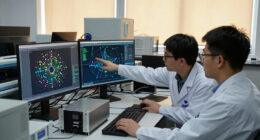

📊 Full opportunity report: World Model Readiness: Are You Ready for AI That Acts? on ThorstenMeyerAI.com — validation score, market gap, and execution plan.

Get business pricing on tech for your team
- Business-only prices and quantity discounts
- Tax-exempt purchasing
- Multiple users, one account, clear invoices
TL;DR
AI development is shifting from language models to world models that predict and act within environments. A new diagnostic tool helps organizations evaluate their readiness for this transition, which could significantly impact operational safety and decision-making.
AI systems capable of predicting and acting in real-world environments are emerging rapidly, prompting the introduction of a new diagnostic tool called World Model Readiness. This tool aims to help organizations evaluate whether they are prepared to adopt AI that moves beyond language prediction to environment understanding and decision-making, a shift that could transform operational safety and efficiency.
The concept of world models involves AI systems that build internal representations of how environments function, enabling them to predict future states and respond accordingly. This development is backed by significant industry activity: Yann LeCun’s startup, AMI Labs, has raised approximately one billion dollars to develop such models. Additionally, major players like Google DeepMind with its Genie 3 system, Meta with V-JEPA 2, and others including Nvidia and Waymo are actively pursuing research and applications in this area.
By early 2026, the field has shifted from research curiosity to a potential industry revolution, with many labs aiming to create systems capable of understanding physical environments, predicting outcomes, and executing actions. This transition raises questions about operational readiness, as moving from language-based suggestions to environment-aware actions involves complex challenges such as data collection, process modeling, supervision, and safety calibration.
The World Model Readiness diagnostic is designed not to build models but to assess whether organizations have the necessary data, processes, supervision, and understanding to effectively deploy such systems. It emphasizes the importance of calibration and awareness of current limitations, including the ‘reality gap’ between simulation and real-world performance.
World Model Readiness — are you ready for AI that acts?
LLMs describe. World models predict and act. The next AI shift isn’t “have we adopted a chatbot” — it’s whether you’d know what to do with a model that anticipates consequences.
Independent commentary, produced with AI assistance under human editorial oversight. The views are the author’s own and may change. World Model Readiness is an early, positioning-stage diagnostic — an assessment framework, not a prediction, guarantee, or technical advice; its conclusions depend on the framework’s assumptions. “World models” are an emerging, rapidly-evolving area of AI; statements about the field reflect publicly reported developments as of mid-2026 and may quickly date. References to companies, labs, and products describe public reporting and imply no affiliation, endorsement, or verification. Product, model, and company names are trademarks of their respective owners.
Implications of Transitioning to Action-Oriented AI
This shift toward AI that can predict and act has profound implications for industries relying on automation, robotics, and decision support. Organizations that are unprepared risk deploying systems that may act unpredictably or cause unintended consequences. The diagnostic provides a way to identify gaps in data, process modeling, and oversight, helping organizations avoid costly mistakes and build safer, more reliable AI systems.
Furthermore, understanding and addressing the calibration and reality gap is critical. Without proper assessment, organizations may overestimate their readiness, leading to failures or safety hazards. The diagnostic aims to prevent such issues by fostering honest evaluation and targeted preparation, rather than panic-driven overhauls.
AI environment simulation software
As an affiliate, we earn on qualifying purchases.
As an affiliate, we earn on qualifying purchases.
Rapid Industry Adoption and Research Momentum
Over the past three years, the AI community has shifted focus from language models that generate text to world models that understand physical environments and predict future states. Notable milestones include Yann LeCun’s departure from Meta to found AMI Labs, and the release of systems like Genie 3, which can generate real-time, photorealistic 3D worlds from prompts. Major corporations such as Google DeepMind, Meta, Nvidia, and Waymo are investing heavily in this area, signaling a broad industry push toward environment-aware AI systems.
This momentum has led to a growing recognition that the next frontier involves AI that can perceive, understand, and act within complex environments, moving beyond the capabilities of current large language models. While promising, these systems are still in early stages, with significant technical and safety challenges remaining, especially around the ‘reality gap’ and model calibration.
“The move from description to action in AI fundamentally changes what organizations need to be prepared for—it’s not just about adopting new tools, but about rethinking processes and safety measures.”
— Thorsten Meyer, AI researcher
As an affiliate, we earn on qualifying purchases.
Current Limitations and Unknowns in World Model Deployment
While progress is evident, significant uncertainties remain. Most current systems are data- and compute-intensive, with limited success outside constrained environments like games or simulations. The ‘reality gap’ — the difference between simulation and real-world performance — remains a major obstacle. It is not yet clear how quickly or reliably organizations can bridge this gap or how well current models will perform in unpredictable, real-world settings.
Additionally, the specifics of how organizations should implement oversight, safety protocols, and calibration for environment-aware AI are still evolving. The diagnostic tool itself is in early stages, and its effectiveness across diverse industries and operational contexts is yet to be validated.
AI data collection and modeling hardware
As an affiliate, we earn on qualifying purchases.
As an affiliate, we earn on qualifying purchases.
Next Steps for Organizations Preparing for Action-Oriented AI
Organizations should begin evaluating their data infrastructure, process modeling capabilities, and safety protocols to determine their world model readiness. Industry leaders are expected to pilot and refine the diagnostic in diverse operational contexts, helping to establish best practices. Meanwhile, research will continue addressing core challenges like the reality gap and model calibration.
In the coming months, expect further developments in AI systems that can perceive and act, alongside increased emphasis on safety, oversight, and standards for deployment. Companies that proactively assess their preparedness will be better positioned to leverage this transformative shift.
AI decision-making diagnostic tools
As an affiliate, we earn on qualifying purchases.
As an affiliate, we earn on qualifying purchases.
Key Questions
What is a world model in AI?
A world model is an AI system that builds an internal representation of how an environment functions, allowing it to predict future states and respond accordingly, moving beyond simple language prediction to actual environment understanding and action.
Why is readiness for AI that acts important now?
As AI systems begin to predict and act within real environments, organizations need to understand whether they have the data, processes, and safety measures in place to deploy these systems safely and effectively, avoiding potential failures or hazards.
What does the World Model Readiness diagnostic assess?
It evaluates whether an organization has the necessary data, process models, supervision, and calibration practices to deploy environment-aware AI systems, and identifies gaps that could hinder safe and effective implementation.
Are current systems ready for real-world deployment?
Most current systems are still in early stages, with significant challenges like the reality gap and limited success outside controlled environments. Readiness varies across organizations and industries, and ongoing research aims to address these limitations.
What should organizations do next to prepare?
They should assess their data infrastructure, process modeling, and safety protocols, and consider using the World Model Readiness diagnostic to identify gaps and develop strategies for safe deployment of environment-aware AI systems.
Source: ThorstenMeyerAI.com
Halloween Picks
halloween
As an affiliate, we earn on qualifying purchases.