TL;DR
OpenAI began rolling out ChatGPT Wallet on November 13, 2026, allowing eligible ChatGPT Pro users in the United States to approve purchases by its dots agents. Each purchase requires a user review and security check, while merchants receive a payment token instead of the actual card number. Spending limits and purchases without individual approval are not available at launch.
OpenAI launched ChatGPT Wallet on November 13, letting eligible U.S. ChatGPT Pro subscribers authorize its dots agents to pay for items they find and place in a store’s online cart. Every purchase still requires the user to review the order and approve it with a security check, while a card-network token is used in place of the shopper’s actual card number.

Get business pricing on tech for your team
- Business-only prices and quantity discounts
- Tax-exempt purchasing
- Multiple users, one account, clear invoices
The initial rollout is limited to ChatGPT Pro subscribers aged 18 or older in the United States with eligible U.S.-issued cards. OpenAI’s announcement says Wallet begins in dots, its cloud-based agents, while an OpenAI news feed refers more broadly to agents in ChatGPT Work and Codex. The supplied launch reporting says those other settings are not included yet.
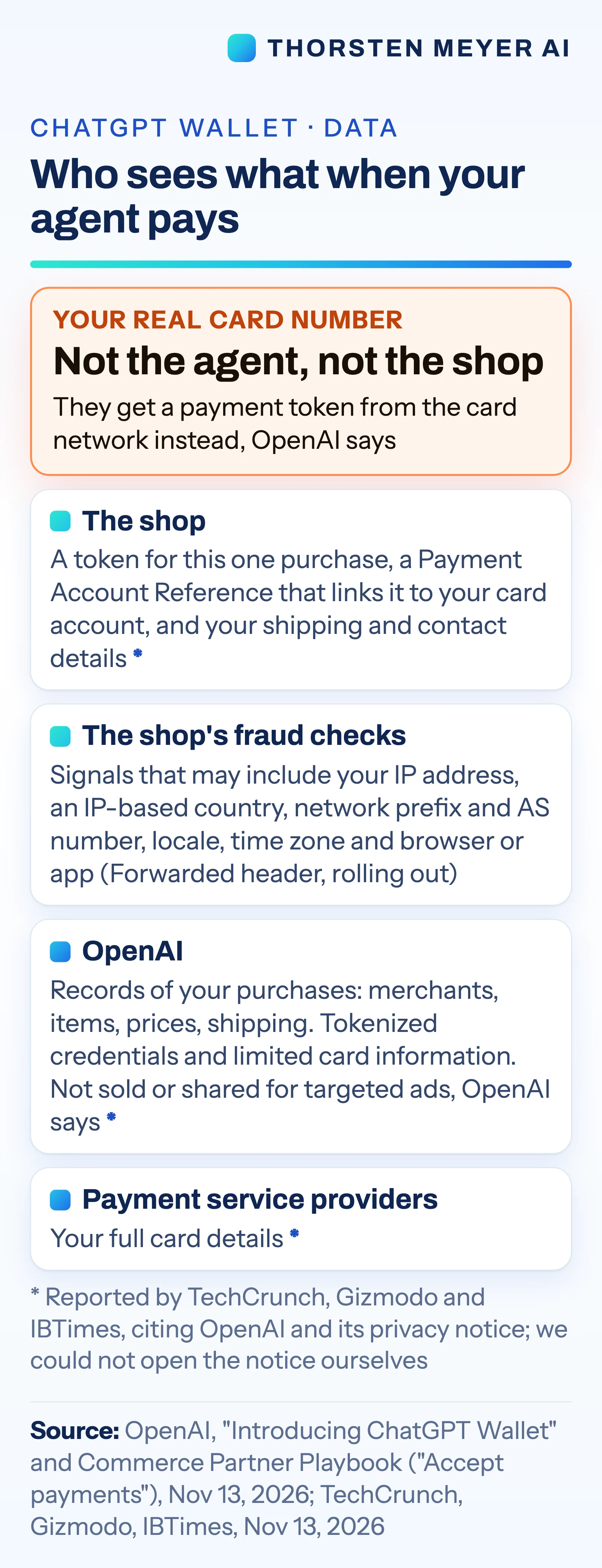
For a purchase, a dot visits a merchant’s website, finds an item and fills the cart. The Wallet screen then shows the items, total and selected card. After the user approves with a security check such as Face ID or a fingerprint, the card network issues a payment token with its own card number, security code and expiration date. The merchant charges that token; OpenAI says neither the merchant nor the agent sees the real card details.
The merchant still receives order information and may receive signals used for fraud checks, including an IP-based country and time zone. OpenAI says the approval leaves a record. Returns and customer service remain with the merchant, and eligible disputes use protections already attached to the card. OpenAI’s merchant guidance says, “Customers are ultimately responsible for the actions they take.”
Agents Reach the Payment Step
Wallet adds payment authorization to an agent workflow that could already research products and fill a cart. That moves dots closer to completing online shopping tasks on a user’s behalf, while leaving a person in the approval loop for each transaction. The distinction matters: at launch, the agent can prepare a purchase, but it cannot independently authorize payment.
The design also divides responsibility across several parties. OpenAI supplies the agent and approval flow; card networks issue the payment token; and the merchant fulfills the order and handles returns and service. Card protections may apply to eligible disputes, according to OpenAI, but the announcement does not describe a new OpenAI-run refund or support process.
Whether this makes agent-led shopping reliable in practice is still an open question. The source material says many websites and fraud systems may block or decline purchases made by agents. A token protects the actual card number from the merchant and agent, but it does not guarantee that a store will accept an agent’s checkout or that a disputed order will be resolved in a particular way.
Products Worth Considering

Bose SoundLink Plus Portable Bluetooth Speaker, Black

Bose TV Speaker Compact Soundbar with Bluetooth and HDMI-ARC, Black

Amazon Kindle Scribe (16GB) with Premium Pen, Tungsten
As an affiliate, we earn on qualifying purchases.
From Product Research to Checkout
OpenAI describes dots as always-on agents that operate in the cloud with their own computer and browser, so they can continue working while a user’s computer is off. Before Wallet, those agents could research products and prepare carts; payment was the step requiring a user to handle checkout directly. Wallet adds a confirmation step for that payment.
OpenAI calls the service “the first wallet that lets agents pay without access to users’ actual card details and that requires a security check for every purchase, while also preserving existing card rewards and protections for eligible disputes.” That is OpenAI’s characterization. The source material notes that critics question how novel the approach is, but supplies no detailed comparison to substantiate or resolve that criticism.
The launch follows an earlier OpenAI shopping feature. IBTimes reports that the company introduced Instant Checkout in September 2025 for selected products bought in chat. The Decoder reports that OpenAI later dropped it as insufficiently flexible and developed Wallet. Those accounts provide background; the current launch announcement establishes the new service’s initial scope and approval process.
““An agent making a purchase should strengthen, not bypass, the trust built into payments.””
— Sherri Haymond, Mastercard’s head of digital commercialization
Limits and Merchant Acceptance
OpenAI has not made spending limits or pre-approved purchases available. The company says it expects to add them “over time,” but has not provided a schedule or details about how users will set those controls.
The supplied material does not list every eligible card or explain how availability will expand beyond U.S. Pro subscribers using dots. It also does not specify what happens if a merchant rejects an agent-assisted checkout, or give evidence on how often agent purchases are blocked by store or fraud systems. The source says such declines remain a practical obstacle.
OpenAI presents card rewards and existing protections as preserved for eligible disputes. The announcement, as summarized in the source material, does not detail which protections apply in each case, how responsibility is divided when an agent makes an error, or whether the service adds any separate dispute process. Those questions may become clearer as the limited rollout develops.
A Limited Rollout Comes First
OpenAI says it is starting with a limited group of ChatGPT Pro users to learn from real-world use. The immediate next step is wider experience with eligible users and participating card products, though the source material gives no date for broader access.
OpenAI has said additional controls, including spending limits and pre-approved purchases, are expected “over time.” Until those features arrive, users must review and approve every purchase individually. Merchants’ acceptance of agent-driven checkout and the handling of orders that fail or lead to disputes will also shape how useful Wallet is in practice.
Key Questions
Who can use ChatGPT Wallet at launch?
The initial rollout is for ChatGPT Pro subscribers aged 18 or older in the United States with eligible U.S.-issued cards, using dots.
Can a dot buy something without my approval?
No. At launch, every purchase requires the user to review the items, total and selected card, then approve with a security check such as Face ID or a fingerprint.
Does the merchant see my actual card number?
OpenAI says the merchant charges a payment token issued by the card network, rather than receiving the actual card number. The merchant still receives order details and may receive fraud-check signals such as an IP-based country and time zone.
Who handles returns and payment disputes?
The merchant handles returns and customer service. OpenAI says eligible disputes use the card’s existing protections; the supplied launch details do not describe a separate OpenAI dispute process.
Are spending limits available?
Not at launch. OpenAI says spending limits and pre-approved purchases are planned “over time,” without announcing a release date.
Source: Thorsten Meyer AI