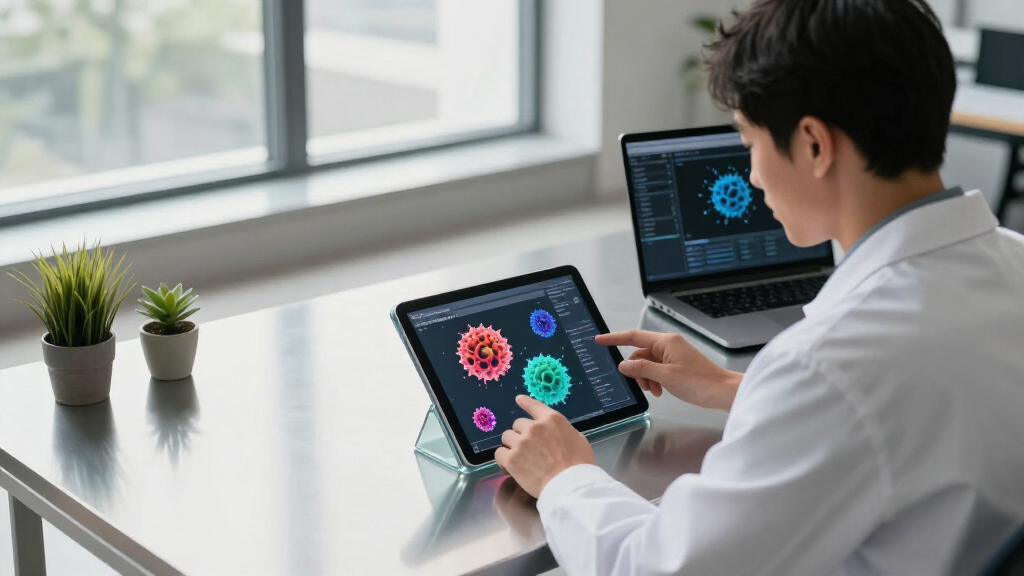

📊 Full opportunity report: Unveiling 'SINGULARITY': Particle Geometry Mapping And Its Role In AI Evolution on ThorstenMeyerAI.com — validation score, market gap, and execution plan.
Listen free for 30 days with Audible
Thousands of audiobooks and originals — cancel anytime.
Start your free trialAs an affiliate, we earn on qualifying purchases.
TL;DR
The ‘SINGULARITY’ project introduces Particle Geometry Mapping to create immersive AI-driven environments. This innovation aims to shape the future of intelligent spaces by integrating advanced algorithms with visionary design.
‘SINGULARITY’ is a groundbreaking design project that demonstrates the application of Particle Geometry Mapping to create immersive, AI-driven environments. Developed as a case study, it explores how advanced algorithms and innovative design converge to influence the future of intelligent spaces, making it a notable development in AI and digital art.
The project, detailed by Thorsten Meyer, transforms a stark black room into a visual symphony of data and geometry through precise technical techniques. Particle Geometry Mapping is used to breathe life into abstract concepts, enabling the creation of environments that challenge traditional notions of form and function.
According to Meyer, every element in the space is meticulously crafted, balancing technical complexity with aesthetic clarity. The design process navigates complex challenges, integrating data, algorithms, and artistic vision to produce a seamless experience that exemplifies the potential of AI in creative environments.
While the project is primarily a conceptual showcase, it hints at future applications where such techniques could underpin real-world AI interfaces, intelligent spaces, and data visualization tools.
AI Environment Design / Case Study
Unveiling ‘SINGULARITY’
Particle Geometry Mapping turns abstract data into spatial form—combining algorithms, computational geometry and artistic direction to imagine a more immersive generation of intelligent environments.
01 / The mechanism
Data becomes geometry
Particle Geometry Mapping translates data points and algorithmic relationships into spatial structures. In SINGULARITY, the technique transforms a stark black room into a visual system where information can be perceived as form, motion and atmosphere.
Signals are decomposed
Complex datasets and AI processes are broken into addressable points, relationships and changing values.
Rules create structure
Mapping algorithms determine density, position, scale and behavior while preserving the meaning behind the source data.
Geometry becomes experience
Particles resolve into dynamic spatial forms that make invisible processes more intuitive, expressive and navigable.
02 / AI evolution
Where the concept could matter
SINGULARITY suggests a route beyond flat dashboards: AI systems whose logic is communicated through responsive environments. The opportunity is strongest where complex information must become understandable at a glance.
Readiness spectrum
No deployment timeline, commercial product or industry partnership has been announced. Practical adoption will require interactive prototypes, performance testing and scalable tooling.
03 / Comparative view
From screen to spatial interface
The project’s central proposition is not simply visual spectacle. It is a shift in how users might encounter data, algorithms and automated decisions—moving from static representation toward responsive, environmental communication.
| Design characteristic | Traditional dashboard | Particle geometry space | Current evidence |
|---|---|---|---|
| Spatial data representation | ✗ Limited | ✓ Native | Demonstrated conceptually |
| Immersive interpretation | ~ Partial | ✓ Central | Visual case study |
| Dynamic AI process display | ~ Possible | ✓ Intended | Requires interactive testing |
| Commercial scalability | ✓ Established | ~ Unclear | No rollout announced |
| Hardware independence | ✓ Strong | ~ Variable | Implementation-dependent |
Assessment reflects the project’s reported conceptual status, not a validated commercial benchmark.
04 / Development path
What must happen next
The path from digital-art case study to useful AI environment depends on proving that spatial beauty can preserve accuracy, improve comprehension and remain responsive with real-world datasets.
Increase data complexity
Test whether mappings remain legible as datasets become larger, faster and more multidimensional.
Build responsive prototypes
Allow users and AI systems to manipulate the geometry through movement, questions and live inputs.
Measure understanding
Compare comprehension, cognitive load and decision quality against conventional interfaces.
Pilot practical spaces
Explore controlled applications in VR, AR, visualization labs and responsive smart environments.
The SINGULARITY traceability chain
05 / Key questions
What the project establishes—and what it does not
SINGULARITY offers a compelling design direction, but its longer-term significance depends on evidence from functioning interfaces and real users.
What is Particle Geometry Mapping?
A technique that translates data points and relationships into spatial forms for dynamic visualization, interactive environments and digital installations.
How could it influence AI design?
It could make complex AI processes more visible and intuitive by embedding information in responsive geometry instead of limiting it to conventional screens.
Is it commercially ready?
Not yet. The reported work remains conceptual, with scalable tools, deployments and commercial partnerships still unannounced.
Where could it appear first?
Likely test environments include data-visualization labs, virtual and augmented reality, interactive exhibitions and experimental smart spaces.
Implications of Particle Geometry Mapping for AI-Driven Spaces
This development matters because it pushes the boundaries of how AI environments are designed and experienced. By integrating Particle Geometry Mapping, the project offers a new way to visualize complex data and algorithms, potentially transforming fields like data visualization, virtual reality, and smart environments. It demonstrates a tangible step toward more immersive, intelligent spaces that could enhance human-AI interaction and automation.
Furthermore, this approach could influence future AI architecture, enabling more intuitive and visually engaging interfaces that better communicate complex processes to users. The project underscores the importance of combining artistic creativity with technical innovation in shaping the future of AI environments.
As an affiliate, we earn on qualifying purchases.
Background and Technological Foundations of SINGULARITY
The ‘SINGULARITY’ project builds on recent advances in algorithmic art, data visualization, and immersive design. Particle Geometry Mapping, a technique that translates data points into spatial forms, has gained attention for its ability to produce complex, dynamic visuals. This approach has been explored in digital art but now finds a new application in AI environment design.
Developed by Thorsten Meyer and his team, the project emerged as a response to increasing demands for more engaging AI interfaces that go beyond traditional screens and static visuals. It follows a broader trend of integrating artistic principles with technical innovation to create environments that are both functional and aesthetically compelling.
While the project is still in a conceptual stage, it draws from established fields such as computational geometry, data science, and interactive design, aiming to bridge these disciplines into practical applications.
“Particle Geometry Mapping allows us to visualize data and AI processes in ways that are both intuitive and aesthetically compelling.”
— Thorsten Meyer
As an affiliate, we earn on qualifying purchases.
Unconfirmed Practical Applications and Future Development
It is not yet clear how soon Particle Geometry Mapping techniques like those in ‘SINGULARITY’ will be adopted for real-world AI environments or commercial applications. The project remains primarily a conceptual showcase, and no specific deployment timelines or industry partnerships have been announced. Further development is needed to translate this design into scalable, practical tools for broader use.
immersive AI environment design software
As an affiliate, we earn on qualifying purchases.
As an affiliate, we earn on qualifying purchases.
Next Steps for Advancing AI Environment Design
Future developments may include refining Particle Geometry Mapping for more complex data sets and testing its integration into interactive AI interfaces. Researchers and designers are likely to explore how this technique can be adapted for virtual reality, augmented reality, and smart spaces. The next milestone could be prototype applications or pilot projects that demonstrate practical utility beyond conceptual art.
digital art and data visualization tools
As an affiliate, we earn on qualifying purchases.
As an affiliate, we earn on qualifying purchases.
Key Questions
What is Particle Geometry Mapping?
Particle Geometry Mapping is a technique that translates data points into spatial forms, creating dynamic visualizations that can be integrated into AI environments and art installations.
How does ‘SINGULARITY’ influence AI design?
It introduces a new method for visualizing complex AI processes and data, potentially leading to more immersive and intuitive AI interfaces in the future.
Is this technology ready for commercial use?
Currently, ‘SINGULARITY’ is a conceptual project. Practical, scalable applications are still in development and have not yet been announced.
What industries could benefit from this innovation?
Data visualization, virtual reality, augmented reality, and smart environment design are among the fields that could benefit from advances like Particle Geometry Mapping.
When might we see real-world applications?
It remains uncertain; further research and development are needed before practical applications become available.
Source: ThorstenMeyerAI.com
NFL season / tailgating Picks
team gear
As an affiliate, we earn on qualifying purchases.

![Kimi-K3 Technical Report [Pdf]](https://auto-blogging.com/wp-content/uploads/2026/07/kimi-k3-technical-report-pdf-featured-560x300.jpg)