

To train custom AI models for niche content effectively, focus on ongoing evaluation of performance metrics like accuracy and precision, using representative datasets. Use targeted data augmentation techniques—such as image transformations or paraphrasing—to boost diversity without sacrificing relevance. Continuously refine your approach by monitoring results after each augmentation cycle, ensuring your model adapts to unique niche challenges. Keep optimizing and expanding your data strategies to develop a reliable, specialized AI that truly understanding your niche’s nuances.
Key Takeaways
- Use representative, niche-specific datasets for targeted model training and accurate predictions.
- Apply data augmentation techniques to increase diversity and prevent overfitting.
- Continuously evaluate model performance with relevant metrics on validation and test sets.
- Iteratively refine the model by combining evaluation results with tailored augmentation strategies.
- Maintain an ongoing cycle of data collection, evaluation, and augmentation for sustained improvement.

Have you ever wondered how to create an AI model tailored specifically to your needs? Building a custom AI model for niche content requires more than just feeding it data; it involves careful evaluation and strategic data handling. One of the first steps is understanding how to assess your model’s performance through rigorous model evaluation.
This process helps you identify whether your model is learning correctly or if it’s overfitting or underperforming. During evaluation, you’ll use metrics like accuracy, precision, recall, and F1 score to measure how well your model predicts or classifies your specific niche data. It’s vital to set aside validation and test datasets that truly represent your niche content to get an honest picture of your model’s capabilities.
Evaluating your model with proper metrics and representative datasets ensures accurate, reliable niche content predictions.
To improve your model’s robustness, data augmentation plays a pivotal role. Data augmentation involves artificially increasing the size and diversity of your training data, which is especially valuable when working with limited or highly specialized datasets.
By applying techniques such as flipping images, adding noise, or adjusting parameters like brightness and contrast, you help your model learn to generalize better. This process prevents overfitting, where the model memorizes training data but performs poorly on new, unseen content.
For text-based niche content, data augmentation might mean paraphrasing sentences, swapping synonyms, or altering sentence structures. These strategies help your model understand variations within your niche, making it more adaptable and accurate when faced with real-world data.
Additionally, understanding the weight of wind turbine blades can inform how different design choices impact the robustness of models related to renewable energy, ensuring your AI is aligned with real-world technical factors.
As you progress, it’s important to continuously evaluate your model after each round of data augmentation. This iterative process allows you to see how your adjustments impact performance and helps identify the most effective augmentation techniques for your specific niche.
Remember, data augmentation isn’t just about increasing data volume — it’s about enriching the diversity of your dataset to make your model more resilient. When combined with consistent model evaluation, these strategies guarantee you’re building an AI that truly understands and performs well within your niche content.
Finally, keep in mind that creating a custom AI model isn’t a one-time task. It’s an ongoing process of refinement. As you gather more niche-specific data, revisit your evaluation metrics and apply targeted data augmentation.
This continuous cycle helps your model evolve, becoming more accurate and dependable over time. By focusing on thorough model evaluation and smart data augmentation, you set yourself up for success in deploying a tailored AI that meets your unique needs, whether you’re automating specialized content generation or developing niche-specific prediction tools.

Bluetooth Thermal Shipping Label Printer: 4x6 Wireless Label Maker with Tape for Small Business - Compatible with iPhone, Android, Windows & Mac, Widely Used for USPS UPS Ebay Amazon Shopify Etsy
Multi-Label Size Support: Supports thermal labels with a width of 1.57" to 4.3", Compatible with 4x6, 3x2, and...
As an affiliate, we earn on qualifying purchases.
Frequently Asked Questions
How Long Does It Typically Take to Train a Niche AI Model?
It typically takes anywhere from a few days to several weeks to train a niche AI model. You’ll need to gather sufficient training data and run multiple model iterations to improve accuracy.
The exact time depends on factors like data quality, model complexity, and computational resources. By continuously refining your training data and optimizing each iteration, you can achieve a more effective model within your desired timeframe.
What Are the Costs Associated With Training Custom AI Models?
The costs for training custom AI models vary based on factors like data quality, model complexity, and infrastructure. You should do a thorough cost analysis to understand expenses for hardware, cloud services, and talent.
Effective budget planning helps you allocate resources efficiently, avoiding surprises. Keep in mind, investing in quality data and tools can reduce long-term costs, ensuring your niche content AI performs well without overspending upfront.
Can I Update My AI Model With New Niche Data Later?
Yes, you can update your AI model with new niche data later, like adding fresh leaves to a tree. You’ll perform model updating through data integration, feeding in the latest information to keep it sharp.
This process helps your AI stay relevant and accurate, adapting to evolving trends. Just make certain you have quality data and a plan for seamless integration, so your model continues to grow and thrive.
How Do I Evaluate the Accuracy of My Custom AI Model?
To evaluate your custom AI model’s accuracy, start with model validation by testing it on a separate dataset you haven’t trained on.
Use error analysis to identify where it struggles or makes mistakes. Look for patterns in errors to refine your model further.
This process helps you verify your model performs well and maintains high accuracy in niche content, giving you confidence in its real-world application.
What Are Common Challenges Faced During Niche AI Training?
You’ll often face data scarcity, making it hard to train your niche AI effectively. Bias mitigation is another challenge, as limited or skewed data can lead to inaccurate or unfair results.
You need to gather diverse data sources and use techniques like data augmentation or transfer learning to overcome these issues. Being mindful of these challenges helps you improve your model’s accuracy and fairness in specialized content areas.
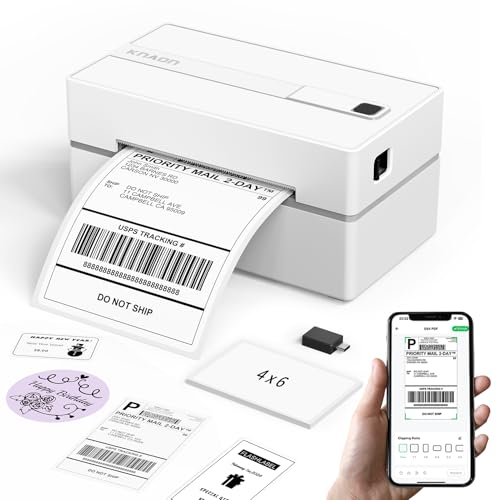
KNAON Bluetooth Thermal Shipping Label Printer, 4x6 Portable Thermal Address Label Printer for Small Business, Compatible with iPhone,Android,Windows,Mac–Works with Etsy Shopify USPS&More, White
Bluetooth Wireless Connection: KNAON Bluetooth shipping label printer enables wireless printing. For iOS and Android users, need to...
As an affiliate, we earn on qualifying purchases.
Conclusion
By mastering the art of training custom AI models for niche content, you unleash a power so immense it could revolutionize your entire industry. Imagine creating an AI so tailored, so precise, that it outperforms every competitor and dominates your market like a unstoppable force. Don’t hold back—this is your moment to harness technology that can change everything. Step into the future confidently, because with your own custom AI, nothing can stand in your way!

Nelko Bluetooth Thermal Shipping Label Printer, Wireless 4x6 Shipping Label Printer for Shipping Packages, Support Android, iPhone and Windows, Widely Used for Amazon, Ebay, Shopify (Black)
Go Wireless by Bluetooth: Download the "NELKO"app to print via Bluetooth on your Nelko Bluetooth thermal label printer...
As an affiliate, we earn on qualifying purchases.

PEDOOLO Label Printer, 4x6 Shipping Label Thermal Printer for Packages, Bluetooth Conection and Compatible with Android. iPhone.Windows, Mac, Chromebook, Amazon, Ebay, UPS.USPS, FedEx, Shopify
【Wireless & Support for Multi-Systems】PEDOOLO thermal printer prints wirelessly. For iPhone and Android, download the App “Label Expert”...
As an affiliate, we earn on qualifying purchases.