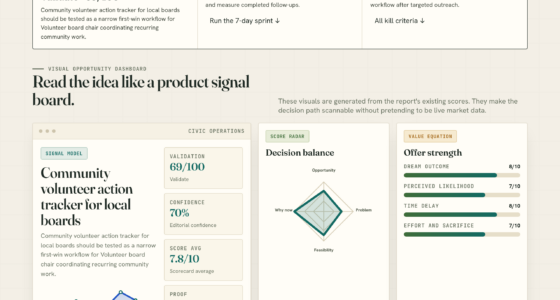

📊 Full opportunity report: The Channel Move: Anthropic, Wall Street, and the Acquisition of the Real Economy on ThorstenMeyerAI.com — validation score, market gap, and execution plan.
TL;DR
Anthropic and major private equity firms have formed a $1.5 billion joint venture to embed AI directly into the operations of thousands of portfolio companies. This move aims to standardize and accelerate enterprise AI deployment at scale, bypassing traditional sales channels. The development signals a significant shift in how AI is integrated into the real economy.
Anthropic, Blackstone, Hellman & Friedman, Goldman Sachs, and General Atlantic have jointly announced a $1.5 billion venture to embed Anthropic’s Claude AI directly into thousands of companies within their portfolios, marking a major shift in enterprise AI deployment.
The joint venture involves roughly $300 million from each of the four private equity firms, with Goldman Sachs contributing approximately $150 million. The initiative will create a consulting and implementation arm modeled after Palantir’s forward-deployed engineer approach, aimed at deploying AI across the operating businesses owned by these firms.
This effort targets thousands of companies, integrating AI into their operational workflows to improve margins and productivity. It is designed to bypass traditional SaaS sales channels, instead embedding AI directly into portfolio company operations through portfolio-level agreements.
Anthropic is concurrently raising around $50 billion at a valuation near $900 billion, with an enterprise ARR exceeding $30 billion as of April 2026. The move underscores a strategic shift toward large-scale, portfolio-wide AI adoption, with early discussions underway with startups like Fractile and deployment initiatives like OpenAI’s DeployCo.
The channel move.
Anthropic, Wall Street, and the acquisition of the real economy.
A model lab and three of the largest private equity firms in the world walked into a room. They walked out with a $1.5 billion joint venture aimed at the operating businesses inside the buyout firms’ portfolios. This is not a partnership announcement. It is a distribution acquisition. The number that matters isn’t $1.5 billion. It’s “thousands.”
Capital flows in. Distribution flows out.
Five investors. One joint venture. Thousands of operating companies. The structure mirrors Palantir’s forward-deployed engineer model, scaled across an entire portfolio class. Distribution beats persuasion every time the structure permits it.
Read individually, each move is legible. Read together, they describe a different company.
The PE channel is one of three Anthropic moves happening in the same quarter. Together, they describe a company building an end-to-end position no one else in AI currently holds: secured supply at the bottom of the stack, secured distribution at the top, and a $900B valuation in the middle that the market will underwrite because both ends are now load-bearing.
Pre-IPO funding round.
~$900B valuation. Board decision May 2026. $30B+ ARR with 1,000+ seven-figure enterprise customers. Likely last private round before October 2026 IPO window.
Fourth silicon supplier.
Early talks with UK SRAM-based startup Fractile — adds to Nvidia, Google TPU, and Amazon Trainium. The architecture posture: zero single-vendor exposure, even at the chip layer.
The PE-portfolio channel.
Distribution into thousands of operating companies, via the firms that already own them. The standardization decision moves from CIO to portfolio operating partner.
In PE-owned companies, the 9% gap closes much faster.
The 9% / 47.9% gap is real for now. Not for portfolio companies for long.
The April analysis distinguished AI-attributed layoffs (47.9%) from AI-actual layoffs (9%) — the latter clustered in tier-1 support, junior engineering, document extraction, and structured data. That category mix is also where PE-owned companies cluster. The owner has the authority. The board is supportive. The operating partner is incentivized. The CEO either implements or gets replaced. The cohort where AI substitution can happen with the least friction is exactly the cohort the JV will deploy into first.
The standardization decision just moved up the org chart.
Mid-market enterprise SaaS.
“Multi-model” positioning is no longer a hedge if the customer’s owner has chosen the model. A portfolio standardization mandate supersedes the SaaS vendor’s own AI choice — silently, above the CIO’s head.
Open-weight providers.
The ~70% of enterprise queries that should economically run on self-hosted open weights (per File 0427) shrink in PE portfolios. The owner’s standardization decision sits above the cost-routing analysis.
Strategy consultancies.
The McKinsey-Bain-BCG playbook of getting placed via LP relationships now has a competitor that is 20% owned by the AI vendor being deployed. Process + methodology + technology + alignment is a tighter package than three out of four.
The model is no longer the moat. The moat is the room where your customer’s owner already sits.
Four assignments. By role.
Decide explicitly. The default is no longer neutral.
Letting individual portfolio companies decide is now a position against the deal your peers just signed. If you’re not in, you’re visibly out.
Map your customer base by ownership.
Customers inside the participating firms’ portfolios are now in active standardization risk. Plan accordingly. Multi-model neutrality stops protecting the account when the owner has picked.
Read this as a directive, not an offer.
The standardization is coming. The choice is whether to lead it inside your business or receive it as an instruction. The first option produces materially better outcomes for the existing workforce.
Audit owner-mandated AI vendor concentration.
If management has been instructed to standardize on Claude, that is a single-vendor dependency that needs to be named, audited, and exit-planned. Lock-in does not become acceptable just because the mandate came from above.
Transforming Enterprise AI Deployment at Scale
This move signifies a fundamental change in how AI is integrated into the real economy. By embedding AI directly into the operations of thousands of portfolio companies, private equity firms can achieve rapid margin improvements and operational efficiencies, creating a new standard for enterprise AI adoption. It also grants Anthropic a direct distribution channel into the core of the global economy, potentially reshaping competitive dynamics among AI vendors and enterprise software providers.
AI Deployment Pipelines: Enterprise MLOps Governance | AI Tools and Platforms | Data Privacy in AI | AI Performance Metrics | Sustainable AI Systems | Future of AI in Cloud | AI Deployment Strategies
As an affiliate, we earn on qualifying purchases.
As an affiliate, we earn on qualifying purchases.
Background of Portfolio-Wide AI Integration Strategies
For over two decades, enterprise software vendors and consultancies have targeted large corporations with channel programs and portfolio-wide engagements. Private equity firms, owning significant portions of the global economy through their portfolio companies, have historically relied on consultancies like McKinsey and BCG to implement operational improvements. This new joint venture marks a shift, with AI vendor ownership and direct integration into portfolio operations, creating a streamlined, standardized deployment model at unprecedented scale. The deal builds on prior trends of AI’s expanding role in enterprise productivity but now targets a portfolio-wide, embedded approach.“The scale and scope of this joint venture are unprecedented. It effectively turns AI deployment into a portfolio-level operational discipline, akin to how consultancies have historically driven large-scale transformations.”
— Industry executive familiar with the deal

AI for Small Business: From Marketing and Sales to HR and Operations, How to Employ the Power of Artificial Intelligence for Small Business Success (AI Advantage)
As an affiliate, we earn on qualifying purchases.
As an affiliate, we earn on qualifying purchases.
Unclear Details on Deployment and Market Impact
It remains unclear how quickly and effectively the joint venture can embed AI into the thousands of portfolio companies, and what the measurable impact on margins and productivity will be. Additionally, the long-term financial and strategic implications for Anthropic and the participating PE firms are still emerging, including how this model will evolve and whether other vendors will adopt similar approaches.

The AI-Driven Leader: Harnessing AI to Make Faster, Smarter Decisions
As an affiliate, we earn on qualifying purchases.
As an affiliate, we earn on qualifying purchases.
Next Steps in Portfolio-Wide AI Integration
The joint venture is expected to begin pilot deployments within select portfolio companies over the coming months, with broader rollouts contingent on initial results. Monitoring the impact on operational efficiencies and financial metrics will be crucial. Additionally, Anthropic’s ongoing funding rounds and strategic partnerships will likely influence the scale and scope of this initiative, with potential expansion into other sectors and markets.

AI Implementation Quick Start Kit 2026: The Small Business Framework to Automate Workflows and Scale Operations
As an affiliate, we earn on qualifying purchases.
As an affiliate, we earn on qualifying purchases.
Key Questions
What is the main goal of this joint venture?
The primary goal is to embed Anthropic’s AI directly into thousands of portfolio companies’ operations to improve margins, productivity, and operational efficiency at scale.
How does this move change AI deployment in enterprises?
It shifts from one-off SaaS sales to portfolio-wide, embedded AI integration, bypassing traditional sales channels and creating a standardized, scalable deployment model.
Who are the main participants in this venture?
The main participants are Anthropic, Blackstone, Hellman & Friedman, Goldman Sachs, and General Atlantic, each contributing significant capital and strategic resources.
What are the risks or uncertainties involved?
Uncertainties include the effectiveness of large-scale deployment, integration challenges, and the long-term financial impact on both Anthropic and the participating private equity firms.
What does this mean for the AI market overall?
This move could accelerate enterprise AI adoption at an unprecedented scale, potentially reshaping competitive dynamics among AI vendors and enterprise software providers.
Source: ThorstenMeyerAI.com