

📊 Full opportunity report: Technology operations signal monitor: Show HN: Kage – Shadow any website to a single binary for offline viewing on IdeaNavigator AI — validation score, market gap, and execution plan.

Get business pricing on tech for your team
- Business-only prices and quantity discounts
- Tax-exempt purchasing
- Multiple users, one account, clear invoices
TL;DR
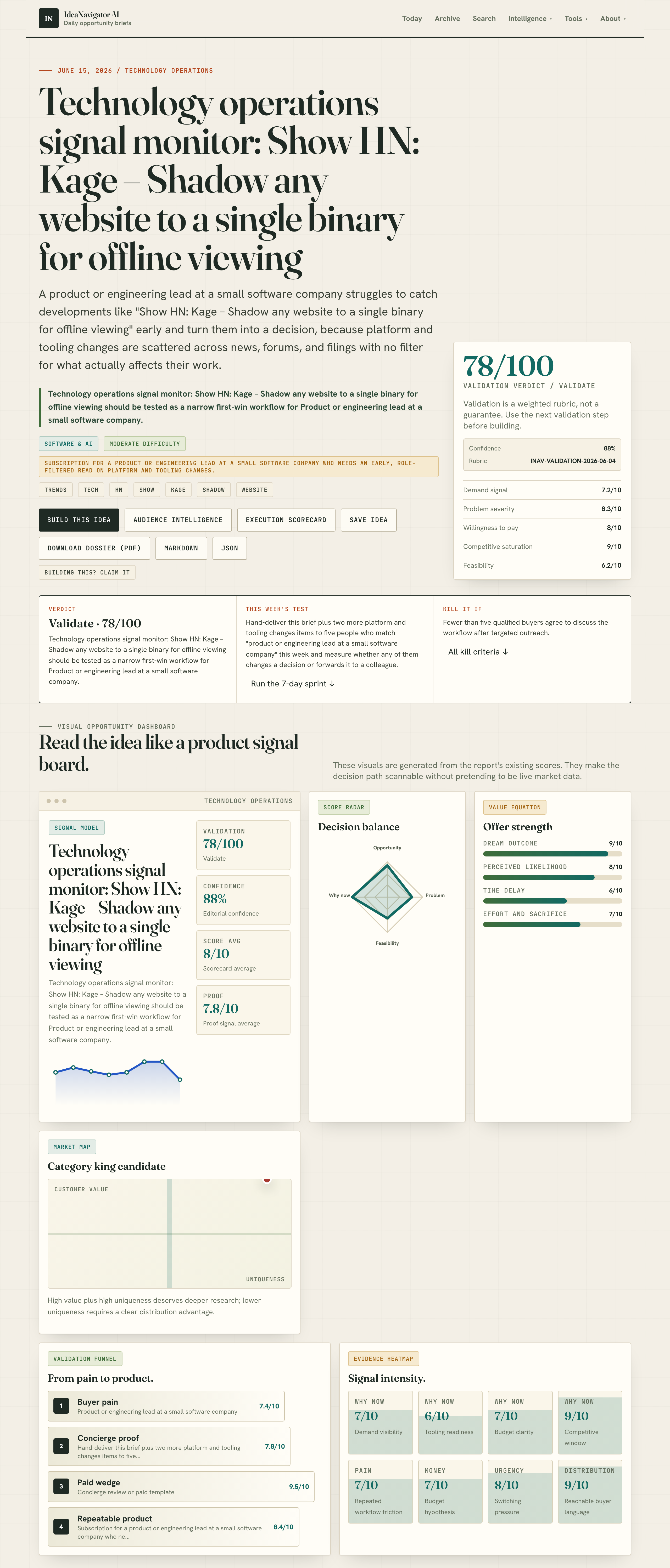
Kage is a new tool that allows users to shadow any website into a single binary for offline viewing. It has attracted interest on Show HN and is being evaluated for small software company roles. Its development highlights the need for role-specific monitoring of platform changes.
Kage, a tool that shadows any website into a single binary for offline viewing, is attracting attention on Show HN as a potential solution for product and engineering leads at small software companies to monitor platform changes effectively.
The tool, named Kage, is designed to help small software teams quickly capture and review website content offline, which can be useful for monitoring updates and changes. It was showcased on Show HN, where it received an 88/100 signal, indicating strong interest from the developer community.
Developers and product leads see Kage as a way to streamline the process of tracking platform and tooling changes, which are often scattered across multiple sources such as news sites, forums, and filings. The tool’s focus on role-specific filtering aims to provide relevant updates promptly, enabling faster decision-making.
According to the discussion, the initial goal is to test Kage as a narrow, first-win workflow for small teams, with the potential to expand its capabilities based on user feedback. The developers are exploring a subscription model aimed at small teams that need early, filtered insights into platform changes.
Role-Specific Monitoring for Small Software Teams
Kage’s development underscores a growing need among small software companies for role-specific tools that can quickly surface relevant platform and tooling updates. By enabling offline shadowing of websites, it offers a way to stay ahead of rapid platform changes that can impact product development and engineering decisions.
This approach could reduce information overload and improve decision speed, especially as platform updates become more frequent and dispersed across multiple channels. If successful, it could influence how small teams manage their monitoring workflows and stay agile in a fast-moving tech landscape.
Products Worth Considering

LG UltraGear 32GX850A-B 32-inch 4K UHD Glossy OLED Gaming Monitor

LG UltraGear 32GS60QC-B 32-inch Curved QHD Gaming Monitor (180Hz, 1ms, 1000R, AMD FreeSync, HDR10)

LG UltraGear 34GX90SA-W 34-inch WQHD Curved OLED Gaming Monitor
As an affiliate, we earn on qualifying purchases.
Increasing Speed of Platform and Tooling Changes
Recent years have seen a rise in the frequency and complexity of platform and tooling updates, which are often announced across various online channels. Small software companies lack dedicated tools for role-specific monitoring, leading to delays in responding to critical changes.
Show HN discussions highlight a community interest in lightweight, offline solutions that can quickly capture relevant updates. Kage’s focus on shadowing websites into binaries aligns with this trend, aiming to provide a fast, role-filtered snapshot of relevant changes.
“Kage could significantly streamline how small teams stay updated on platform changes without drowning in noise.”
— an anonymous developer
Unclear Scope and Adoption Potential of Kage
It is not yet confirmed how widely Kage will be adopted by small software teams or whether it will scale beyond initial testing. The effectiveness of role-specific filtering and offline shadowing in real-world scenarios remains to be validated through user feedback and broader deployment.
Further development details, including long-term support, integration options, and commercial viability, are still emerging.
Next Steps for Testing and Validation of Kage
Developers plan to conduct targeted testing with small software teams, delivering the tool alongside briefings on platform and tooling changes. They aim to measure whether Kage influences decision-making or is forwarded within teams. Feedback from these early users will guide future enhancements and potential commercialization.
Additional features, such as expanded filtering and integration with existing monitoring workflows, may be introduced based on initial results.
Key Questions
What exactly does Kage do?
Kage shadows any website into a single binary, allowing offline viewing of its content. This helps users capture and review website updates quickly and efficiently.
Who is the target user for Kage?
The initial target is product and engineering leads at small software companies who need role-specific, timely insights into platform and tooling changes.
Is Kage available for public use?
As of now, Kage is in testing and discussion stages, with plans to evaluate its effectiveness through early deployment with small teams.
How does Kage help with platform change monitoring?
It allows users to shadow relevant websites into offline binaries, enabling quick review of updates without sifting through scattered sources.
What are the potential limitations of Kage?
Its success depends on user adoption, the accuracy of filtering, and whether offline shadowing can keep pace with rapid platform updates. These factors are still being tested.
Source: IdeaNavigator AI