📊 Full opportunity report: Singapore: Engineer the Transition on ThorstenMeyerAI.com — validation score, market gap, and execution plan.
TL;DR
Singapore is implementing a comprehensive strategy to manage economic and technological change through targeted reskilling programs and AI development. The government emphasizes a calibrated, multi-lever approach to stay ahead of automation and AI disruption.
Singapore is pursuing a comprehensive, calibrated approach to economic and technological transition, focusing on continuous reskilling of its workforce and strategic AI development, led by a government that trusts its capacity to design targeted policies.
The Singaporean government has adopted a multi-instrument strategy to manage its transition, including SkillsFuture for lifelong learning, Workfare for income support, the Central Provident Fund for savings, and a national AI strategy overseen by a Prime Minister-chaired AI Council. This approach emphasizes relentless reskilling to pre-empt displacement by automation, rather than relying solely on income support or universal benefits.
SkillsFuture provides citizens with credits and heavily subsidized courses starting at age 25, with additional top-ups and allowances for mid-career workers, directly addressing the challenge of retraining while maintaining income. The government also invests over a billion dollars in AI research, pairing this with pragmatic governance and regional ambitions to become an AI hub, despite physical and infrastructural constraints.
Singapore’s strategy reflects its core belief: a capable, meritocratic state can engineer a smooth transition by designing precise, targeted interventions for each part of the problem, rather than depending on a single solution or grand scheme.
Engineer the Transition
Where others pick one lever, Singapore engineers all of them — a calibrated, well-funded instrument for each — and bets hardest that a high-capacity state can keep workers perpetually ahead of the machine.
Independent commentary, produced with AI assistance under human editorial oversight. The views are the author’s own and may change. This is analysis, not policy, economic, investment, or legal advice. Descriptions of SkillsFuture, Workfare, the CPF, the Progressive Wage Model, Singapore’s National AI Strategy and AI Council, and Temasek/GIC reflect publicly reported information as of mid-2026 and may change; figures are indicative. This phase maps differing approaches and endorses none; characterizations of contested arrangements present competing views, not a verdict. Country, program, and company names are referenced for analysis and imply no affiliation.
Why Singapore’s Multi-Lever Approach Matters
This strategy demonstrates how a highly capable state can manage complex economic and technological shifts through precise, well-funded policies tailored to specific challenges, as discussed in unit economics analysis. Singapore’s emphasis on continuous reskilling and strategic AI investment offers a model of proactive adaptation that contrasts with reliance on basic income or broad regulatory frameworks, highlighting the importance of institutional capacity in managing transitions.

BEYOND COURSES: Reimagining Learning & Development in the Age of AI: A Playbook for Learning & Development Professionals
As an affiliate, we earn on qualifying purchases.
As an affiliate, we earn on qualifying purchases.
Singapore’s Unique Policy Ecosystem for Transition
Singapore’s approach is rooted in its history of building a highly efficient, meritocratic government capable of designing and executing targeted policies. Unlike many jurisdictions that lean on broad social safety nets or regulation, Singapore’s strategy involves a suite of calibrated programs, including SkillsFuture, Workfare, and its AI strategy, all overseen by a government that prioritizes active management of economic change. This approach has been evolving over the past decade, with renewed emphasis in 2026 on AI and workforce resilience amid global shifts.
“Our strategy is to keep every worker ahead of automation through continuous reskilling, supported by targeted policies and investments.”
— Singapore government spokesperson

Singapore Math – Level 4A Math Practice Workbook for 5th Grade, Paperback, Ages 10–11 with Answer Key
- Supports Singapore Math curriculum: Supports Singapore Math curriculum
- Includes method introduction: Clear introduction to Singapore Math
- Teacher and parent approved: Reviewed and recommended by educators
As an affiliate, we earn on qualifying purchases.
As an affiliate, we earn on qualifying purchases.
Uncertainties Around Implementation and Outcomes
While Singapore’s policies are well-funded and carefully crafted, it remains unclear how effectively they will scale across the entire economy over the next few years. Questions persist about the actual uptake of reskilling programs, the long-term impact of AI investments, and whether the government’s capacity can sustain these efforts amid global economic uncertainties.
government subsidized skill development programs
As an affiliate, we earn on qualifying purchases.
As an affiliate, we earn on qualifying purchases.
Next Steps in Singapore’s Transition Strategy
Singapore will continue to refine its reskilling programs, monitor AI deployment and governance, and evaluate the economic impact of its policies. Key milestones include expanding participation in SkillsFuture, assessing AI research outcomes, and ensuring workforce resilience through ongoing policy adjustments. The government is also likely to increase regional AI collaborations and infrastructure investments to support its ambitions.
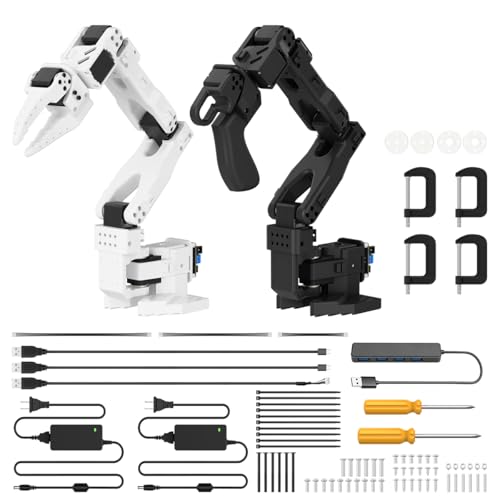
AI Robotic Arm Kit Hiwonder SO-ARM101 Embodied Imitation Learning Open Source 6-Axis Robot Arm 12 High-Torque Bus Servo Motors AI Vision Recognition (Starter Kit, Included 3D Printed Parts, Assembled)
- Imitation Learning Platform: Supports end-to-end AI imitation learning
- Dual-Camera System: Includes gripper and external cameras for vision
- High-Performance Servo Motors: 12 high-torque bus servos with magnetic feedback
As an affiliate, we earn on qualifying purchases.
As an affiliate, we earn on qualifying purchases.
Key Questions
How effective are Singapore’s reskilling programs so far?
Early indicators suggest high participation rates and positive feedback, but comprehensive data on long-term employment outcomes is still emerging.
What role does AI play in Singapore’s economic future?
AI is central, both as an economic driver and as a tool to enhance productivity, with significant public investment and a strategic focus on becoming a regional AI hub.
Can Singapore’s model be replicated elsewhere?
While its institutional capacity is exceptional, the success of Singapore’s approach depends on its specific governance, resources, and context, which may limit direct replication.
What are the main challenges Singapore faces in this transition?
Key challenges include maintaining policy effectiveness, scaling up reskilling participation, and managing external economic uncertainties that could impact funding and technological deployment.
Source: ThorstenMeyerAI.com