TL;DR

Get business pricing on tech for your team
- Business-only prices and quantity discounts
- Tax-exempt purchasing
- Multiple users, one account, clear invoices
Google opened Gemini 4 Carbon to paying developers, businesses and Google AI Ultra subscribers on November 10, alongside a model card. On the new MKA benchmark, Carbon scored 54.3%, behind Claude Fable 5.2 at 56.6%; Google DeepMind reported a $5.63 cost per Carbon task, compared with $35.28 for Fable. Google co-developed MKA, and its private tasks prevent outside researchers from checking the test directly.
Google opened Gemini 4 Carbon to paying developers, businesses and Google AI Ultra subscribers on November 10, as Google DeepMind and Artificial Analysis introduced a new test for AI agents working with documents such as blueprints, scans and charts. Carbon scored 54.3% on MKA, placing second behind Anthropic’s Claude Fable 5.2, while Google DeepMind reported that a Carbon task cost $5.63, compared with $35.28 for Fable.
The release expands access to a model that had previously been available to a small group of cyber defenders through Google’s Fairwind Program. Carbon is also accessible through the paid Gemini API, Google AI Studio and Gemini for business. In the Gemini app and AI Mode in Search, access is limited to Google AI Ultra subscribers, according to the supplied source material.
Google’s introductory API price is $2 per million input tokens and $10 per million output tokens through November 30. Starting December 1, the listed rates rise to $4 per million input tokens and $20 per million output tokens. These are token prices; they do not by themselves establish what a particular user’s workload will cost.
On MKA, Claude Fable 5.2 scored 56.6%, Carbon scored 54.3%, and Claude Opus 5.5 scored 53.0%. The source says the three results fall within the test’s margin of error. Google DeepMind’s report gives Carbon’s cost as $5.63 per task and Fable 5.2’s as $35.28. The supplied material does not specify the cost calculation details, so the figures should be read as the report’s comparison rather than a universal estimate for using either model.
MKA comprises 200 expert-built tasks across 10 sectors. It is intended to assess agents handling visual and structured material rather than plain text alone. Google describes Carbon as a higher-compute model for difficult work, including multi-step coding and open-ended research. Its model card says Carbon uses more thinking tokens than Gemini 4 Argon, which can mean higher token use and longer responses.
Cost and Scores on MKA
The MKA results offer buyers a comparison that combines task performance with reported cost. Carbon placed three-tenths of a percentage point above Claude Opus 5.5 and 2.3 points below Fable 5.2. With all three scores within the stated margin of error, the headline ranking does not establish a clear performance gap among them. The cost figures may still matter to companies running many agent tasks, though actual spending depends on workload and how the reported task costs were calculated.
Carbon’s availability also gives developers a new option for work that Google says tests the limits of a model’s capabilities. But its price is changing in December, and the model card identifies trade-offs including higher token use, occasional slowness and timeouts. Google says Argon remains its preferred choice for most software engineering and knowledge work, positioning Carbon as a model for harder cases rather than a general replacement.
For consumers, access is narrower: the Gemini app and Search’s AI Mode require an Ultra subscription, according to the source. The release therefore matters most immediately to developers and businesses who can test the model through paid tools and decide whether its task results justify the cost for their own needs.
Products Worth Considering

Jackery Explorer 300 Portable Power Station with 40W Solar Panel

DJI Mini 3 Drone with DJI RC and 3-Axis Mechanical Gimbal

Apple AirPods Pro (2nd Generation) Wireless Earbuds with USB‑C Charging, Up to 2X More Active Noise Cancelling, Transparency Mode, Adaptive
As an affiliate, we earn on qualifying purchases.
From Limited Access to Paid Release
Artificial Analysis lists Carbon’s release date as October 28, when Google first made it available to a small group of cyber defenders. Google opened broader paid access on November 10 and published its model card that day. The model is built on Gemini 4 Argon, but Google describes Carbon as intended for especially demanding tasks and says it uses more thinking tokens to examine hypotheses and verify work.
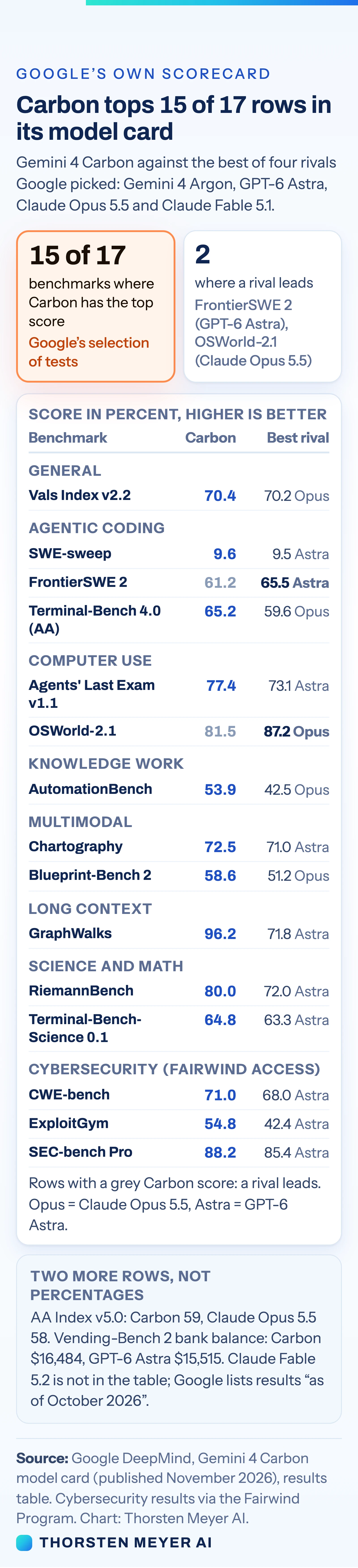
Google’s model card reports Carbon as the top model on 15 of 17 benchmarks selected by Google, compared with Gemini 4 Argon, GPT-6 Astra, Claude Opus 5.5 and Claude Fable 5.1. The card’s results are dated as of October 2026 and do not include Claude Fable 5.2, which the source says was released November 9. On two listed tests, Carbon did not lead: GPT-6 Astra scored 65.5% on FrontierSWE 2 against Carbon’s 61.2%, while Claude Opus 5.5 scored 87.2% on OSWorld-2.1 against Carbon’s 81.5%.
A separate Artificial Analysis ranking also places Carbon behind Fable 5.2. On the Intelligence Index version 5.0.1, Carbon at its high setting scored 60; Fable 5.2 scored 62 at high and 65 at its maximum setting. The source says an earlier index version shown in Google’s model card had Carbon ahead of Claude Opus 5.5 by one point. These are different versions of the index, so their scores should not be treated as a single unchanged ranking.
““tasks that test the limits of a model’s intelligence””
— Google, in the Gemini 4 Carbon model card
Limits of the MKA Results
Google co-developed MKA, and the benchmark’s tasks are private, according to the source material. That means outside researchers cannot inspect the questions or independently reproduce the published comparison. The reported scores and costs are useful as a snapshot, but the supplied material does not include enough detail to independently assess the task selection, scoring process or cost methodology.
The three leading MKA scores are described as being within the margin of error, but the source does not give the size of that margin. It is therefore unclear how much practical difference the reported score gaps represent. Nor does the provided information establish how the models perform across all real-world sectors or on a buyer’s specific documents and workflows.
Google’s benchmark table and Artificial Analysis’s index use different test sets and methods. Their rankings do not settle which model is best for every task. The source also gives no specific details about the eligibility or review process for the cyber defender program, or when Carbon’s security features might become available to other users.
Access and Pricing After November
Developers and businesses can evaluate Carbon through Google’s paid API, AI Studio and business offering, while Ultra subscribers can use it in the Gemini app and AI Mode in Search. The next stated pricing milestone is December 1, when API rates are scheduled to double from the introductory prices. Buyers comparing models will need to weigh their own task results and usage against those rates.
Further independent assessments could help clarify how Carbon performs outside the benchmarks Google selected and the MKA test it co-developed. The supplied material does not identify a scheduled update to MKA, a release date for the next Artificial Analysis index, or a timetable for wider access to Carbon’s security features.
Key Questions
How did Gemini 4 Carbon score on MKA?
Carbon scored 54.3%, behind Claude Fable 5.2 at 56.6% and ahead of Claude Opus 5.5 at 53.0%. The source says all three scores fall within the test’s margin of error.
How much does a Carbon task cost?
Google DeepMind’s report lists $5.63 per task for Carbon and $35.28 for Claude Fable 5.2. The source does not explain the full cost calculation, and actual expenses depend on how a model is used.
Who can use Gemini 4 Carbon?
It is available through the paid Gemini API, Google AI Studio and Gemini for business. Use in the Gemini app and AI Mode in Search is limited to Google AI Ultra subscribers, according to the source.
Can outside researchers verify the MKA results?
Not directly from the information provided: MKA’s tasks are private, and Google co-developed the benchmark with Artificial Analysis. The source does not provide enough detail to reproduce the test independently.
Source: Thorsten Meyer AI