🔍 Read the full analysis: How AI Helped Shape “Luciole — The Synchronous Fireflies Of Vallon Creux” on ThorstenMeyerAI.com

Get business pricing on tech for your team
- Business-only prices and quantity discounts
- Tax-exempt purchasing
- Multiple users, one account, clear invoices
TL;DR
Luciole is an AI-built web exhibit about fictional fireflies in a fictional hollow. Its 96 simulated lights use a Kuramoto-style oscillator model to show synchronization, while the exhibit’s source material also exposes the art-direction prompt that shaped the site. The supplied account describes the design and implementation, but does not provide independent testing or evidence about the AI production process beyond that account.
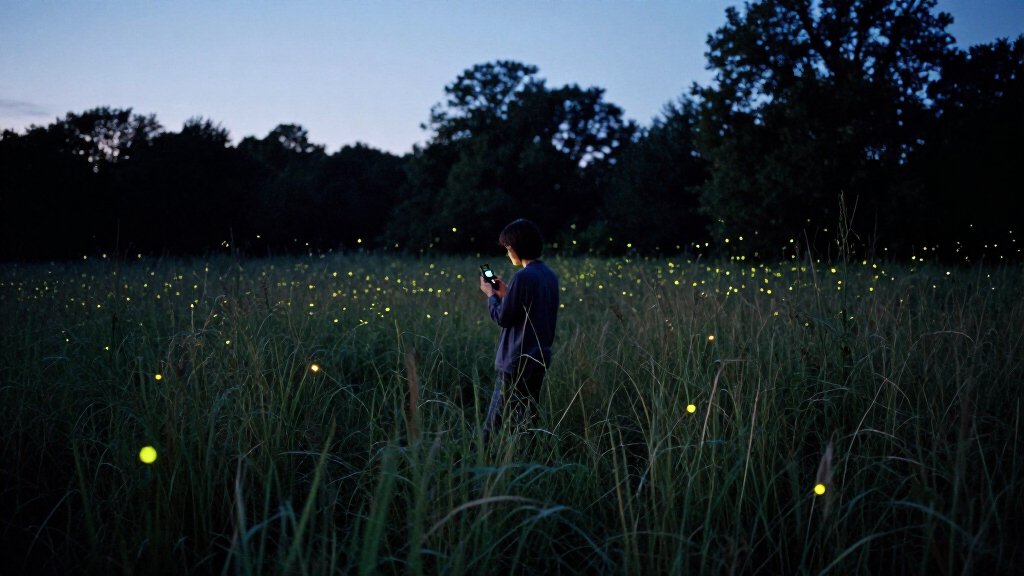
Luciole — The Synchronous Fireflies of Vallon Creux is an AI-built interactive web exhibit in which visitors watch 96 simulated fireflies move from scattered flashes toward a shared rhythm. The account published by ThorstenMeyerAI.com presents the work as Room 155 of a 175-room series and says the site exposes its original art-direction prompt, making both the simulation and the AI-assisted design process part of the exhibit, as detailed in the original account.
The fireflies and the setting are fictional: Vallon Creux is not a real location, and the display is not a field study. According to the source account, each simulated insect has an individual phase and tempo and is influenced by nearby neighbors. Visitors can adjust a coupling control to change the strength of that influence, while a live coherence measure indicates how closely the flashes align.
Pointer interaction can disturb the phases, after which the same simulation rules guide the system toward coherence again. A trace records the measured decline and recovery, and a phase diagram draws on the simulation’s state. The account says these displays are linked to the behavior on screen rather than being decorative graphics. It describes the simulation as based on Kuramoto synchronization, a model of coupled oscillators; no technical paper, code review, or independent validation accompanies the account.
The site’s visual treatment is also described as part of its content. A near-black green background sets off chartreuse flashes, while dusk mauve marks notes and annotations. Serif text evokes a naturalist’s notebook, with handwritten-style accents used sparingly. The source says the visuals are made with HTML, CSS, SVG and canvas, without downloaded image assets or prerecorded firefly footage.
Room 155 / FABLE 175 · AI-assisted web exhibit
How AI Helped Shape Luciole
“The Synchronous Fireflies of Vallon Creux” is presented as an interactive field notebook: 96 fictional lights, a synchronization model, and the art-direction prompt behind the site.
01 / The experience
Make synchrony visible
Instead of presenting a finished animation, Luciole lets visitors disturb a simulated field and watch its behavior change under the model’s rules.
Observe
Individual rhythms
Each simulated firefly has its own phase and tempo. At first, flashes appear scattered across the fictional hollow.
Adjust
Neighbor influence
A coupling control changes how strongly nearby oscillators affect one another. Pointer interaction can inject a disturbance.
Measure
Alignment over time
A live coherence measure, trace, and phase diagram are described as views of the same simulation state—not decorative overlays.
02 / The model
From scattered flashes to shared rhythm
The account says the simulation is Kuramoto-style: coupled oscillators influence one another. No code review or independent validation is supplied.
A loop visitors can interrupt
Each light advances at an individual tempo. Local coupling nudges phases toward alignment. A click or pointer action perturbs the field; the trace records the decline and recovery as the simulated system responds.
What the visitor is meant to see
Illustrative labels only. The supplied account gives no coherence formula, benchmark, or measured convergence time.
03 / Visitor path
A field notebook in four beats
The exhibition moves from atmosphere to interaction, then makes its own creative brief available for inspection.
Enter the hollow
Meet a slow nocturnal scene in a fictional setting.
Watch the field
See 96 simulated lights flash with separate rhythms.
Break the pattern
Change coupling or perturb the phases; observe the response.
Read the prompt
Open the footer’s Prompt link to inspect the stated art direction.
04 / Art direction
The making becomes part of the exhibit
The prompt is presented as source material, letting readers compare the stated brief with the described finished room.
Visual language
Notebook after dusk
The account describes a near-black green backdrop, chartreuse flashes, dusk-mauve notes, serif text, and restrained handwritten accents.
Built in code
Generated visuals
HTML, CSS, SVG, and canvas are cited. The account says the room uses no downloaded image assets or prerecorded firefly footage.
Brief versus build
A visible difference
The brief asks for “hundreds” of lights and a roughly 20-second move to unison; the account describes 96 and gives no measured convergence time.
05 / From the source
Words that frame the experience
The following excerpts are attributed to the account and reproduced art-direction brief.
“Luciole and Vallon Creux are fictional, created for the exhibit—not a real company, place, or field study.”ThorstenMeyerAI.com account
06 / Evidence check
What the supplied account can establish
Descriptions of a site and its brief are useful context. They are not the same as independent testing or a documented production history.
Known limits
Claims remain unverified
The supplied material includes no source code, reproducible synchronization method, performance benchmarks, accessibility audit, device-by-device results, dated build records, or independent critique. It does not establish which parts were generated by AI, how much human editing occurred, or whether the requested three-pass review was completed. The source identifies a live room at fable-25-830.netlify.app/sites/luciole/, but does not confirm current availability.
07 / Reader guide
Questions worth keeping open
Visit the room and prompt to inspect the experience and stated design goals; independent evidence would be needed to assess the implementation.
Reality
Is Vallon Creux real?
No. The account says the setting and fireflies are fictional, not a real location or field study.
Mechanics
How does alignment work?
According to the account, 96 individual phases and tempos are influenced by nearby neighbors in a Kuramoto-style model.
Authorship
How much was made by AI?
The source calls the exhibit AI-built, but does not independently document AI contributions or the extent of human involvement.
The Design Makes Synchrony Observable
Luciole’s central idea is to make a technical process something visitors can watch and affect. Rather than showing synchronization as a finished animation, the exhibit lets users disrupt the simulated field and observe what happens under the model’s local interaction rules. That can make the distinction between an illustration and a running simulation easier to see: the trace and phase diagram are presented as measurements of the same behavior shown by the lights.
The work also puts the AI-production prompt on display. The source says a “Prompt” link in the footer reveals the art-direction brief, including aesthetic instructions, technical constraints and an account of a three-pass production process. For readers interested in AI-made web work, this offers a way to compare the stated brief with the resulting site. However, the material supplied does not independently establish which parts were generated by AI, how much human editing occurred, or whether the described review steps were completed as specified.
That distinction matters because the exhibit’s claims about its own construction are not the same as an external assessment of quality or accessibility. The account says the page pauses animation when relevant views are offscreen or the browser tab is hidden, and provides reduced-motion behavior, focus styling and a mobile field map. Those are useful design details, but no test results or device-by-device audit are supplied.
interactive firefly synchronization exhibit
As an affiliate, we earn on qualifying purchases.
As an affiliate, we earn on qualifying purchases.
A Fictional Field Notebook
The source frames Luciole as an interactive field notebook, not a documentary about a real firefly population. It describes a slow, nocturnal visual environment and a sequence in which the visitor first watches the field, then sees notes explaining how synchronization is represented. This presentation links the fictional naturalist setting to a mathematical model without claiming that the simulation reproduces a particular species or ecosystem.
The art-direction brief reproduced in the source gives more detail about the intended experience. It calls for a self-contained single-page site, code-generated visuals, a “wait for it” section, invented species and a moment in which a visitor breaks the synchrony and watches it return. It also specifies responsive layouts, accessible controls, reduced-motion handling and a three-pass review process. The source says the live room was made for the FABLE/175 pipeline and attributes the original brief to “Claude Fable 5,” identified there as an art director.
There is a difference between what the brief requested and what the source says the finished room contains. The account specifically describes 96 simulated fireflies, although the prompt asks for “hundreds.” It also describes a live site at fable-25-830.netlify.app/sites/luciole/. The supplied material does not explain that difference in particle counts or provide dated records of the build.
“Luciole and Vallon Creux are fictional, created for the exhibit—not a real company, place, or field study.”
— ThorstenMeyerAI.com account
Kuramoto oscillator simulation model kit
As an affiliate, we earn on qualifying purchases.
As an affiliate, we earn on qualifying purchases.
Evidence Behind the Build Claims
The source gives a descriptive account, not an independent technical or editorial review. It does not provide the site’s source code, a reproducible method for measuring synchronization, or benchmarks for performance and accessibility. It is therefore not possible from the supplied material alone to confirm the implementation details or evaluate how the experience performs across browsers and devices.
The brief calls for “hundreds” of fireflies and a roughly 20-second move from disorder to unison, while the account describes 96 simulated fireflies and gives no measured convergence time. The source does not explain whether the build changed those requirements, whether timing varies with the controls, or how the coherence score is calculated. It also does not document the stated three-pass process with screenshots or an external critique.
The source identifies a live URL but supplies no publication date, update history, creator interview or separate statement from the FABLE/175 pipeline. The extent of AI authorship and human involvement remains unclear, as does whether the site is still available and behaves as described at the time of reading.
As an affiliate, we earn on qualifying purchases.
Check the Live Room and Prompt
Readers can visit the live Luciole room at the URL supplied by the source and use its controls to observe how the simulated field responds. The source points to a footer “Prompt” link for the art-direction brief. These materials allow visitors to inspect the experience and its stated design goals directly, though they do not substitute for independent verification of the code or production history.
No follow-up announcement, release schedule, or planned update is included in the supplied account. Further reporting would need to establish who built and reviewed the site, how the simulation’s measurements are calculated, and whether the accessibility and performance requirements were tested against the stated targets.
As an affiliate, we earn on qualifying purchases.
Key Questions
Are Luciole and Vallon Creux real?
No. The source says both are fictional creations for the exhibit, not a real place or field study.
How does the firefly synchronization work?
According to the source, each of the 96 simulated fireflies has its own phase and tempo and is influenced by nearby neighbors. A coupling control changes the strength of that influence; the account describes the simulation as based on the Kuramoto model.
What does the visitor control do?
The source says visitors can adjust coupling and disturb the field with pointer interaction. The display then shows how the simulated lights move toward coherence again, with a trace and phase diagram tied to the simulation.
What role did AI play in making the site?
The source describes the site as AI-built and says its original art-direction prompt is available through a footer link. It does not provide an independent account of the AI tools used or the extent of human editing and review.
Is the simulation evidence about real fireflies?
No. It is a model-driven, fictional exhibit. The supplied account does not present field data or claim that the simulated behavior documents a real firefly population.
Source: ThorstenMeyerAI.com
Halloween Picks
halloween
As an affiliate, we earn on qualifying purchases.