
TL;DR
Mistral is playing a different game, emphasizing sovereignty, open weights, and control over the latest frontier performance. While it may lag in reasoning on benchmarks, it targets regulated and European markets that value data control and independence.
Imagine a world where controlling your AI isn’t just about having the biggest model. It’s about sovereignty, data residency, and independence. That’s exactly what Mistral is betting on. While other labs chase the latest reasoning feat, Mistral is carving out a different path — one rooted in control.
In this article, we’ll break down what makes Mistral’s approach unique, whether it’s a smart strategy or a sign of falling behind, and what it means for you if you’re considering AI for regulated industries or European markets.
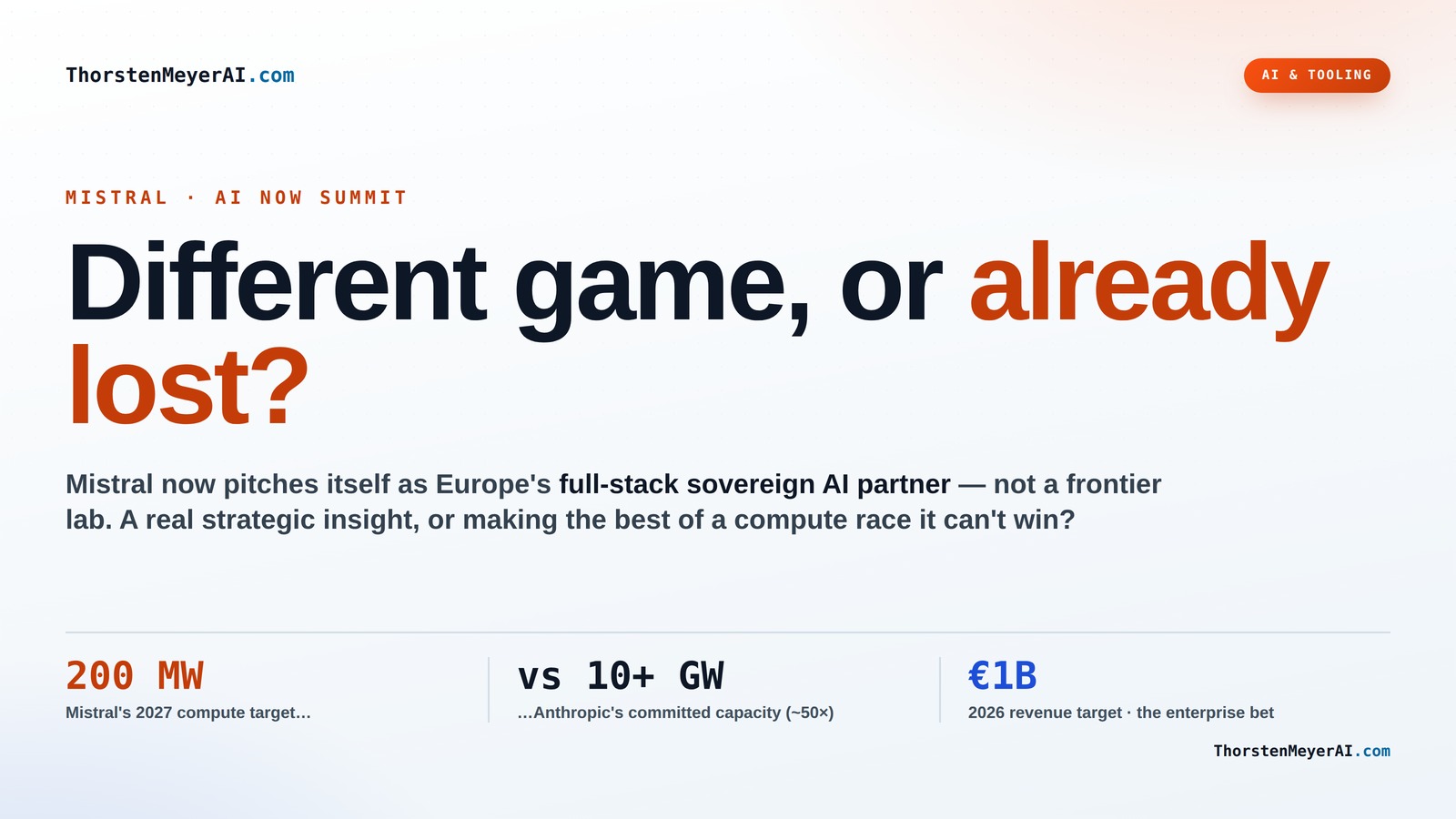
Different game, or already lost?
Mistral now pitches itself as Europe’s full-stack AI provider — compute, models, platform, consultancy — not a frontier-model lab. Is that a real strategic insight, or making the best of a race it can’t win? Both readings fit the same facts.
From model lab to full-stack provider
The clearest signal from the summit wasn’t a model — it was a posture. Heavy on enterprise logos and partnerships (ASML, BNP Paribas, Alexa+), light on new-model announcements. That absence is exactly what skeptics seized on.
Compute
40MW Paris DC + Sweden build · 200MW target by 2027
Models
Open & custom · efficient · you own and run them
Platform
Forge for custom models · Vibe for Work agent
Consultancy
Sales teams, integrators, EU provenance & support
Small & focused, or large & general?
Mistral bets on specialized small models. The claim isn’t that they win a reasoning leaderboard — they don’t. It’s that on the metrics that matter in production agent systems, a purpose-built small model wins. Flip the metric to see the case reverse.
Small specialized vs large general — by what you measure
In token-heavy agentic apps making hundreds of calls, speed/energy/cost compound. Toggle the metric.
Narrow models doing real work
Each is one model doing one thing efficiently — the tangible version of the strategy. Strong on their own terms; the open question is whether the bundle beats a free Chinese open-weight download.
On-prem KYC compliance
Mistral models run inside the bank’s walls for know-your-customer checks. Sensitive financial data never leaves. (BNP was Mistral’s first customer, 2023.)
Voxtral multilingual voice
A focused voice model powering Alexa+ across Europe — speed and efficiency over raw size.
Robostral industrial robotics
Plus a “physics AI” push (via the Emmi acquisition) into aerospace, automotive & semiconductor design and simulation.
Document AI / OCR at scale
Large-scale text extraction — the unglamorous, high-volume enterprise work small models excel at.
The strategy is downstream of the compute gap
Once you see the raw numbers, “why is Mistral behind?” answers itself — and the specialized-small-model strategy starts looking partly like a smart adaptation to a binding constraint, not a pure philosophical choice.
Compute & capital · Mistral vs a frontier leader, this same week
Not a knock — it’s the constraint that forces the efficiency-first, sovereignty-wedge strategy. Adapting intelligently to your position is what good strategy is.
“I want them to win, but I’m worried”
That ambivalence is the most accurate read of where Mistral sits. The enterprise pivot gets read two opposite ways — and both deserve airing.
On-prem, real sales teams, the Koyeb deployment acquisition, EU provenance — exactly what regulated enterprises want, and stickier than consumer mindshare. Targeting €1B revenue in 2026 with 1,000 staff, up from 15 people and one customer in 2023. US closed-API labs structurally can’t match the sovereignty axis.
“Software consultancy with a data center,” not a foundation-model moat. Enterprise B2B is where European startups go when they can’t win consumer or world-scale SaaS. Why pay Mistral on-prem when you could run Qwen free? One paying Le Chat Pro user said the quality gap with frontier labs is now hard to ignore.
Key Takeaways
- Mistral is betting on sovereignty, control, and open weights, targeting European and regulated industries.
- Their models focus on small, efficient, purpose-built tools rather than chasing leaderboard dominance.
- European buyers prioritize data residency and model ownership, making Mistral’s strategy highly relevant.
- There’s a tradeoff: Mistral may lag in reasoning and medium-context tasks, but it gains control and compliance advantages.
- The future of AI might shift towards sovereignty-focused models, especially as regulation and geopolitical tensions grow.
As an affiliate, we earn on qualifying purchases.
Sovereignty First: Why Mistral’s Strategy Looks Different
Mistral is not just another AI lab rushing to build the largest model. It’s aligning itself with Europe’s push for digital sovereignty. Learn more about the latest in AI and innovation. Think of it as building a fortress of control — models you can own, run, and audit without depending on US or Chinese cloud giants.
Take BNP Paribas, Mistral’s first customer, running models on-prem for financial compliance. The bank keeps sensitive data inside its own walls, not floating in some cloud. This isn’t just about privacy — it’s about control, trust, and compliance in a heavily regulated industry.
For European firms, sovereignty isn’t a buzzword. It’s a survival tactic. Mistral’s bet is clear: if you want to be independent, you need models you can download, fine-tune, and host yourself. This strategic choice shapes everything from product design to customer relationships.

As an affiliate, we earn on qualifying purchases.
Open Weights as a Business Model, Not Just a Technical Choice
Mistral’s reputation was built on downloadable, self-hostable models like Mistral 7B and Mixtral. Discover more about AI models and control. Unlike OpenAI’s API-only approach, these open weights let organizations own the model—updating, auditing, and deploying as they see fit.
This isn’t just tech nostalgia. It’s a business move. Customers in regulated sectors want transparency and control. They need to inspect the weights, modify the model, and run it inside their own secure environment.
For example, a European health insurer can fine-tune Mistral models for customer service, all while keeping data within their firewall. That level of control is a game-changer in industries where compliance isn’t optional.

As an affiliate, we earn on qualifying purchases.
Is Mistral Behind on Frontier Capability, or Just Optimized for a Different Market?
Many critics say Mistral falls short on reasoning benchmarks and medium-context tasks, especially compared to giants like OpenAI or Anthropic. Explore the latest AI developments. They point out that the latest Mistral models aren’t matching the reasoning prowess of GPT-4 or Claude.
But here’s the twist: Mistral isn’t chasing leaderboard bragging rights. Instead, it focuses on smaller, purpose-built models optimized for speed, energy efficiency, and local deployment. Think of a tiny but sharp knife — perfect for specific tasks, not for general intelligence.
This strategic choice means Mistral’s models excel in real-world enterprise scenarios, where cost and control trump raw reasoning power. It’s a different game, with its own rules.

As an affiliate, we earn on qualifying purchases.
Why European Buyers Care About Model Control and Data Residency
European enterprises and governments face strict data laws and a cultural emphasis on control. Learn about AI trends in regulated industries. They prefer models they can host on-prem, inspect, and upgrade themselves.
Imagine a government agency using Mistral models to analyze sensitive data, confident that nothing leaves their secure servers. That’s a reassurance not easily offered by closed-API giants.
For these buyers, sovereignty isn’t just a feature — it’s a requirement. Their buying decision hinges on whether they can meet compliance, audit, and control needs, not just on model size or reasoning benchmarks.

The Real Test: Can a Sovereign AI Strategy Scale?
Some say Mistral’s approach limits its growth. If the best models on benchmarks are from US labs, how can a sovereignty-focused firm keep pace? Read more about sovereignty in AI.
It’s a valid concern. Industry chatter suggests Mistral’s models lag in reasoning and medium-context tasks since late 2025. Critics argue that without top-tier reasoning, its market might stay niche.
But the counterargument: for many European and regulated clients, control and compliance outweigh raw performance. If Mistral can keep delivering tailored, self-hosted models at scale, it may carve out a resilient niche, even if it’s not the biggest player in the reasoning race.

What’s Next? Will Sovereignty Still Matter in AI?
As AI matures, the debate around sovereignty heats up. Governments and large enterprises increasingly demand models they can own, audit, and control. This trend isn’t fading — it’s accelerating.
Regulation, data laws, and geopolitical tensions push organizations toward self-reliance. Mistral’s strategy aligns perfectly with this shift. The question is whether this focus will keep pace with the rapid technical advances of the biggest labs.
In the end, sovereignty isn’t just a regional issue — it’s becoming a core feature of AI’s future, especially in Europe and other regulation-heavy markets.
Frequently Asked Questions
What does “sovereign” mean in Mistral’s context?
In Mistral’s world, “sovereign” means providing models that organizations can own, host, and control entirely — especially for sensitive or regulated data. It’s about independence from external cloud providers and API reliance.Is Mistral actually competitive with the leading frontier labs?
Not on raw reasoning benchmarks. Mistral’s models are designed for control and efficiency, so they might lag in some advanced reasoning tasks. But for many regulated and local use cases, they are highly competitive.Why do governments and regulated enterprises prefer open-weight or self-hostable models?
They need transparency, data control, and the ability to audit and upgrade models without external dependencies. Open weights give them that power, ensuring compliance and security.Is Mistral’s strategy a real moat, or just a regional niche?
It’s both. For Europe and regulated sectors, sovereignty offers a durable advantage. But globally, it might be a niche compared to the scale and performance of US giants.How do sovereignty, compliance, and data residency affect AI buying decisions?
They turn AI procurement into a strategic choice. Organizations prioritize models they can own, ensure compliance, and keep sensitive data within their control, often at the expense of raw model performance.Conclusion
In a world obsessed with size and scale, Mistral reminds us that control can be a powerful strategy. For organizations where data, compliance, and independence matter most, sovereignty isn’t a fallback — it’s a feature.
While they may not lead on reasoning benchmarks, their focus on owning the entire AI stack offers a different kind of strength. The real question: how many industries will choose control over conquest?