

TL;DR

Get business pricing on tech for your team
- Business-only prices and quantity discounts
- Tax-exempt purchasing
- Multiple users, one account, clear invoices
OpenAI launched a beta on November 10 that lets businesses claim ChatGPT profiles, share product information and view aggregated engagement insights. The rollout, alongside an announced acquisition of travel startup Odessia and reported third-quarter revenue of about $10 billion, points to a broader effort to make ChatGPT a place to discover and compare businesses. Revenue and loss figures come from media reports, and the company has not published financial statements.
OpenAI began testing business profiles and AI agents in ChatGPT on November 10, giving eligible companies new ways to present products and interact with users inside the chatbot. The launch came as founder Francis Davidson announced that OpenAI had acquired his travel startup Odessia, while media reports put OpenAI’s third-quarter revenue at about $10 billion—a figure not confirmed in published financial statements.
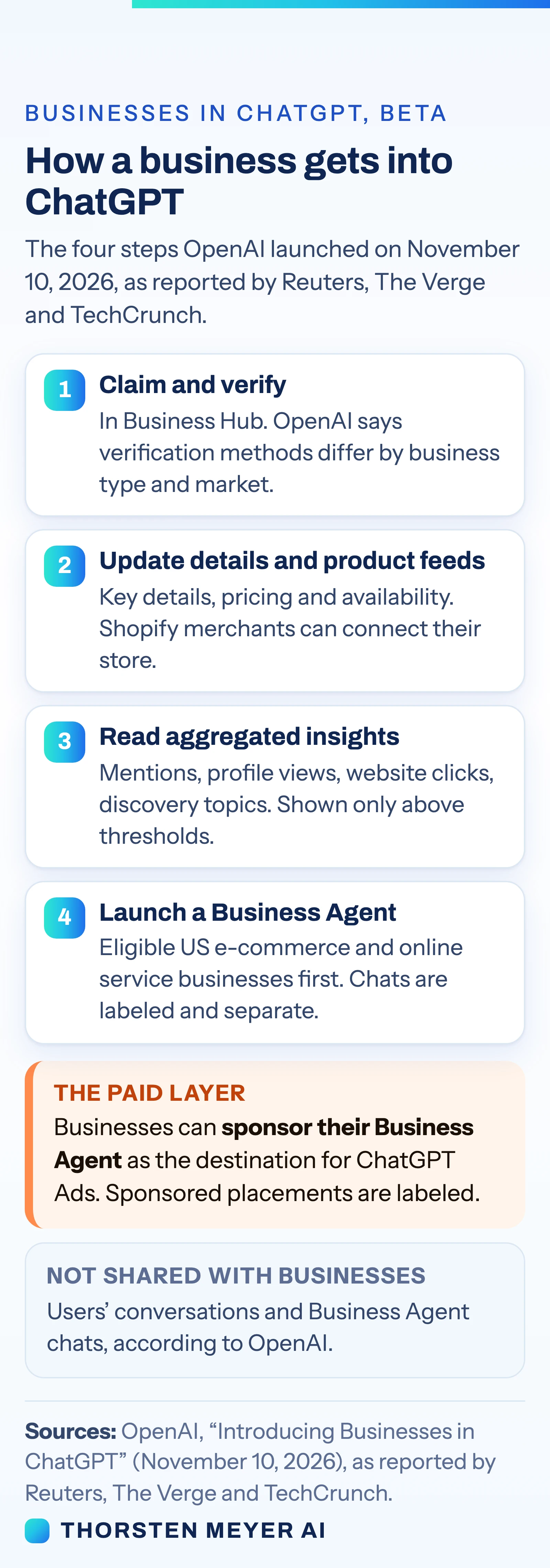
The beta, called Businesses in ChatGPT, includes a Business Hub where companies can claim and verify a profile, update details, submit product feeds with pricing and availability, and review aggregated data. OpenAI said the dashboard can show business mentions in ChatGPT responses, profile views, website clicks and topics associated with discovery. The company has not publicly detailed all verification steps.
A second feature, Business Agents, lets eligible U.S. e-commerce and online service businesses offer a separate AI conversation about their products. Businesses supply the agent’s instructions and information; users can open it from a ChatGPT answer, for example to ask questions or compare offerings. OpenAI says these conversations are labeled and kept separate from the user’s main chat. Businesses may sponsor their agents as destinations for ChatGPT ads, with sponsored placements labeled.
OpenAI said it does not share users’ conversations or Business Agent chats with businesses. It also said aggregated insights appear only after activity reaches certain thresholds. Separately, Odessia founder Francis Davidson announced the acquisition and said he would join OpenAI; an OpenAI spokesperson confirmed his hire to TechCrunch. The terms were not disclosed.
ChatGPT Becomes a Business Discovery Channel
The launch creates a new route for companies to manage how they appear when users ask ChatGPT for recommendations or product information. Business Hub’s mentions, views and clicks could give companies a way to track that activity, though the available metrics do not by themselves show whether a mention led to a sale.
For users, profiles and product feeds could make business information more current, while agents add a direct way to ask questions. Sponsored agents and advertising also introduce a commercial layer into discovery. OpenAI says sponsored placements will be labeled and user chats will not be shared with businesses; how users respond to that mix of recommendations, business-provided information and paid placement remains to be seen.
The reported financial figures add context to the expansion. The Information reported third-quarter revenue of about $10 billion, and Bloomberg reported nearly 50% growth from the prior quarter, citing a person familiar with the matter. Reuters reported that the Wall Street Journal put operating losses at $10.9 billion for the same quarter. These are media-reported figures, not results from published company financial statements.
Products Worth Considering

LG UltraGear 32GX850A-B 32-inch 4K UHD OLED Gaming Monitor

Logitech MX Mechanical Wireless Illuminated Keyboard, Tactile Quiet, Graphite

Logitech MX Ergo S Advanced Wireless Trackball Mouse USB-C – Graphite
As an affiliate, we earn on qualifying purchases.
From ChatGPT Shopping to Business Profiles
OpenAI has previously tried to make ChatGPT a shopping destination with direct checkout and a commission model. TechCrunch reported that the effort did not gain traction and was retired in March. The new beta takes a different route: it gives businesses tools to supply information and engage users while discovery and comparison happen in ChatGPT.
The company has also been developing advertising. OpenAI said in August that ChatGPT Ads had reached a $1 billion annualized revenue run rate. That is a run-rate measure announced by the company, not the same as revenue recognized over a completed year. The November launch links business profiles and agents to that existing ad offering, since companies can sponsor an agent as an ad destination.
OpenAI described the beta as an early step toward bringing businesses further into ChatGPT. Shopify merchants can connect stores through Business Hub or Shopify’s admin, while existing OpenAI Enterprise customers and advertisers can claim businesses through their OpenAI representative, according to reporting by Reuters, The Verge and TechCrunch.
Verification, Reach and Financial Detail
OpenAI has not explained the complete verification process, when the beta will expand beyond eligible U.S. businesses, or how businesses will qualify for Business Agents. The company also has not disclosed the thresholds that must be met before aggregated activity appears in insights, or provided independent evidence about how accurately profiles and agents represent each business.
It is not yet clear how sponsored agents will be distinguished in every discovery flow, how prominently organic and sponsored results will appear, or whether profile activity will translate into customer visits and sales. OpenAI says user chats are not shared with businesses, but the material provided does not specify all data retention or measurement practices.
The reported third-quarter revenue and operating-loss figures remain attributed to media outlets and their sources. OpenAI has not published financial statements confirming them. Terms of the Odessia acquisition have also not been announced.
The Beta’s Expansion and Business Uptake
The next signals will be whether OpenAI expands access beyond the launch group, publishes clearer verification and eligibility rules, and adds businesses or markets to Business Agents. Companies considering the tools will be watching how the Hub’s engagement data is defined and whether it helps them reach customers.
Further information about sponsored agents, advertising measurement and privacy practices would clarify how commercial placements fit into ChatGPT recommendations. OpenAI may also provide more detail on the Odessia deal and its financial performance; no timetable for those disclosures was given in the source material.
Key Questions
What did OpenAI launch for businesses in ChatGPT?
It launched a beta Business Hub for claiming profiles, updating business information, adding product feeds and viewing aggregated engagement insights. Eligible U.S. businesses can also offer a separate AI agent conversation about their products or services.
Can businesses see users’ ChatGPT conversations?
OpenAI said it does not share users’ conversations or Business Agent chats with businesses. It said businesses receive aggregated insights only after activity passes certain thresholds.
How much revenue did OpenAI report for the third quarter?
Media reports put third-quarter revenue at about $10 billion, with Bloomberg reporting nearly 50% growth from the previous quarter. OpenAI has not published financial statements confirming those figures.
What happened to Odessia?
Founder Francis Davidson announced that OpenAI acquired the AI travel agent startup and said he would join OpenAI. The acquisition terms were not disclosed.
Source: Thorsten Meyer AI