
🔍 Read the full analysis: From Horses To Tractors: The Shift That Changed Farm Work on ThorstenMeyerAI.com

Get business pricing on tech for your team
- Business-only prices and quantity discounts
- Tax-exempt purchasing
- Multiple users, one account, clear invoices
TL;DR
American farms shifted from horses and mules to tractors over the first half of the 20th century. The change freed cropland used for animal feed and helped raise farm output per worker, while farm employment fell and workers moved toward jobs in cities.
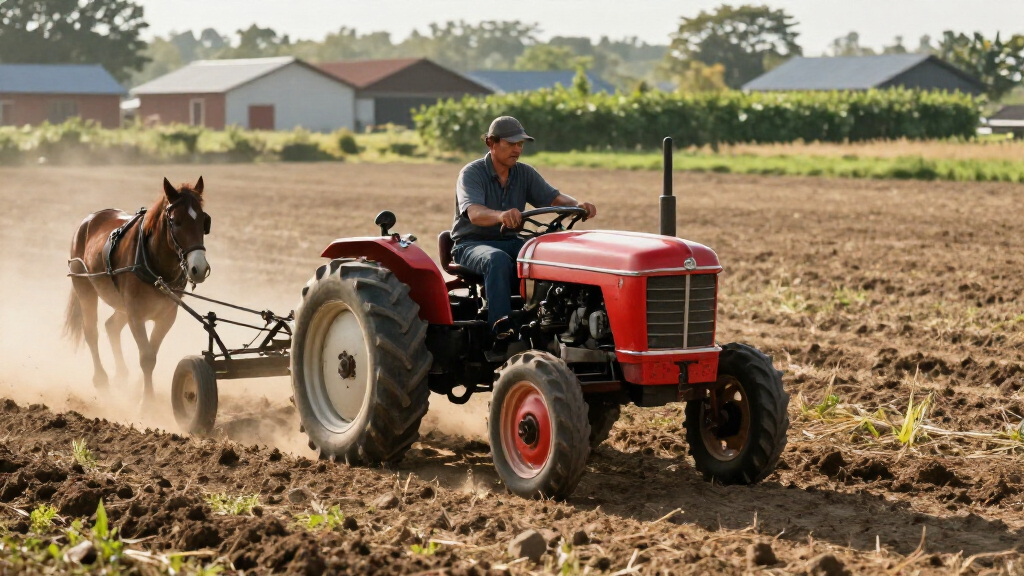
A report published November 4 by ThorstenMeyerAI.com charts how tractors replaced horses and mules as the main source of farm power in the United States, with the change reshaping land use and farm employment. The number of tractors on U.S. farms climbed from about 1,000 in 1910 to 4.69 million in 1960, while farm horses and mules fell from a peak of 26.7 million in 1918 to 3.1 million in 1960.
The report draws on figures reproduced in the U.S. Census Bureau’s 1975 Historical Statistics of the United States. Those estimates put the combined number of horses and mules on farms at 26.7 million on January 1, 1918. Horses alone had peaked earlier, at 21.4 million in 1915. By 1960, the combined farm-animal count was down nearly 90% from its 1918 peak.
Tractor numbers rose sharply over the same period: about 246,000 in 1920, 920,000 in 1930, 1.57 million in 1940 and 3.39 million in 1950. Around 1955, tractors slightly outnumbered horses and mules, according to the report’s figures. The source notes that tractor totals are census counts taken on somewhat different dates; from 1951, federal estimates counted horses and mules together.
The shift also changed what farmland produced. In 1915, about 93 million acres of harvested cropland grew feed for horses and mules, out of 340 million harvested acres. The report says the feed acreage had fallen to about 5 million acres by 1960. Mechanization extended beyond tractors: combine harvesters, which cut and process grain in one pass, increased from about 4,000 on U.S. farms in 1920 to 1.042 million in 1960.
How Mechanization Changed Farm Work
The move from animal power to machinery did more than replace one source of pulling power with another. Horses needed feed throughout the year; tractors consumed fuel when operated. As animals disappeared from farms, land previously devoted to oats, corn and hay could instead grow crops for people or sale. The report describes this as a hidden land-use dividend, though it does not quantify the resulting economic gains.
Farm output per worker rose as machinery and other changes spread. Department of Agriculture figures cited in the report estimate that one farm worker supplied 7.1 people in 1910, 10.7 in 1940 and 47.1 in 1970. The 1970 figure includes people abroad supplied through exports. It reflects more than tractors alone: combines, corn pickers, balers and milking machines, along with fertilizer and improved seed, also contributed.
The gains came alongside a sharp decline in farm employment. The report gives a peak of 13.6 million U.S. farm workers in 1916 and 4.5 million in 1970, even as the overall U.S. labor force doubled. That change mattered to workers and rural communities because many new jobs were in cities, requiring people to move. The figures describe the broad shift, but do not track individual workers or explain how each household adapted.
Products Worth Considering

Apple MacBook Air 15-inch with M5 chip, 16GB Memory, 512GB SSD, and Liquid Retina Display

Bose SoundLink Flex Bluetooth Speaker (2nd Gen) – Portable Outdoor Speaker with Hi‑Fi Audio, Waterproof and Dustproof, USB‑C, Up to 12 Hours

Bose TV Speaker (2nd Gen) Compact Soundbar
As an affiliate, we earn on qualifying purchases.
From Fordson to Farm Machinery
Tractors existed before World War I, but the source describes early models as heavy, expensive and better suited to large farms. Henry Ford introduced the Fordson in 1917. The Henry Ford museum calls it “the first mass-produced and inexpensive lightweight tractor” and says it was built for small farmers. The museum also says it rapidly became America’s most popular tractor. The 100,000th Fordson left the assembly line on February 21, 1920.
The tractor was part of a broader change in farm technology rather than a single-machine revolution. Combines and other equipment spread over subsequent decades, while agricultural inputs and seeds also changed. The historical figures show the combined effect of those developments, but cannot isolate how much of rising output or falling employment came from any one technology.
The report connects the historical change to current farm automation, while cautioning that the horse comparison is an analogy, not a prediction. It cites John Deere’s February 2025 announcement of a 16-camera autonomy kit for tillage on select large tractors. It also reports that China said about 74% of ploughing, sowing and harvesting was mechanized in 2023. Those claims concern different technologies and measures; neither establishes that today’s autonomous systems can perform every farm task.
What the Historical Numbers Cannot Show
The long-term counts establish the scale and direction of the change, but they do not say what happened to each animal or former farm worker. The report says farmers stopped breeding replacement horses and mules, and the working population aged out; it does not provide a detailed account of animal ownership, sale or disposal. Nor do the employment totals show which workers moved, what jobs they found or how the transition affected particular communities.
The source also treats the horse-to-tractor story as a warning some economists apply to automation, not as proof that machines will have the same effects on people. The historical figures cannot establish how current autonomous equipment will alter employment. The cited autonomy kit is limited to tillage on select large tractors, and the report does not supply adoption totals or evidence of performance across different farms and tasks.
Several figures have scope limits. The tractor counts use census dates that vary slightly, and horses and mules were combined in federal estimates beginning in 1951. China’s reported 74% mechanization rate is attributed to the Chinese government, and the source does not specify a comparable U.S. measure. These qualifications limit direct comparisons.
Tracking Automation on Today’s Farms
The historical series ends with the reported 1960 count of 3.1 million farm horses and mules; the Department of Agriculture stopped its yearly estimates soon afterward. A fuller account of the labor shift would require worker and community records beyond the national totals cited here.
For present-day automation, the next useful evidence will be how widely autonomous equipment is adopted, which jobs and tasks it can reliably perform, and whether it changes farm employment or output. The source gives no forecast or next milestone for the technology. Its historical lesson is narrower: farm machinery changed both the work people did and the land devoted to producing it, but the horse analogy alone cannot determine what modern automation will mean for workers.
Key Questions
When did tractors outnumber horses and mules on U.S. farms?
According to the report’s figures, the crossover happened around 1955: about 4.35 million tractors compared with 4.31 million horses and mules.
How many horses and mules worked on U.S. farms at the peak?
The combined count reached 26.7 million on January 1, 1918, according to estimates reproduced in the Census Bureau’s historical statistics. Horses alone peaked at 21.4 million in 1915.
What happened to the farm horses as tractors spread?
The report says farmers stopped breeding replacements and the working population aged out. It does not give a detailed account of what happened to individual animals.
Did tractors alone cause farm employment to fall?
No. The report describes tractors as one part of a wider shift that included combines, other machinery, fertilizer and improved seed. Its figures do not isolate the contribution of each factor.
Can the horse-to-tractor shift predict what AI will do to workers?
Not by itself. The report presents the comparison as an analogy, not a law. The historical figures do not establish how modern autonomous equipment will affect jobs, and the cited tractor system is limited to particular machines and tillage tasks.
Source: ThorstenMeyerAI.com