
TL;DR

Get tech for your team delivered free — and shop member deals
- Fast, free delivery on millions of items
- Access to Prime Big Deal Days deals on October 6–7
- Prime Video, Amazon Music and more included
The Technology Innovation Institute describes Falcon-Emirati-7B, a 7-billion-parameter model adapted from Falcon-H1-Arabic to handle Emirati Arabic and related cultural references. Its developers say they combined native dialect material, Modern Standard Arabic sources about Emirati culture and synthetic data guided by Emirati glossaries and style rules. The report does not provide independent evaluation results or enough detail to establish how consistently the model performs across real-world use.
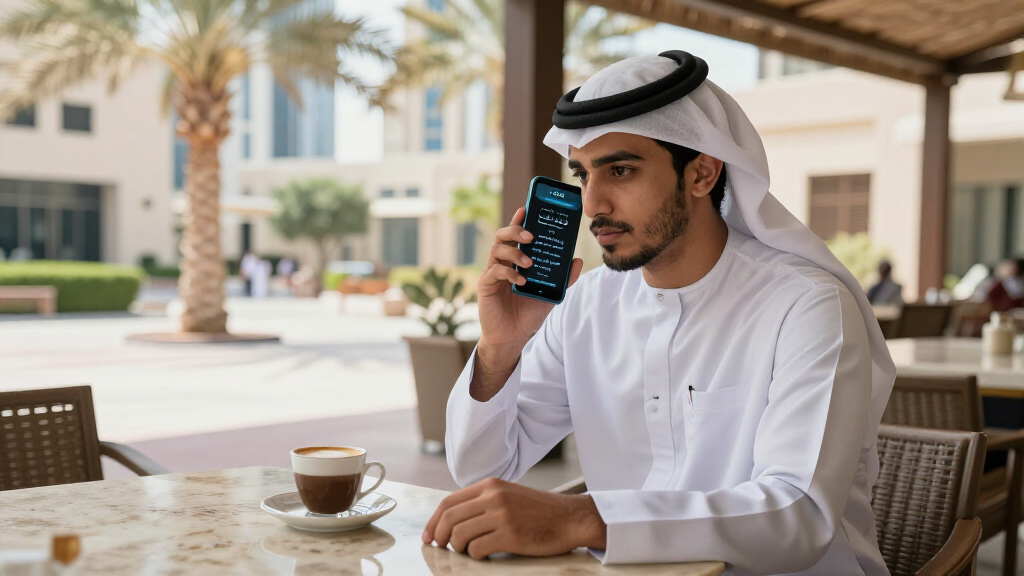
The Technology Innovation Institute (TII) has presented Falcon-Emirati-7B, a 7-billion-parameter language model adapted to understand and generate Emirati Arabic. The announcement matters because the model targets a spoken dialect whose idioms, humor and cultural references can be missed by systems trained mainly on Modern Standard Arabic (MSA); claims about native-level performance, however, are not independently established in the supplied report.
In a report published on Hugging Face, TII says the model builds on Falcon-H1-Arabic rather than starting from scratch. That broader Arabic model family was trained on MSA and several dialect groups, including Gulf, Levantine, Egyptian and Maghrebi Arabic, alongside English and multilingual data. Falcon-Emirati-7B focuses that foundation on Emirati vocabulary, grammar and cultural knowledge.
The developers describe a data pipeline using three sources: web content written in Emirati dialect, MSA-language material about Emirati culture and identity, and synthetic examples produced under glossaries and style rules. TII says those constraints were intended to reduce synthetic writing that sounds generically Gulf Arabic rather than specifically Emirati. The report also describes experiments with data mixes and training stages, but the supplied material does not give full results or reproducible measurements.
TII says it selected the 7B-parameter scale as a balance between capacity and the costs of training and serving a dialect-focused chat model. The report suggests the larger 34B version might improve quality at higher cost, while the 3B version offered less capacity for the adaptation. Those are the developers’ design judgments, not a published independent comparison in the source material.
Why Emirati Dialect Coverage Matters
Arabic-language systems often perform more reliably on formal written Arabic than on everyday speech. A dialect-focused model addresses a practical gap for people who use Emirati Arabic in conversation, storytelling, negotiation and humor, settings where literal translation may preserve words while missing intent. TII’s project also treats cultural knowledge as part of language adaptation, rather than assuming that vocabulary substitution alone is enough.
The potential uses include chat interfaces and other language applications intended for Emirati speakers, but the report does not document deployments, user adoption or measured benefits. The announcement is therefore evidence of a targeted development effort, not proof that the model is ready for every public-facing task. Performance in sensitive settings would depend on accuracy, safety, privacy and whether users find the generated dialect natural and appropriate.
The project also highlights a broader technical challenge: dialects with less written material online can be harder to represent in training data. Combining native text with cultural references and carefully constrained synthetic examples is one approach TII says it tested. Whether that recipe transfers to other dialects, or reliably captures variation among Emirati speakers, remains an open question.
As an affiliate, we earn on qualifying purchases.
From Falcon-H1 to Emirati Arabic
Falcon-H1-Arabic is the base for the new model. TII describes its Falcon-H1 architecture as combining State Space Models (Mamba) and Transformer attention in parallel within each block. The source says the wider model family spans 3B, 7B and 34B parameter versions, with context windows reaching 128K and 256K tokens. These are details about the base family; they do not, by themselves, establish Falcon-Emirati-7B’s quality on dialect tasks.
TII frames dialect adaptation as difficult because Emirati Arabic appears less often in written online material than MSA, while idioms, proverbs and poetic forms may rely on shared cultural knowledge. The report specifically mentions nabati poetry, a form of poetry associated with the region, as an example of meaning that can be lost through word-for-word interpretation. It also says there is no established training recipe for how much dialect data to use or which stages of model training best support dialect learning.
“A model that only knows MSA can translate every word of an Emirati sentence and still miss what it actually means.”
— Technology Innovation Institute, in its Hugging Face report
Emirati dialect language translator
As an affiliate, we earn on qualifying purchases.
As an affiliate, we earn on qualifying purchases.
Performance Evidence Still Needed
The supplied report does not include enough benchmark tables, evaluation protocols or independent testing to verify how accurately Falcon-Emirati-7B handles different Emirati speakers, topics or writing styles. TII says it used human judgment and benchmark scores during development, but the source excerpt does not identify the benchmarks, report scores or explain who took part in the human assessments.
It is also unclear how the training data was filtered for quality, how synthetic examples were checked for cultural or linguistic errors, and how the model handles variation within Emirati Arabic. The source does not specify release terms, access limits, safety testing, or whether the model has been assessed for stereotypes and inappropriate responses. Claims that it understands the dialect as a native speaker would should be treated as the project’s aim, not a verified result.
Arabic dialect speech recognition device
As an affiliate, we earn on qualifying purchases.
As an affiliate, we earn on qualifying purchases.
Awaiting Evaluation and Access Details
The immediate next step for readers and developers is to consult TII’s model materials for access terms, usage guidance and evaluation results as they become available. The supplied report does not set out a dated launch schedule or announce a deployment, so broader availability and planned applications remain unconfirmed.
Further reporting should look for transparent comparisons with Falcon-H1-Arabic and other Arabic models, including tests by Emirati speakers across conversational and cultural tasks. Details on safety evaluation, data governance and performance limitations would help users judge where the model is suitable and where human review remains necessary.
As an affiliate, we earn on qualifying purchases.
Key Questions
What is Falcon-Emirati-7B?
It is a 7-billion-parameter model that TII says it adapted from Falcon-H1-Arabic to handle Emirati Arabic, including dialect vocabulary and cultural references.
How did TII train the model for Emirati Arabic?
TII describes using native Emirati-dialect web material, MSA sources about Emirati culture and identity, and synthetic data guided by Emirati glossaries and style rules.
Has independent testing confirmed its performance?
The supplied report does not provide independent testing or enough benchmark detail to confirm the model’s performance. TII says it used human judgment and benchmark scores during development, but does not give the relevant results in the provided material.
Is the model publicly available?
The supplied source does not specify access terms or confirm a release schedule. Readers should check TII’s model page for current availability and usage conditions.
Source: rss
Halloween Picks
halloween
As an affiliate, we earn on qualifying purchases.